


US officials received intelligence that al-Qaeda operatives had been 45 days away from releasing a deadly gas into New York City subways when the plan was called off by Osama bin Laden's second-in-command in 2003, according to a book excerpt released yesterday on Time magazine's Web site.
According to the investigative report by Pulitzer-prize winning journalist Ron Suskind, an informant close to al-Qaeda management told US officials that Ayman al-Zawahri canceled the plan in January 2003, despite the likelihood that the strike would have killed as many people as the Sept. 11 attacks.
The informant said that operatives had planned to use a small, easily concealed delivery system to release hydrogen cyanide into multiple subway cars.
However, US officials had already discovered plans for the device in the computer of a Bahraini jihadist arrested in February 2003, and they had been able to construct a working model from the plans.
EASY TO MAKE
The easy-to-make device, called the "mubtakkar," meaning the "invention" or "initiative," represented a breakthrough in weapons technology that "was the equivalent of splitting the atom," Suskind writes.
All previous efforts to use the deadly gas, similar to that used in Holocaust-era gas chambers, in mass attacks had failed.
The FBI declined to confirm the details of Suskind's account.
Agency spokesman Bill Carter in Washington said on Saturday that the bureau would have no comment on the excerpted material.
A New York Police Department spokesman said authorities had known of the planned attack.
PRECAUTIONS TAKEN
"We were aware of the plot and took appropriate precaution," Paul Browne said on Saturday.
New York City Metropolitan Transportation Authority spokesman Tom Kelly also declined to comment.
According to the report, US President George W. Bush was shown a model of the weapon in March 2003 and ordered alerts sent through the US government.
When intelligence arrived that al-Zawahri had called off the attack, Bush worried that something worse was in the works, Suskind writes.
At least two of Suskind's sources remembered Bush saying, "This is bad enough. What does calling this off say about what else they're planning? ... What could be the bigger operation Zawahri didn't want to mess up?" the author said.
SECOND-WAVE DESTRUCTION
"What has been concluded for the most part is this: al-Qaeda's thinking is that a second-wave attack should be more destructive and more disruptive than 9/11," Suskind told Time.
The informant, who had become disgruntled with al-Qaeda's leadership, linked the organization's top agent on the Arabian peninsula to the attacks, Suskind writes.
The man was later killed in a violent standoff with authorities in Saudi Arabia.
The excerpt of Suskind's forthcoming book, The One Percent Doctrine, was to appear in today's print edition of Time.
Suskind is a former reporter for the Wall Street Journal.
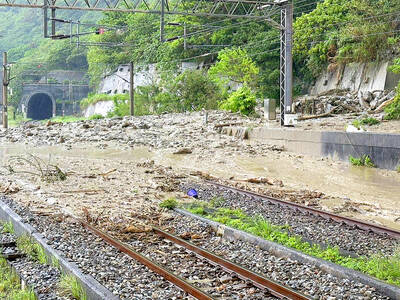
ROLLER-COASTER RIDE: More than five earthquakes ranging from magnitude 4.4 to 5.5 on the Richter scale shook eastern Taiwan in rapid succession yesterday afternoon Back-to-back weather fronts are forecast to hit Taiwan this week, resulting in rain across the nation in the coming days, the Central Weather Administration said yesterday, as it also warned residents in mountainous regions to be wary of landslides and rockfalls. As the first front approached, sporadic rainfall began in central and northern parts of Taiwan yesterday, the agency said, adding that rain is forecast to intensify in those regions today, while brief showers would also affect other parts of the nation. A second weather system is forecast to arrive on Thursday, bringing additional rain to the whole nation until Sunday, it
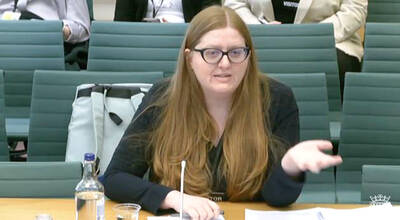
CONDITIONAL: The PRC imposes secret requirements that the funding it provides cannot be spent in states with diplomatic relations with Taiwan, Emma Reilly said China has been bribing UN officials to obtain “special benefits” and to block funding from countries that have diplomatic ties with Taiwan, a former UN employee told the British House of Commons on Tuesday. At a House of Commons Foreign Affairs Committee hearing into “international relations within the multilateral system,” former Office of the UN High Commissioner for Human Rights (OHCHR) employee Emma Reilly said in a written statement that “Beijing paid bribes to the two successive Presidents of the [UN] General Assembly” during the two-year negotiation of the Sustainable Development Goals. Another way China exercises influence within the UN Secretariat is
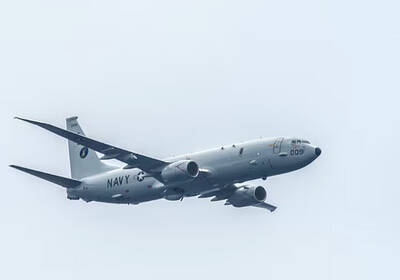
CHINA REACTS: The patrol and reconnaissance plane ‘transited the Taiwan Strait in international airspace,’ the 7th Fleet said, while Taipei said it saw nothing unusual The US 7th Fleet yesterday said that a US Navy P-8A Poseidon flew through the Taiwan Strait, a day after US and Chinese defense heads held their first talks since November 2022 in an effort to reduce regional tensions. The patrol and reconnaissance plane “transited the Taiwan Strait in international airspace,” the 7th Fleet said in a news release. “By operating within the Taiwan Strait in accordance with international law, the United States upholds the navigational rights and freedoms of all nations.” In a separate statement, the Ministry of National Defense said that it monitored nearby waters and airspace as the aircraft

Taiwan’s first drag queen to compete on the internationally acclaimed RuPaul’s Drag Race, Nymphia Wind (妮妃雅), was on Friday crowned the “Next Drag Superstar.” Dressed in a sparkling banana dress, Nymphia Wind swept onto the stage for the final, and stole the show. “Taiwan this is for you,” she said right after show host RuPaul announced her as the winner. “To those who feel like they don’t belong, just remember to live fearlessly and to live their truth,” she said on stage. One of the frontrunners for the past 15 episodes, the 28-year-old breezed through to the final after weeks of showcasing her unique


 RSS
RSS