


A powerful land mine ripped through a packed bus in northern Sri Lanka yesterday, killing at least 64 people in the worst act of violence since a 2002 ceasefire, the army said. Sri Lanka's air force responded by bombing rebel-held areas in the northeast.
The government blamed Tamil Tiger rebels for blowing up the bus crowded with commuters and schoolchildren -- spokesman Keheliya Rambukwella called it "a barbaric act" -- but the rebels, who fought for two decades to create a homeland for the country's minority Tamils, denied responsibility.
Yesterday's violence came during nearly a year of sporadic fighting that began with last summer's assassination of Sri Lanka's foreign minister. With the ceasefire as shaky as ever and diplomats saying relations between the government and Tigers are at a low point, Sri Lanka appeared once again on the brink of full-scale war.
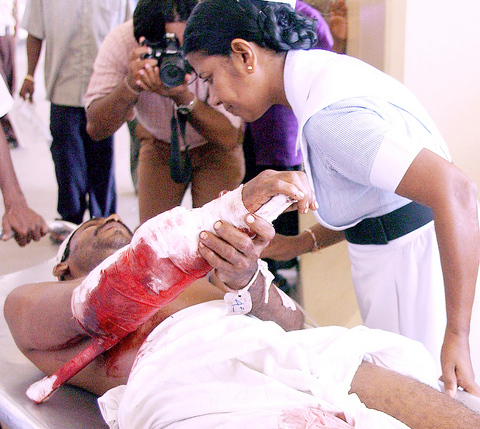
PHOTO: AFP
Rebel commanders met quickly to map out their next moves.
"Our Central Command is discussing possible defensive measures we need to take to protect our Tamil people," senior rebel leader Seevaratnam Puleedevan told reporters from the rebel town of Kilinochchi.
He said that the air raids have left "a lot of casualties," but gave no figures.
The explosion was described as "huge" by military spokesman Brigadier Prasad Samarasinghe, who said it tore through the bus outside this northern town around 8am.
Pair of mines
The blast was believed to have been caused by a pair of land mines hanging from a tree, and detonated from a remote position, he said. Rigging mines to trees or bicycles is a common Tiger tactic, officials say, done so the ground does not absorb as much of the force of a blast.
The area around Kabithigollewa, which is under government control but near territory controlled by the Tigers, was frequently the scene of violence when all-out war shook the island.
"The blasts hit the middle of the bus and it overturned, trapping passengers," said Bandula Seneviratne, a Sri Lankan photographer who was among the first to reach the scene, about 210km northeast of Colombo.
A doctor at the hospital where the victims were taken, S.B. Bothota, said 15 schoolchildren were among the 64 killed. Another 78 people were wounded, he said.
At the hospital morgue, bodies of the victims were laid in rows. Some victims were relatives of a policeman killed on Monday, apparently by rebels. They were heading to the slain man's funeral when the explosion tore through their bus.
Air raids
Hours after the blast, the pro-rebel TamilNet Web site said two jets bombed areas in the north of the country. Samarasinghe confirmed the bombings, saying the air force was taking limited deterrent action.
Samarasinghe blamed the Tigers for the blast, saying their "motive is to create terror."
Police said the victims were primarily ethnic Sinhalese.
But rebel leader Puleedevan countered the army accusation, suggesting that the attack could have been "the work of forces seeking to create ethnic tension between the Sinhalese and the Tamil population."
"The Liberation Tigers condemn the attack on civilians in strongest possible terms," Puleedevan was quoted as saying by TamilNet.
The Liberation Tigers of Tamil Eelam fought for 20 years to carve out a separate homeland in Sri Lanka's north and east for the country's 3.2 million minority Tamils, who are largely Hindu, saying years of oppression by the majority Sinhalese Buddhists left them no other choice.
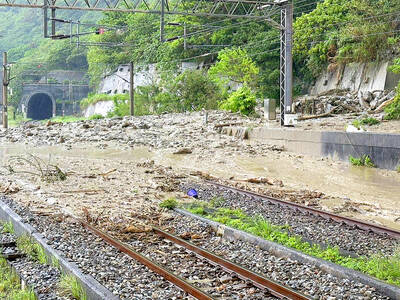
ROLLER-COASTER RIDE: More than five earthquakes ranging from magnitude 4.4 to 5.5 on the Richter scale shook eastern Taiwan in rapid succession yesterday afternoon Back-to-back weather fronts are forecast to hit Taiwan this week, resulting in rain across the nation in the coming days, the Central Weather Administration said yesterday, as it also warned residents in mountainous regions to be wary of landslides and rockfalls. As the first front approached, sporadic rainfall began in central and northern parts of Taiwan yesterday, the agency said, adding that rain is forecast to intensify in those regions today, while brief showers would also affect other parts of the nation. A second weather system is forecast to arrive on Thursday, bringing additional rain to the whole nation until Sunday, it

CONDITIONAL: The PRC imposes secret requirements that the funding it provides cannot be spent in states with diplomatic relations with Taiwan, Emma Reilly said China has been bribing UN officials to obtain “special benefits” and to block funding from countries that have diplomatic ties with Taiwan, a former UN employee told the British House of Commons on Tuesday. At a House of Commons Foreign Affairs Committee hearing into “international relations within the multilateral system,” former Office of the UN High Commissioner for Human Rights (OHCHR) employee Emma Reilly said in a written statement that “Beijing paid bribes to the two successive Presidents of the [UN] General Assembly” during the two-year negotiation of the Sustainable Development Goals. Another way China exercises influence within the UN Secretariat is
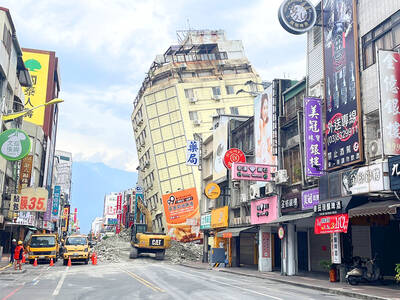
LANDSLIDES POSSIBLE: The agency advised the public to avoid visiting mountainous regions due to more expected aftershocks and rainfall from a series of weather fronts A series of earthquakes over the past few days were likely aftershocks of the April 3 earthquake in Hualien County, with further aftershocks to be expected for up to a year, the Central Weather Administration (CWA) said yesterday. Based on the nation’s experience after the quake on Sept. 21, 1999, more aftershocks are possible over the next six months to a year, the agency said. A total of 103 earthquakes of magnitude 4 on the local magnitude scale or higher hit Hualien County from 5:08pm on Monday to 10:27am yesterday, with 27 of them exceeding magnitude 5. They included two, of magnitude

Taiwan’s first drag queen to compete on the internationally acclaimed RuPaul’s Drag Race, Nymphia Wind (妮妃雅), was on Friday crowned the “Next Drag Superstar.” Dressed in a sparkling banana dress, Nymphia Wind swept onto the stage for the final, and stole the show. “Taiwan this is for you,” she said right after show host RuPaul announced her as the winner. “To those who feel like they don’t belong, just remember to live fearlessly and to live their truth,” she said on stage. One of the frontrunners for the past 15 episodes, the 28-year-old breezed through to the final after weeks of showcasing her unique


 RSS
RSS