


Iran yesterday rejected US conditions for talks on its controversial nuclear program, saying it was ready for negotiations but unwilling to freeze sensitive nuclear work.
"We support dialogue in a fair and unbiased atmosphere, but we will not talk about our undeniable and legitimate rights, because this is the right of our people according to international laws and treaties," Foreign Minister Manouchehr Mottaki told reporters.
"We are ready to talk about common concerns and if the conditions are such in a way that we have outlined ... we are ready to negotiate with all parties," he said, giving the Islamic republic's first reaction to the US proposal.
In what has been regarded as a major policy shift, US Secretary of State Condoleezza Rice announced on Wednesday that Washington was ready to enter the European-led negotiations on Iran's nuclear ambitions if Tehran suspended uranium enrichment.
Enrichment can be extended from making civilian reactor fuel to producing the core of a nuclear weapon, but Iran insists its activities are strictly peaceful and therefore enshrined as a "right" under the nuclear Non-Proliferation Treaty.
But Mottaki said that Rice's statement -- which also touched on US concerns over Iran's human rights record and its alleged support for terrorism -- "did not have any new words in it."
"They have repeated their old old words. A new solution and a logical solution for the nuclear issue was not seen in the declaration," he said of the offer for the first substantive talks since diplomatic ties were broken off 26 years ago.
"Maybe they wanted to cover up their crimes in the region. First and foremost, the US should be held accountable for their crimes in Iraq, Afghanistan, the prisons of Guantanamo and [Baghdad's] Abu Ghraib [jail]," he added.
Iran's refusal to halt enrichment, in line with UN Security Council and International Atomic Energy Agency demands, leaves the country exposed to sanctions.
The US, Europe, Russia and China were to meet in Vienna yesterday to continue talks on a carrot-and-stick approach to the crisis -- trade and other incentives if Iran complies and sanctions if it refuses.
Iranian officials have indicated Tehran may be willing to limit itself to research-scale work using only a small number of centrifuges, the machines that spin uranium gas in order to refine it.
But the US position is that even one centrifuge is too many, otherwise Iran will acquire the "break-out" capability for making nuclear weapons.
Diplomats in Washington and Vienna said the US offer to hold talks with Iran was linked to an effort to get China and Russia to ease categorical opposition to UN sanctions if negotiations stalled.
"What they [China and Russia] have agreed is that if Iran does not accept this offer of negotiations or does not negotiate in good faith, we will return to the [UN] Security Council" for sanctions, a senior US official said.
"It's a kind of moment of truth for Iran," Rice also told CBS TV.
According to an early draft text, the possible sanctions include an arms embargo on Iran -- something Russia, a key arms supplier to Iran, and China, a major consumer of Iranian oil, resist.
On the benefits side, the EU-3 proposal says world powers should help Iran build light water reactors for its civilian nuclear energy program.
But Iran's frosty response to Washington's offer comes despite widespread international support for the proposal.
"Today a real chance has appeared to achieve such a resolution. We call on Iran to respond to it constructively," the Russian foreign ministry said.
"We welcome the US gesture to solve the issue through talks," Chinese Ministry of Foreign Affairs Spokesman Liu Jianchao (
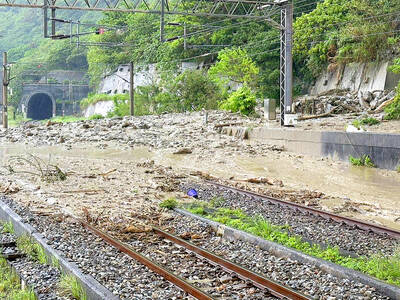
ROLLER-COASTER RIDE: More than five earthquakes ranging from magnitude 4.4 to 5.5 on the Richter scale shook eastern Taiwan in rapid succession yesterday afternoon Back-to-back weather fronts are forecast to hit Taiwan this week, resulting in rain across the nation in the coming days, the Central Weather Administration said yesterday, as it also warned residents in mountainous regions to be wary of landslides and rockfalls. As the first front approached, sporadic rainfall began in central and northern parts of Taiwan yesterday, the agency said, adding that rain is forecast to intensify in those regions today, while brief showers would also affect other parts of the nation. A second weather system is forecast to arrive on Thursday, bringing additional rain to the whole nation until Sunday, it

CONDITIONAL: The PRC imposes secret requirements that the funding it provides cannot be spent in states with diplomatic relations with Taiwan, Emma Reilly said China has been bribing UN officials to obtain “special benefits” and to block funding from countries that have diplomatic ties with Taiwan, a former UN employee told the British House of Commons on Tuesday. At a House of Commons Foreign Affairs Committee hearing into “international relations within the multilateral system,” former Office of the UN High Commissioner for Human Rights (OHCHR) employee Emma Reilly said in a written statement that “Beijing paid bribes to the two successive Presidents of the [UN] General Assembly” during the two-year negotiation of the Sustainable Development Goals. Another way China exercises influence within the UN Secretariat is
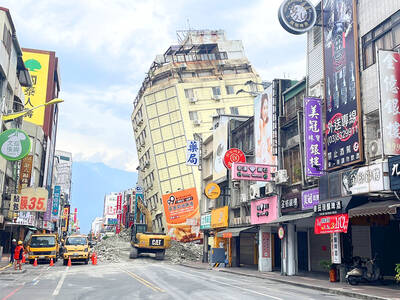
LANDSLIDES POSSIBLE: The agency advised the public to avoid visiting mountainous regions due to more expected aftershocks and rainfall from a series of weather fronts A series of earthquakes over the past few days were likely aftershocks of the April 3 earthquake in Hualien County, with further aftershocks to be expected for up to a year, the Central Weather Administration (CWA) said yesterday. Based on the nation’s experience after the quake on Sept. 21, 1999, more aftershocks are possible over the next six months to a year, the agency said. A total of 103 earthquakes of magnitude 4 on the local magnitude scale or higher hit Hualien County from 5:08pm on Monday to 10:27am yesterday, with 27 of them exceeding magnitude 5. They included two, of magnitude

Taiwan’s first drag queen to compete on the internationally acclaimed RuPaul’s Drag Race, Nymphia Wind (妮妃雅), was on Friday crowned the “Next Drag Superstar.” Dressed in a sparkling banana dress, Nymphia Wind swept onto the stage for the final, and stole the show. “Taiwan this is for you,” she said right after show host RuPaul announced her as the winner. “To those who feel like they don’t belong, just remember to live fearlessly and to live their truth,” she said on stage. One of the frontrunners for the past 15 episodes, the 28-year-old breezed through to the final after weeks of showcasing her unique


 RSS
RSS