


Chinese President Hu Jintao (胡錦濤) was tailed by protesters after arriving in Seattle on Tuesday on the first stop of his US visit, with signs and placards denouncing China's cruel treatment of Falun Gong members and calling for the release of dissidents.
Dozens of demonstrators lined the streets outside the Fairmont Olympic Hotel in downtown Seattle, where Hu was staying, holding large banners and using bullhorns to try to grab his attention as his motorcade whisked through.
"Nazi-like brutal genocide concentration camps are re-emerging in China," and "Bring criminal officials who persecute Falun Gong to justice," two signs by the banned Falun Gong spiritual movement said outside the hotel.
"Free Tibet. China get out of Tibet," Tibetans and Tibet rights advocates shouted.
Across the street, however, a handful of Chinese tried to counter the protests by playing drums and and waving Chinese flags.
Both sides were peaceful and orderly. No confrontations occurred.
Perhaps due to the expected loud protests in the US, security at his hotel was tighter than usual.
Journalists were not allowed to enter the hotel or wait outside, in contrast to common practice when Hu is overseas. Reporters are normally allowed to wait in the lobby for him, in hopes he will make some comments.
"This time it will be different," a foreign ministry official said, without explaining why.
Protesters followed Hu everywhere, waiting at street corners along his route.
Several Falun Gong members sat on the lawn of the Microsoft compound in Redmond, near Seattle, with legs folded, meditating.
"Falun Dafa [Gong] is Good," the group's sign said. China banned the group as an "evil cult" in 1999 and has jailed tens of thousands of its members.
Other protesters quietly held up signs demanding the release of locked up dissidents, including US permanent resident Yang Jianli (楊建利), whose case is expected to be raised by US President George W. Bush during a summit in Washington today.
Still others called for the lifting of Internet restrictions, including the shutting down of politically sensitive Web sites and jailing of Web masters and writers for expressing their opinions.
One placard also addressed to Microsoft founder Bill Gates said: "Bill and Hu, Free the Web."
Chinese foreign ministry spokesman Liu Jianchao (劉建超) brushed aside the protests.
"We believe their efforts to disturb President Hu's visit will not be successful," Liu said at a briefing.
Neither Gates nor anyone who met with Hu on Tuesday raised issues of Internet censorship, human rights or jailed dissidents, Liu said.
Despite an Easter break, the US Congress scheduled meetings this week to scrutinize China's human rights record, with lawmakers saying on Tuesday they did not want China's abysmal human rights record glossed over during Hu's visit.
Liu said China was willing to discuss human rights with the US, under the basis of mutual respect and equality.
Around 70 Falun Gong members continued to meditate outside Hu's hotel late into the night.
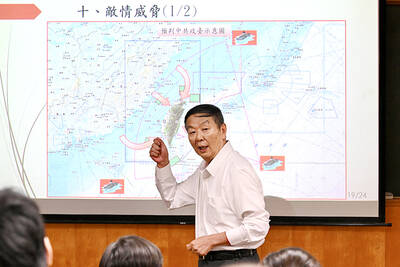
RETHINK? The defense ministry and Navy Command Headquarters could take over the indigenous submarine project and change its production timeline, a source said Admiral Huang Shu-kuang’s (黃曙光) resignation as head of the Indigenous Submarine Program and as a member of the National Security Council could affect the production of submarines, a source said yesterday. Huang in a statement last night said he had decided to resign due to national security concerns while expressing the hope that it would put a stop to political wrangling that only undermines the advancement of the nation’s defense capabilities. Taiwan People’s Party Legislator Vivian Huang (黃珊珊) yesterday said that the admiral, her older brother, felt it was time for him to step down and that he had completed what he
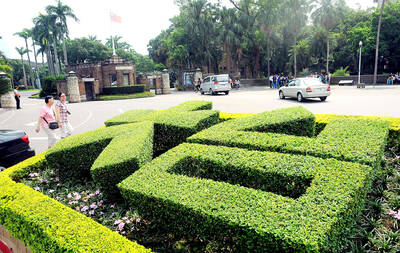
Taiwan has experienced its most significant improvement in the QS World University Rankings by Subject, data provided on Sunday by international higher education analyst Quacquarelli Symonds (QS) showed. Compared with last year’s edition of the rankings, which measure academic excellence and influence, Taiwanese universities made great improvements in the H Index metric, which evaluates research productivity and its impact, with a notable 30 percent increase overall, QS said. Taiwanese universities also made notable progress in the Citations per Paper metric, which measures the impact of research, achieving a 13 percent increase. Taiwanese universities gained 10 percent in Academic Reputation, but declined 18 percent
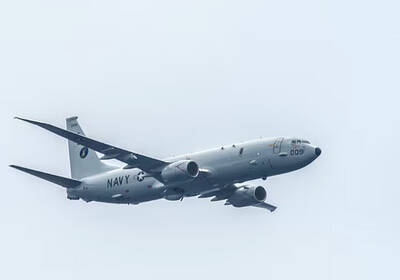
CHINA REACTS: The patrol and reconnaissance plane ‘transited the Taiwan Strait in international airspace,’ the 7th Fleet said, while Taipei said it saw nothing unusual The US 7th Fleet yesterday said that a US Navy P-8A Poseidon flew through the Taiwan Strait, a day after US and Chinese defense heads held their first talks since November 2022 in an effort to reduce regional tensions. The patrol and reconnaissance plane “transited the Taiwan Strait in international airspace,” the 7th Fleet said in a news release. “By operating within the Taiwan Strait in accordance with international law, the United States upholds the navigational rights and freedoms of all nations.” In a separate statement, the Ministry of National Defense said that it monitored nearby waters and airspace as the aircraft

UNDER DISCUSSION: The combatant command would integrate fast attack boat and anti-ship missile groups to defend waters closest to the coastline, a source said The military could establish a new combatant command as early as 2026, which would be tasked with defending Taiwan’s territorial waters 24 nautical miles (44.4km) from the nation’s coastline, a source familiar with the matter said yesterday. The new command, which would fall under the Naval Command Headquarters, would be led by a vice admiral and integrate existing fast attack boat and anti-ship missile groups, along with the Naval Maritime Surveillance and Reconnaissance Command, said the source, who asked to remain anonymous. It could be launched by 2026, but details are being discussed and no final timetable has been announced, the source


 RSS
RSS