


A legislator yesterday urged the government to crack down on ads hawking illegal drugs, after a flurry of such ads for "date rape" drugs appeared recently in local newspapers.
Democratic Progressive Party (DPP) Legislator Huang Wei-cher (
Huang said that he had bought a bottle filled with a GHB (gamma hydroxybutyric acid)-like substance in a small bottle via a telephone order. He said that it was advertised in the newspaper as "liquid ecstasy."
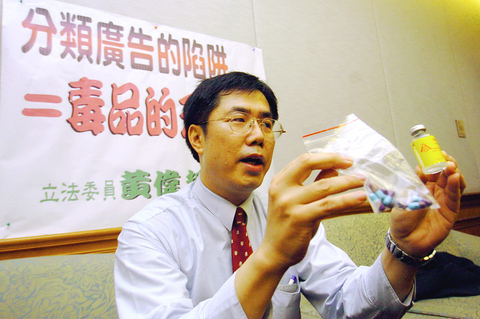
PHOTO: LO PEI-DER, TAIPEI TIMES
There was no Chinese on the label, only the word "Spanish" in English, followed by instructions in German.
GHB, also called liquid ecstasy, is an odorless, colorless liquid that causes euphoria, amnesia and often hallucinations. It is illegal in Taiwan.
Huang also played tape recordings of telephone orders in which the vendors explained how to use the drugs and that "GHB wouldn't be detected by the girl when added to water."
Wang Shu-fang (王淑芳), section chief of the Department of Publications at the Government Information Office (GIO), said that the office can only prevent the ads from being printed if they violate the Child and Juvenile Welfare Law (兒童及青少年福利法). Advertising a drug like GHB is not itself illegal, since it was impossible for authorities to know only from an ad whether an illegal substance was actually being sold, she said.
The GIO urged the media to exercise self-discipline and refuse to run these ads, Wang said.
The ads can be found in all major Chinese-language newspapers, including the United Daily News, Liberty Times, China Times and Apple Daily.
Lan Kuo-yueh (藍國岳), an official from the Bureau of Pharmaceutical Affairs at the Department of Health (DOH), said that there has been cooperation between local health departments and police agencies targeting illegal drugs.
Also, the department had just begun a "central surveillance project," and is having DOH-authorized personnel collect and buy illegal drug products from newspaper ads or the Internet for the department to inspect, Lan said.
The department itself could only punish sellers after a drug is tested and found to be illegal, he said.
Vendors of illegal drugs are subject to a maximum of 12 years in jail and a fine of NT$25 million (US$774,353), Lan said.
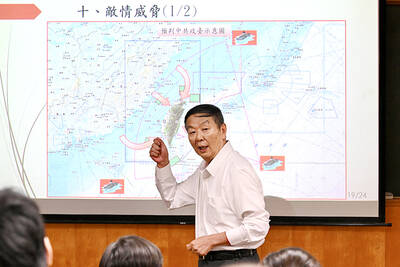
RETHINK? The defense ministry and Navy Command Headquarters could take over the indigenous submarine project and change its production timeline, a source said Admiral Huang Shu-kuang’s (黃曙光) resignation as head of the Indigenous Submarine Program and as a member of the National Security Council could affect the production of submarines, a source said yesterday. Huang in a statement last night said he had decided to resign due to national security concerns while expressing the hope that it would put a stop to political wrangling that only undermines the advancement of the nation’s defense capabilities. Taiwan People’s Party Legislator Vivian Huang (黃珊珊) yesterday said that the admiral, her older brother, felt it was time for him to step down and that he had completed what he

Taiwan has experienced its most significant improvement in the QS World University Rankings by Subject, data provided on Sunday by international higher education analyst Quacquarelli Symonds (QS) showed. Compared with last year’s edition of the rankings, which measure academic excellence and influence, Taiwanese universities made great improvements in the H Index metric, which evaluates research productivity and its impact, with a notable 30 percent increase overall, QS said. Taiwanese universities also made notable progress in the Citations per Paper metric, which measures the impact of research, achieving a 13 percent increase. Taiwanese universities gained 10 percent in Academic Reputation, but declined 18 percent
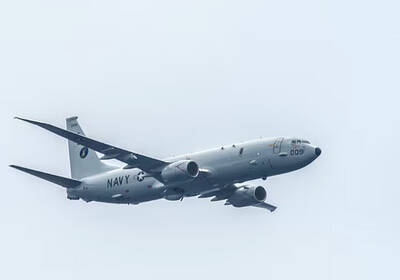
CHINA REACTS: The patrol and reconnaissance plane ‘transited the Taiwan Strait in international airspace,’ the 7th Fleet said, while Taipei said it saw nothing unusual The US 7th Fleet yesterday said that a US Navy P-8A Poseidon flew through the Taiwan Strait, a day after US and Chinese defense heads held their first talks since November 2022 in an effort to reduce regional tensions. The patrol and reconnaissance plane “transited the Taiwan Strait in international airspace,” the 7th Fleet said in a news release. “By operating within the Taiwan Strait in accordance with international law, the United States upholds the navigational rights and freedoms of all nations.” In a separate statement, the Ministry of National Defense said that it monitored nearby waters and airspace as the aircraft

UNDER DISCUSSION: The combatant command would integrate fast attack boat and anti-ship missile groups to defend waters closest to the coastline, a source said The military could establish a new combatant command as early as 2026, which would be tasked with defending Taiwan’s territorial waters 24 nautical miles (44.4km) from the nation’s coastline, a source familiar with the matter said yesterday. The new command, which would fall under the Naval Command Headquarters, would be led by a vice admiral and integrate existing fast attack boat and anti-ship missile groups, along with the Naval Maritime Surveillance and Reconnaissance Command, said the source, who asked to remain anonymous. It could be launched by 2026, but details are being discussed and no final timetable has been announced, the source


 RSS
RSS