


Iraqi documents captured by US forces in 2003 say Russian intelligence had sources inside the US military that enabled it to feed information about US troop movements and battle plans to deposed Iraqi president Saddam Hussein, according to a Pentagon report.
The unclassified report released on Friday does not assess the value or accuracy of the information Saddam got or offer details on Russia's information pipeline. It cites captured Iraqi documents that say the Russians had "sources inside the American Central Command" and that intelligence was passed to Saddam through the Russian ambassador in Baghdad.
Maria Zakharova, spokeswoman for Russia's UN mission in New York, said the allegations were false.
"To my mind, from my understanding it's absolutely nonsense and it's ridiculous," she said, adding that the US government had not shown Russia the evidence cited in the report. "Somebody wants to say something, and did -- and there is no evidence to prove it."
The Iraqi documents leave unclear who may have been the sources at Central Command's war-fighting headquarters, which is at Camp As Saliyah just outside Doha, the capital of Qatar. No Russians were authorized to be at the closely guarded base.
A classified version of the report, titled Iraqi Perspectives Project, is not being made public. It was assembled by US Joint Forces Command, which reviewed a vast array of captured Iraqi documents and interviewed Iraqi political and military leaders, not including Saddam.
The report does not address the possibility that the US military deliberately fed false information to the Russians, expecting them to pass it to Saddam. It does say that "such external sources of information were only one of the fog-generators obscuring the minds of Iraq's senior leadership."
Among the information the Iraqis said they received from the Russians, some of which proved inaccurate, was:
* That the movement of US troops into southern Iraq from Kuwait was a diversion. In fact it was the main avenue of attack, supported by special forces entering from Jordan and paratroopers flying into northern Iraq.
* That the ground assault on Baghdad would not begin until the Army's 4th Infantry Division was in place, around April 15. In fact, the 4th Infantry, whose originally planned invasion route from Turkey was blocked by the Turkish government, was not yet on Iraqi territory when the Baghdad ground assault began on April 7. Thus, by design or chance, the information from the Russians actually reinforced a US military deception effort.
* That the main focus of US ground forces moving toward Baghdad from the southwest was the area around the city of Karbala. (This was true. After crossing a bridge over the Euphrates River outside of Karbala, the 3rd Infantry Division had a clear path to the Iraqi capital and Saddam's chances of stopping the assault had ended.)
That US troops moving through southern Iraq would not attempt to occupy cities but instead bypass them. (This was true and was a central feature of an invasion plan that stressed speed and tactical surprise.)
The lead author of the Pentagon report, Kevin Woods, told reporters at a Pentagon briefing that he was surprised to learn that the Russians had passed intelligence to Saddam, and he said he had no reason to doubt the authenticity of the Iraqi documents.
"But I don't have any other knowledge of that topic," Woods added, referring to the Russian link.
A Pentagon spokesman, Lieutenant Colonel Barry Venable, referred inquiries seeking comment to Central Command. At Central Command headquarters in Tampa, Florida, officials did not immediately respond to a request.
It is standard procedure for Russia and other countries not part of a US coalition to try to gain inside information on US military plans. It's certainly not surprising in the case of Iraq, a country which had such long-standing economic and military ties to Moscow. But until now the Pentagon had not indicated that the Russians might have succeeded.
Pavel Felgenhauer, a respected independent Moscow-based military analyst, said on Friday that a Russian military intelligence unit, known only by its abbreviation GRU, was actively working in Iraq at the time of the US invasion.
The information about a Russian intelligence link to Baghdad was a small part of a much broader report by Joint Forces Command that attempts to explain the forces and their motivations behind Iraqi military decision-making in the months leading up to the invasion and in the first few weeks after the capital Baghdad fell in April.
The report paints a picture of an Iraqi regime that was largely blind to the threat it faced, hampered by Saddam's inept military leadership, preoccupied by the prospect of a Shiite uprising and deceived by its own propaganda.
"The largest contributing factor to the complete defeat of Iraq's military forces was the continued interference by Saddam," the report said.
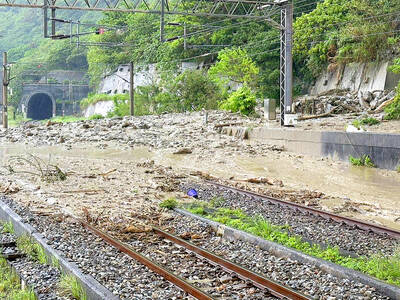
ROLLER-COASTER RIDE: More than five earthquakes ranging from magnitude 4.4 to 5.5 on the Richter scale shook eastern Taiwan in rapid succession yesterday afternoon Back-to-back weather fronts are forecast to hit Taiwan this week, resulting in rain across the nation in the coming days, the Central Weather Administration said yesterday, as it also warned residents in mountainous regions to be wary of landslides and rockfalls. As the first front approached, sporadic rainfall began in central and northern parts of Taiwan yesterday, the agency said, adding that rain is forecast to intensify in those regions today, while brief showers would also affect other parts of the nation. A second weather system is forecast to arrive on Thursday, bringing additional rain to the whole nation until Sunday, it
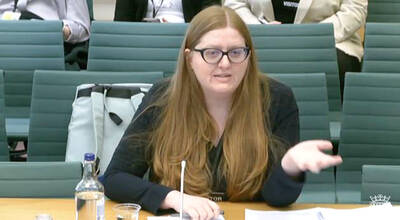
CONDITIONAL: The PRC imposes secret requirements that the funding it provides cannot be spent in states with diplomatic relations with Taiwan, Emma Reilly said China has been bribing UN officials to obtain “special benefits” and to block funding from countries that have diplomatic ties with Taiwan, a former UN employee told the British House of Commons on Tuesday. At a House of Commons Foreign Affairs Committee hearing into “international relations within the multilateral system,” former Office of the UN High Commissioner for Human Rights (OHCHR) employee Emma Reilly said in a written statement that “Beijing paid bribes to the two successive Presidents of the [UN] General Assembly” during the two-year negotiation of the Sustainable Development Goals. Another way China exercises influence within the UN Secretariat is
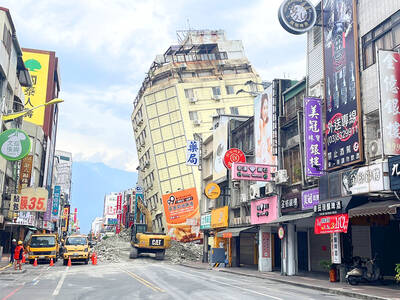
LANDSLIDES POSSIBLE: The agency advised the public to avoid visiting mountainous regions due to more expected aftershocks and rainfall from a series of weather fronts A series of earthquakes over the past few days were likely aftershocks of the April 3 earthquake in Hualien County, with further aftershocks to be expected for up to a year, the Central Weather Administration (CWA) said yesterday. Based on the nation’s experience after the quake on Sept. 21, 1999, more aftershocks are possible over the next six months to a year, the agency said. A total of 103 earthquakes of magnitude 4 on the local magnitude scale or higher hit Hualien County from 5:08pm on Monday to 10:27am yesterday, with 27 of them exceeding magnitude 5. They included two, of magnitude

Taiwan’s first drag queen to compete on the internationally acclaimed RuPaul’s Drag Race, Nymphia Wind (妮妃雅), was on Friday crowned the “Next Drag Superstar.” Dressed in a sparkling banana dress, Nymphia Wind swept onto the stage for the final, and stole the show. “Taiwan this is for you,” she said right after show host RuPaul announced her as the winner. “To those who feel like they don’t belong, just remember to live fearlessly and to live their truth,” she said on stage. One of the frontrunners for the past 15 episodes, the 28-year-old breezed through to the final after weeks of showcasing her unique


 RSS
RSS