


A US State Department purchase of more than 15,000 computers built by the Lenovo Group Ltd (聯想), a company controlled by the Chinese government, is starting to draw criticism in the latest sign of US unease about the role of foreign companies in the US economy.
The computers, worth more than US$13 million, are coming from factories in Raleigh, North Carolina, and Monterey, Mexico, that were part of the personal computer division that Lenovo purchased from IBM Corp last May.
Sean McCormack, a US state Department spokesman, said at the department's daily media briefing on Wednesday that the computers were intended for unclassified systems and would be serviced by the former IBM division.
The computer contracts are drawing heat from a diverse group of liberal and conservative critics who have been warning about China's growing power for years. These critics have been encouraged by the congressional scrutiny given to a plan by a company controlled by the royal family of Dubai in the United Arab Emirates to acquire operations at six US ports; the company has since agreed to give up those operations.
The critics warn that the deal could help China spy on US embassies and US intelligence-gathering activities, using hardware and software planted in the computers.
"The opportunities for intelligence gains by the Chinese are phenomenal," said Michael Wessel, a member of the US-China Economic and Security Review Commission, which was created by Congress to monitor and report on the bilateral relationship.
Larry Wortzel, the commission's chairman, said in an interview two weeks ago that while he would not be concerned if Airbus moved an aircraft production line to China, he would be worried if Lenovo ever started to sell computers to US government agencies involved in foreign affairs.
Responding on Thursday to the Lenovo deal, he predicted that, "Members of Congress, I think, will react very strongly when they see a deal like this come through."
Lenovo is a publicly traded subsidiary of Legend Holdings, which was started by the Chinese government in 1984 and is still controlled by the government; Lenovo declined on Thursday to comment on the computer sales to the State Department.
Word of the computer deal began to trickle out on Monday when a Lenovo distributor, CDW Government, a wholly owned subsidiary of the CDW Corp, announced its contracts to help the State Department modernize its information technology systems.
Max Peterson, the vice president of federal sales at CDW Government, said in a telephone interview that the State Department had approved a list of specific computer models, including the Lenovo models, and had asked computer systems integrators to bid for contracts to meet the department's needs and make their own choices among approved models.
CDW won the contracts and chose to begin delivering 500 Lenovo computers a week starting in November, he said.
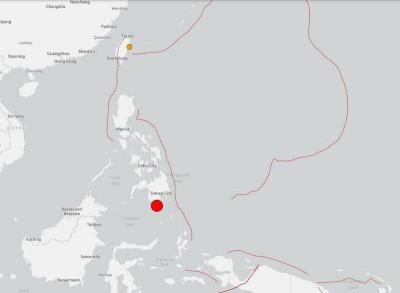
A magnitude 7.8 earthquake struck off the southern coast of Mindanao in the Philippines at 7:38am today, prompting the US Tsunami Warning System to issue an alert for neighboring countries, including Taiwan. The system issued a purple alert indicating a "tsunami threat." The potential threat zone includes Taiwan, the Philippines, Papua New Guinea, Yap and Palau. Philippine authorities were assessing the damage from the quake, with the office of civil defense seeking to verifying initial reports that 15 people had been killed and 129 injured in the region, mostly from falling debris. Arlene Hollero, disaster chief of Maasim town in the Philippines' Sarangani Province,
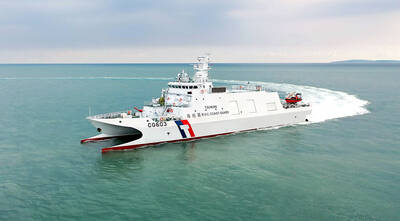
‘GRAY ZONE’ PRESSURE: Beijing’s activities are intended to create the deceitful impression that China has jurisdiction over the area around Taiwan, the CGA said Taiwan’s rights over its territorial waters and exclusive economic zone must not be violated by any country, the Mainland Affairs Council said yesterday, adding that it will not accept any unprovoked actions. The council issued the remarks in response to the China Coast Guard conducting maritime enforcement drills near eastern Taiwan and claiming to fully exercise China’s maritime administrative law enforcement authority. The Coast Guard Administration (CGA) has been closely monitoring the situation and is taking concrete steps to defend the nation’s sovereignty and secure its waters, the council said. China has no sovereign rights over the waters off eastern
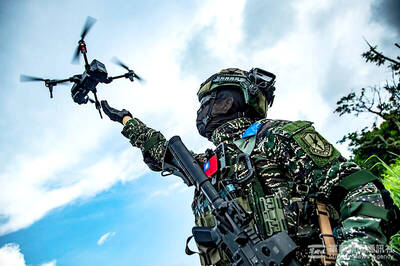
RESILIENCE: Taiwan plays a key role in semiconductors, energy, information infrastructure and advanced manufacturing, AIT Director Raymond Greene said Taiwan’s continued investment in deterrence and resilience remains vital, especially in uncrewed systems and other emerging technologies, American Institute in Taiwan (AIT) Director Raymond Greene said yesterday. Greene made the remarks at the annual National Strategic Summit on Supply Chain Resilience held by the Research Institute for Democracy, Society and Emerging Technology (DSET), a government-backed think tank. As Taiwan last year became the US’ fourth-largest trading partner and supply chain security is becoming more important, cooperation in emerging technologies continues to deepen between the two countries, he said. The US is committed to accelerating innovation, building key infrastructure, strengthening cooperation

RIGHT DIRECTION: Taiwan’s efforts to prevent forced labor include a proposal to ‘fully prohibit’ employers from withholding workers’ documents, an official said Taiwan is to establish a mechanism to restrict imports of goods linked to forced labor, the Executive Yuan said yesterday, after the US proposed imposing additional tariffs on Taiwanese goods over labor concerns. “The Ministry of Labor and the Ministry of Economic Affairs are to establish an interministerial review procedure,” Executive Yuan spokesperson Michelle Lee (李慧芝) said at a news briefing in Taipei. “The government is to use the Foreign Trade Act [貿易法] as the legal basis to restrict imports of goods produced with forced labor” and bring its supply chain governance more in line with international standards on human rights, resilience


 RSS
RSS