


Farmers losing their land to development projects in China are becoming increasingly riotous, but analysts say there is little hope for them as China's economic boom fuels corruption and power abuse.
A slew of violent confrontations between villagers and officials over land seizures have thrown the issue into the spotlight over the past year, with the nation's top leaders identifying the rising unrest as a major concern.
Premier Wen Jiabao (
The protection of farmers' rights and improvement of their livelihoods will likely be a top agenda item during the annual legislative session that begins on Sunday.
Powerful locals
But Wu Guoguang (吳國光), a China specialist at Canada's University of Victoria, said the government was not able to protect farmers' rights because local authorities were too powerful.
With the ongoing collusion between local government officials and property developers, farmers would continue to have little choice but to resort to confrontation in their efforts to seek justice, he said.
"It is a triangular game -- central government, local government and the people," Wu said. "And Beijing will always be on the local officials' side, because the power is in the local governments' hands."
In one of the highest-profile incidents over the past year, police in December shot dead as many as 30 protesters in a confrontation in Dongzhou Village in Guangdong Province over a land dispute.
In another incident in Hebei Province in June, at least six people from Dingzhou Village were killed and scores wounded after the local government deployed hundreds of thugs to beat people who refused to make way for a power plant.
Tip of the iceberg
But these cases are only the tip of the iceberg.
The number of "public order disturbances" in China rose by 6.6 percent to 87,000 last year, while "mass gatherings that disturbed social order" climbed 13 percent, according to government statistics.
China's wealth gap is at the same time getting dangerously high, with the roughly 700 million rural residents having an average income of just US$403 last year, less than one-third of their urban counterparts.
Analysts say a major problem is China's Constitution, which states that farmland is collectively owned, allowing local governments to easily seize land for little or no compensation and sell it to property developers for huge profits.
Last week, Chen Xiwen (
"As long as there are no real property rights over land in China there is no solution to this, because the farmers do not own their land," said Pierre Landry, a political scientist at Yale University.
Few rights
Peasant frustrations are only magnified when they find they have few legal rights, with most local courts rejecting their cases under pressure from local officials.
"Chinese courts ... are under the Communist Party leadership, so they are often manipulated by the desires of the officials," said legal scholar and farmers' rights activist Li Baiguang (
"Under these circumstances, citizens can only resort to confrontation," said Li, who was imprisoned for five weeks last year.
Li is just one of many activists, lawyers and journalists who have been detained or intimidated in what appears to be a concerted government campaign to silence public activism and dissent.
Analysts say officials fear these isolated rural protests could turn into larger-scale political movements through the involvement of these intellectuals.
"The Communist Party historically grew powerful through combining intellectuals and ordinary people," said Wu, a former aide to late reformist leader Zhao Ziyang (
But violent suppression will only sow more seeds of discontent, Li warned.
"We need an open media, we need a government elected by voters," he said.
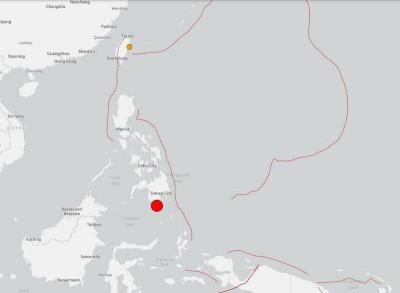
A magnitude 7.8 earthquake struck off the southern coast of Mindanao in the Philippines at 7:38am today, prompting the US Tsunami Warning System to issue an alert for neighboring countries, including Taiwan. The system issued a purple alert indicating a "tsunami threat." The potential threat zone includes Taiwan, the Philippines, Papua New Guinea, Yap and Palau. Philippine authorities were assessing the damage from the quake, with the office of civil defense seeking to verifying initial reports that 15 people had been killed and 129 injured in the region, mostly from falling debris. Arlene Hollero, disaster chief of Maasim town in the Philippines' Sarangani Province,

‘GRAY ZONE’ PRESSURE: Beijing’s activities are intended to create the deceitful impression that China has jurisdiction over the area around Taiwan, the CGA said Taiwan’s rights over its territorial waters and exclusive economic zone must not be violated by any country, the Mainland Affairs Council said yesterday, adding that it will not accept any unprovoked actions. The council issued the remarks in response to the China Coast Guard conducting maritime enforcement drills near eastern Taiwan and claiming to fully exercise China’s maritime administrative law enforcement authority. The Coast Guard Administration (CGA) has been closely monitoring the situation and is taking concrete steps to defend the nation’s sovereignty and secure its waters, the council said. China has no sovereign rights over the waters off eastern

RESILIENCE: Taiwan plays a key role in semiconductors, energy, information infrastructure and advanced manufacturing, AIT Director Raymond Greene said Taiwan’s continued investment in deterrence and resilience remains vital, especially in uncrewed systems and other emerging technologies, American Institute in Taiwan (AIT) Director Raymond Greene said yesterday. Greene made the remarks at the annual National Strategic Summit on Supply Chain Resilience held by the Research Institute for Democracy, Society and Emerging Technology (DSET), a government-backed think tank. As Taiwan last year became the US’ fourth-largest trading partner and supply chain security is becoming more important, cooperation in emerging technologies continues to deepen between the two countries, he said. The US is committed to accelerating innovation, building key infrastructure, strengthening cooperation

RIGHT DIRECTION: Taiwan’s efforts to prevent forced labor include a proposal to ‘fully prohibit’ employers from withholding workers’ documents, an official said Taiwan is to establish a mechanism to restrict imports of goods linked to forced labor, the Executive Yuan said yesterday, after the US proposed imposing additional tariffs on Taiwanese goods over labor concerns. “The Ministry of Labor and the Ministry of Economic Affairs are to establish an interministerial review procedure,” Executive Yuan spokesperson Michelle Lee (李慧芝) said at a news briefing in Taipei. “The government is to use the Foreign Trade Act [貿易法] as the legal basis to restrict imports of goods produced with forced labor” and bring its supply chain governance more in line with international standards on human rights, resilience


 RSS
RSS