


President Chen Shui-bian (陳水扁) yesterday signed a document ordering that the National Unification Council (NUC) will "cease to function" and that the Guidelines for National Unification will "cease to apply" as an irate Beijing continued to thunder yesterday about his "splittist" activities.
Chen made the decision on the council and guidelines on Monday after chairing a National Security Council meeting.
Later yesterday he defended his actions to an audience commemorating the 228 Incident, calling the council and guidelines "products of absurdity" that were "created in a police state."
In response, the Chinese Nationalist Party (KMT), with the endorsement of KMT Chairman Ma Ying-jeou (
Ma said yesterday that although impeaching Chen is unlikely given the vote threshold required, the opposition nonetheless needed to express its disapproval of Chen.
Chen asked why the KMT was planning to impeach him over the scrapping of the council and guidelines when Ma had already acknowledged that independence was an option for the country.
"If what Ma says is true and comes from the bottom of his heart, the KMT should have supported the decision I made today," Chen said at a ceremony at the 228 Peace Memorial Park in Taipei.
"I'd like to ask you something: Is A-bian [Chen] wrong? Is A-bian wrong? Is A-bian wrong by returning the right of choosing their future to the 23 million people of Taiwan?" he said in Hoklo (also known as Taiwanese).
The audience responded, "No, no, no."
Chen told the audience that his decision to cease the operations of the council and the guidelines did not change the "status quo" in the Taiwan Strait. Instead, he said, it prevented the "status quo" from being changed unilaterally.
"Taiwan is an independent sovereign state," Chen said. "The sovereignty of the nation lies with the people of Taiwan. Only the 23 million people of Taiwan have the right to decide the future of Taiwan."
"Today, with the unification council and guidelines officially entering the history books, I hand you, the great people of Taiwan, the right to decide your own future, without setting any preconditions," he said.
Chen said it was his mission to safeguard the lives and property of the Taiwanese people, and that he hoped the public would support his decision on the council and guidelines.
Branding the unification council and guidelines as "products of absurdity rendered in an absurd era" and "products created in a police state," Chen said that the KMT had failed to ask the public whether they wanted the council or guidelines when they were established 15 years ago.
"It [the KMT] openly stripped the people of their democratic right to choose, and I believe most Taiwanese people do not want to continue to accept such an historical absurdity," the president said.
China, in its first official statement on the matter, criticized Chen yesterday for "leading the nation towards disaster" and "endangering regional peace."
The statement called the move Chen's "first step toward his goal of achieving de jure independence for Taiwan."
"We will never permit Taiwan independence and splittist forces under any name or under any form to separate Taiwan from the motherland," China's Taiwan Affairs Office said in the statement.
It added that Taiwan's independence movement was "doomed to failure" and that Chen's strategy was a threat to cross-strait relations.
Mainland Affairs Council Chairman Joseph Wu (吳釗燮) said that China's reaction revealed how little it knew about Taiwan and its democracy.
"Taiwan has, over the past several years, developed into a sovereign and independent country and its sovereignty belongs to the 23 million people of Taiwan. Only the people of Taiwan have the right to change its future. If China still can't recognize this situation, I think it will continue to make mistakes about Taiwan, including this one it has made today," he said yesterday.
Wu said that China's push for unification should also be regarded as an attempt to unilaterally change the cross-strait "status quo."
He also rebutted Beijing's claim of sovereignty over Taiwan, saying it was "contradictory" to the current reality, in which the China and Taiwan have no jurisdiction over each other.
Additional reporting by Chang Yun-ping
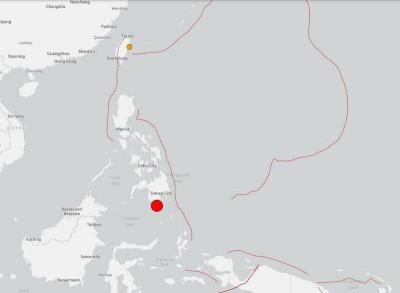
A magnitude 7.8 earthquake struck off the southern coast of Mindanao in the Philippines at 7:38am today, prompting the US Tsunami Warning System to issue an alert for neighboring countries, including Taiwan. The system issued a purple alert indicating a "tsunami threat." The potential threat zone includes Taiwan, the Philippines, Papua New Guinea, Yap and Palau. Philippine authorities were assessing the damage from the quake, with the office of civil defense seeking to verifying initial reports that 15 people had been killed and 129 injured in the region, mostly from falling debris. Arlene Hollero, disaster chief of Maasim town in the Philippines' Sarangani Province,
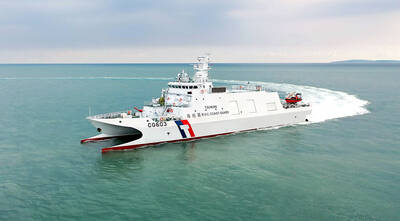
‘GRAY ZONE’ PRESSURE: Beijing’s activities are intended to create the deceitful impression that China has jurisdiction over the area around Taiwan, the CGA said Taiwan’s rights over its territorial waters and exclusive economic zone must not be violated by any country, the Mainland Affairs Council said yesterday, adding that it will not accept any unprovoked actions. The council issued the remarks in response to the China Coast Guard conducting maritime enforcement drills near eastern Taiwan and claiming to fully exercise China’s maritime administrative law enforcement authority. The Coast Guard Administration (CGA) has been closely monitoring the situation and is taking concrete steps to defend the nation’s sovereignty and secure its waters, the council said. China has no sovereign rights over the waters off eastern
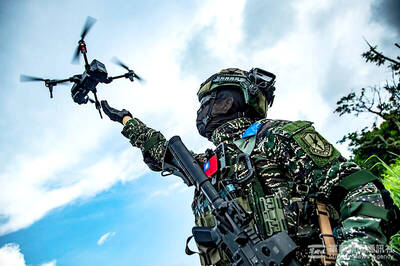
RESILIENCE: Taiwan plays a key role in semiconductors, energy, information infrastructure and advanced manufacturing, AIT Director Raymond Greene said Taiwan’s continued investment in deterrence and resilience remains vital, especially in uncrewed systems and other emerging technologies, American Institute in Taiwan (AIT) Director Raymond Greene said yesterday. Greene made the remarks at the annual National Strategic Summit on Supply Chain Resilience held by the Research Institute for Democracy, Society and Emerging Technology (DSET), a government-backed think tank. As Taiwan last year became the US’ fourth-largest trading partner and supply chain security is becoming more important, cooperation in emerging technologies continues to deepen between the two countries, he said. The US is committed to accelerating innovation, building key infrastructure, strengthening cooperation

RIGHT DIRECTION: Taiwan’s efforts to prevent forced labor include a proposal to ‘fully prohibit’ employers from withholding workers’ documents, an official said Taiwan is to establish a mechanism to restrict imports of goods linked to forced labor, the Executive Yuan said yesterday, after the US proposed imposing additional tariffs on Taiwanese goods over labor concerns. “The Ministry of Labor and the Ministry of Economic Affairs are to establish an interministerial review procedure,” Executive Yuan spokesperson Michelle Lee (李慧芝) said at a news briefing in Taipei. “The government is to use the Foreign Trade Act [貿易法] as the legal basis to restrict imports of goods produced with forced labor” and bring its supply chain governance more in line with international standards on human rights, resilience


 RSS
RSS