


With tension increasing between the US and Taiwan this week, aides to President Chen Shui-bian (陳水扁) and US State Department officials in Washington are close to hammering out a compromise on Chen's Lunar New Year proposal to abolish the National Unification Council.
Despite the obvious frustrations of officials on both sides -- including remarks by one Taiwanese official that State Department officials have a "narrow" mindset and are not up to the challenge that the Taiwan Strait poses -- the meetings may result in a statement of non-use of the council and unification guidelines which would mollify Washington without forcing Chen to entirely abandon his proposals.
But the limited number of meetings meant it was not immediately clear whether other parts of the Bush administration shared the anger of the State Department.
Nevertheless, the Taiwanese expressed confidence that the meetings would ease the tensions, which were sparked by Chen's suggestion that the government should consider eliminating the National Unification Council and the 1991 unification guidelines.
During the meetings, convened as the delegation attended the annual US National Prayer Breakfast, Senior Presidential Adviser Wu Li-pei (吳灃培) argued that the council's existence "sets a premise that this government's ultimate goal is to unify with China, which is not true."
Wu said Chen "promised to the people that only the 23 million Taiwan people can decide their own future. And now does he have to allow this kind of pre-conditioned entity whose [aim] is to unify to exist?"
Carrying out the three stages of unification under the guidelines also "would violate Chen's promise to the people," Wu said.
The meetings, which also included members of major Washington think tanks, may have produced a possible compromise on the competing US and Taiwanese positions on the council and guidelines, Parris Chang (
The NSC could recommend that Chen simply declare that he will not convene the unification council during this term, and that he would not invoke the guidelines.
That would reinforce the perception that the council and guidelines are "dead letters," as most people believe, without alienating Washington by eliminating them.
Such a compromise "achieves the same objective of abolishing [the unification council] without actually doing that," Chang said.
"We are going to study this and take into account the opinions of our American friends as to what they think has to be done, and we are going to come up with a formal recommendation for [Chen] to decide," he said.
The no-action alternative was "certainly one of the options we would seriously consider," he said.
Wu said that he and his group defended Chen's statements during their meeting with the State Department's East Asia policymakers. But he said that he felt "their mindset was so narrow," because they argued strongly against Chen's statements, accusing him of violating his 2000 and 2004 inaugural pledges that included not abolishing unification mechanisms.
Nevertheless, Wu said he did not think that the fuss would have a long-term impact on US-Taiwan relations.
"In [the department officials'] hearts, they do not wish to see Taiwan ceded to China. That would not meet their long-term strategy. But they don't want to pay attention [to cross-strait] issues at this stage," Wu told the Taipei Times.
"They are involved in other areas [such as Iraq and Afghanistan] and they hope this area will calm down and never have anything happen. So they don't have the will or capacity to deal with Taiwan Strait issues," he said.
One of the top officials Wu met was Clifford Hart, the head of the State Department's Taiwan coordination office.
Expressing dissatisfaction with the State Department's reaction to Chen's speech, Wu said Chen was considering only the fate of the unification council.
"I don't think that [Chen] should discuss with the United States everything he is just thinking about," Wu said.
In addition, the council has been "totally inactive" for the past six years, was not a "legal" entity and has virtually no budget, he said.
also see stories:
Editorial: Nothing earth-shattering from Chen
Time to forget about the promises
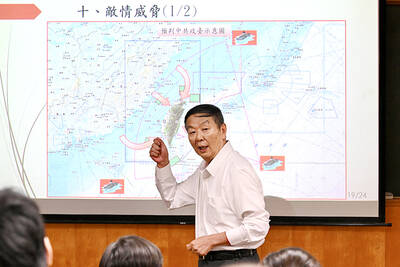
RETHINK? The defense ministry and Navy Command Headquarters could take over the indigenous submarine project and change its production timeline, a source said Admiral Huang Shu-kuang’s (黃曙光) resignation as head of the Indigenous Submarine Program and as a member of the National Security Council could affect the production of submarines, a source said yesterday. Huang in a statement last night said he had decided to resign due to national security concerns while expressing the hope that it would put a stop to political wrangling that only undermines the advancement of the nation’s defense capabilities. Taiwan People’s Party Legislator Vivian Huang (黃珊珊) yesterday said that the admiral, her older brother, felt it was time for him to step down and that he had completed what he
Taiwan has experienced its most significant improvement in the QS World University Rankings by Subject, data provided on Sunday by international higher education analyst Quacquarelli Symonds (QS) showed. Compared with last year’s edition of the rankings, which measure academic excellence and influence, Taiwanese universities made great improvements in the H Index metric, which evaluates research productivity and its impact, with a notable 30 percent increase overall, QS said. Taiwanese universities also made notable progress in the Citations per Paper metric, which measures the impact of research, achieving a 13 percent increase. Taiwanese universities gained 10 percent in Academic Reputation, but declined 18 percent
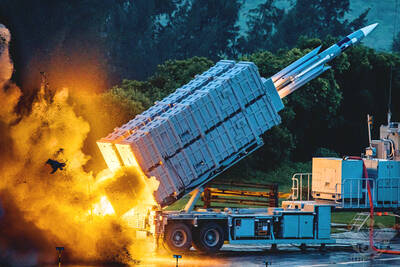
UNDER DISCUSSION: The combatant command would integrate fast attack boat and anti-ship missile groups to defend waters closest to the coastline, a source said The military could establish a new combatant command as early as 2026, which would be tasked with defending Taiwan’s territorial waters 24 nautical miles (44.4km) from the nation’s coastline, a source familiar with the matter said yesterday. The new command, which would fall under the Naval Command Headquarters, would be led by a vice admiral and integrate existing fast attack boat and anti-ship missile groups, along with the Naval Maritime Surveillance and Reconnaissance Command, said the source, who asked to remain anonymous. It could be launched by 2026, but details are being discussed and no final timetable has been announced, the source
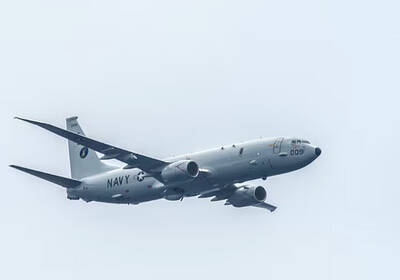
CHINA REACTS: The patrol and reconnaissance plane ‘transited the Taiwan Strait in international airspace,’ the 7th Fleet said, while Taipei said it saw nothing unusual The US 7th Fleet yesterday said that a US Navy P-8A Poseidon flew through the Taiwan Strait, a day after US and Chinese defense heads held their first talks since November 2022 in an effort to reduce regional tensions. The patrol and reconnaissance plane “transited the Taiwan Strait in international airspace,” the 7th Fleet said in a news release. “By operating within the Taiwan Strait in accordance with international law, the United States upholds the navigational rights and freedoms of all nations.” In a separate statement, the Ministry of National Defense said that it monitored nearby waters and airspace as the aircraft


 RSS
RSS