


The US indicated late on Tuesday that conditions for a gradual pullout of its troops from violence-torn Iraq could become ripe "fairly soon," but warned that a decision about their withdrawal will not be made unilaterally.
The US may not need the number of troops it has in Iraq "all that much longer," US Secretary of State Condoleezza Rice said on two TV channels, amid reports the Pentagon may pull back three combat brigades.
With political pressure building on US President George W. Bush to shift course in Iraq, US officials are trying to reassure Americans that sufficient progress is being made in training Iraqi forces to possibly permit some US troops to leave.
In both interviews Rice stressed that the moment when US soldiers will start returning home could be close.
"The president has said that as soon as Iraqi forces are ready, we want to see a reduction in our own forces, and I think those days are going to be coming fairly soon when Iraqis are going to be more and more capable of carrying out the functions to secure their own future," Rice said on Fox News.
On CNN, Rice said the number of international coalition forces in Iraq "is clearly going to come down" because, as she suspected, "the American forces are not going to be needed in the numbers that they are there for all that much longer."
Rice's comments come after a bitter debate on Capitol Hill about Bush's Iraq policy, including a demand by one of the most hawkish members of the US Congress, Democratic Representative John Murtha, that US forces withdraw immediately.
The Washington Post said yesterday that barring any major surprises in Iraq, the Pentagon tentatively plans to reduce the number of US forces there early next year by as many as three combat brigades, from 18 now, but to keep at least one brigade "on call" in Kuwait in case more troops are needed quickly.
Quoting several senior military officers, the Post said Pentagon authorities also have set a series of "decision points" during next year to consider further force cuts that, under a "moderately optimistic" scenario, would drop the total number of troops to fewer than 100,000 from more than 150,000 now, including 10 combat brigades, by the end of the year.
A US Army brigade has between 3,000 and 5,000 soldiers.
Lieutenant General John Vines, the second-ranking US commander in Iraq, told Pentagon reporters in a teleconference on Tuesday that any recommendation from US commanders in Iraq to begin withdrawing forces would be made based on the security situation and not on political considerations.
"A precipitous pullout, I believe, would be destabilizing," Vines said.
BRITISH WARNING
Meanwhile, a report by a British think tank said British and US troops could be embroiled in Iraq for "decades," adding that the occupation was a "gift" to al-Qaeda.
Entitled Iraq and the War on Terror: Twelve Months of Insurgency, the report by the Oxford Research Group said the war was "still in its early stages and likely to last for decades."
The study said al-Qaeda could keep the US tied up in Iraq for many years, and Britain would only withdraw troops in the "highly unlikely" event of a "break" with Washington.
The report said al-Qaeda had won recruits by portraying the US presence in Iraq as a "neo-Christian occupation of a major Islamic state." It also warns that a US withdrawal would be a "foreign policy disaster greater than the retreat from Vietnam."

Taiwan has experienced its most significant improvement in the QS World University Rankings by Subject, data provided on Sunday by international higher education analyst Quacquarelli Symonds (QS) showed. Compared with last year’s edition of the rankings, which measure academic excellence and influence, Taiwanese universities made great improvements in the H Index metric, which evaluates research productivity and its impact, with a notable 30 percent increase overall, QS said. Taiwanese universities also made notable progress in the Citations per Paper metric, which measures the impact of research, achieving a 13 percent increase. Taiwanese universities gained 10 percent in Academic Reputation, but declined 18 percent

Chinese President Xi Jinping (習近平) yesterday met with former president Ma Ying-jeou (馬英九) at the Great Hall of the People in Beijing, with Xi’s opening statement once more emphasizing that people on both sides of the Taiwan Strait are Chinese and that foreign intervention cannot change their inevitable unification. Xi said that 5,000 years of history of zhonghua minzu (中華民族, ethnic Chinese group) have seen their ancestors move to Taiwan to establish new lives, while also documenting them fighting side-by-side against foreign forces and finally freeing Taiwan. “Both sides are Chinese,” and there are no issues that cannot be worked through, he
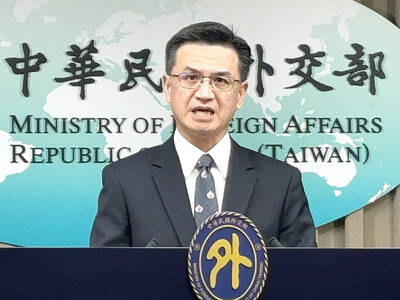
BULLY TACTICS: Beijing has continued its incursions into Taiwan’s airspace even as Xi Jinping talked about Taiwan being part of the Chinese family and nation China should stop its coercion of Taiwan and respect mainstream public opinion in Taiwan about sovereignty if its expression of goodwill is genuine, the Ministry of Foreign Affairs (MOFA) said yesterday. Ministry spokesman Jeff Liu (劉永健) made the comment in response to media queries about a meeting between former president Ma Ying-jeou (馬英九) and Chinese President Xi Jinping (習近平) the previous day. Ma voiced support for the so-called “1992 consensus,” while Xi said that although the two sides of the Taiwan Strait have “different systems,” this does not change the fact that they are “part of the same country,” and that “external

UNDER DISCUSSION: The combatant command would integrate fast attack boat and anti-ship missile groups to defend waters closest to the coastline, a source said The military could establish a new combatant command as early as 2026, which would be tasked with defending Taiwan’s territorial waters 24 nautical miles (44.4km) from the nation’s coastline, a source familiar with the matter said yesterday. The new command, which would fall under the Naval Command Headquarters, would be led by a vice admiral and integrate existing fast attack boat and anti-ship missile groups, along with the Naval Maritime Surveillance and Reconnaissance Command, said the source, who asked to remain anonymous. It could be launched by 2026, but details are being discussed and no final timetable has been announced, the source


 RSS
RSS