


Roche, the maker of the main drug that would be used against a possible bird flu epidemic, is under rising pressure to allow production of generic versions of the medicine.
But the company and some outside experts say production of the drug, Tamiflu, is so complex and time-consuming that even generic makers could not quickly expand global supplies.
Those putting pressure on Roche, a Swiss company, include the head of the UN and health officials in some nations. They are asking whether the health of hundreds of millions of people in a possible pandemic should depend on the efficiency and productivity of a single corporation.
UN Secretary-General Kofi Annan raised the issue last Thursday during a little-noticed visit to the Geneva headquarters of the World Health Organization (WHO).
Annan stopped short of calling for compulsory licensing by Roche but spoke broadly about the need to make sure intellectual property did not get in the way of ensuring the availability not only of Tamiflu but also of vaccines at prices that poor people could afford.
During the weekend, in an interview, Kou Hsu-sung, the director general of Taiwan's Center for Disease Control, was even more critical, saying that Taiwanese scientists could make Tamiflu and were trying to balance respect for Roche's intellectual property with national security.
"We are disappointed that the WHO refused to press Roche to make it a generic in a situation like this," he said.
But the head of the WHO's global influenza program, in a speech in San Francisco on the same day that Annan was visiting the agency's headquarters, said that generic manufacture of Tamiflu could not happen quickly because the production process was too complex.
"There will be no way in the next two years a company would be able to produce generic Tamiflu," said the WHO official, Klaus Stoehr, speaking at the annual meeting of the Infectious Diseases Society of America.
But he also said that even if Roche produced Tamiflu at full capacity for the next 10 years, and the drug were stockpiled, there would be enough at the end of that period for only 20 percent of the world's population.
In a statement on Monday, Roche said the production of Tamiflu required 10 steps -- one of them potentially explosive -- and up to 12 months.
"No one can do it faster," the firm said. "Our assumption is that it would take a generic company about three years to gear up," it said. "Therefore, it does not make sense to out-license manufacturing."
There is no proven preventive vaccine yet available in meaningful quantities to work against the avian flu that is spreading widely among birds in Asia and has begun showing up in some European flocks.
So hopes are riding on Tamiflu as a treatment once people become infected with the disease.
Of the more than 100 people known to have been infected so far, mainly poultry workers, about 60 have died. But health officials fear a pandemic -- a regional or even global epidemic -- if the disease mutates to allow easy human-to-human infection.
A single five-day treatment course of Tamiflu is priced at more than US$60. Analysts have estimated that Roche sells it to governments for less than half that, but poor countries may not be able to afford even a couple of dollars per dose for millions of people.
The pressures on Roche are similar to those exerted on manufacturers of AIDS medicines in the 1990s, and on Bayer in 2001 to sell its Cipro medicine at a discount after anthrax spores had been mailed to members of the US Congress and some journalists.
The pharmaceutical industry has consistently argued that if drug-makers are forced to sell drugs at a deep discount or are required to license generic versions when they are most needed, then the industry would not be able to afford research into the next generation of advanced drugs.
According to a WHO transcript of Annan's remarks last Thursday, he said that the UN would be "encouraging pharmaceutical companies and others to be helpful, making sure that we do not allow intellectual property to get into the way of access of the poor to medication, allowing for emergency production of vaccine in the developing countries, and I wouldn't want to hear the kind of debate we got into when it came to the HIV" drugs.
"So we should be clear that in this situation, we will take the measures to make sure poor and rich have access to the medication and the vaccine required," Annan said. "And the decision should be taken ahead of time so that we don't have to quibble about it when the critical and the crisis moment arrive."
also see story:
Agencies step up bird-flu efforts
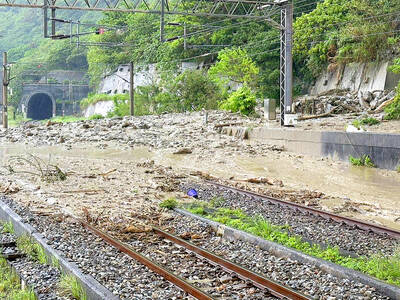
ROLLER-COASTER RIDE: More than five earthquakes ranging from magnitude 4.4 to 5.5 on the Richter scale shook eastern Taiwan in rapid succession yesterday afternoon Back-to-back weather fronts are forecast to hit Taiwan this week, resulting in rain across the nation in the coming days, the Central Weather Administration said yesterday, as it also warned residents in mountainous regions to be wary of landslides and rockfalls. As the first front approached, sporadic rainfall began in central and northern parts of Taiwan yesterday, the agency said, adding that rain is forecast to intensify in those regions today, while brief showers would also affect other parts of the nation. A second weather system is forecast to arrive on Thursday, bringing additional rain to the whole nation until Sunday, it

CONDITIONAL: The PRC imposes secret requirements that the funding it provides cannot be spent in states with diplomatic relations with Taiwan, Emma Reilly said China has been bribing UN officials to obtain “special benefits” and to block funding from countries that have diplomatic ties with Taiwan, a former UN employee told the British House of Commons on Tuesday. At a House of Commons Foreign Affairs Committee hearing into “international relations within the multilateral system,” former Office of the UN High Commissioner for Human Rights (OHCHR) employee Emma Reilly said in a written statement that “Beijing paid bribes to the two successive Presidents of the [UN] General Assembly” during the two-year negotiation of the Sustainable Development Goals. Another way China exercises influence within the UN Secretariat is
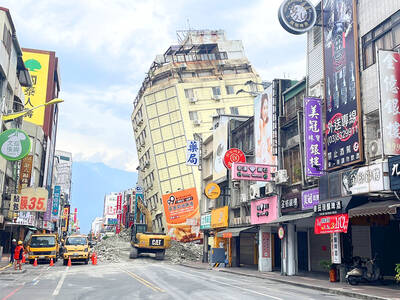
LANDSLIDES POSSIBLE: The agency advised the public to avoid visiting mountainous regions due to more expected aftershocks and rainfall from a series of weather fronts A series of earthquakes over the past few days were likely aftershocks of the April 3 earthquake in Hualien County, with further aftershocks to be expected for up to a year, the Central Weather Administration (CWA) said yesterday. Based on the nation’s experience after the quake on Sept. 21, 1999, more aftershocks are possible over the next six months to a year, the agency said. A total of 103 earthquakes of magnitude 4 on the local magnitude scale or higher hit Hualien County from 5:08pm on Monday to 10:27am yesterday, with 27 of them exceeding magnitude 5. They included two, of magnitude

Taiwan’s first drag queen to compete on the internationally acclaimed RuPaul’s Drag Race, Nymphia Wind (妮妃雅), was on Friday crowned the “Next Drag Superstar.” Dressed in a sparkling banana dress, Nymphia Wind swept onto the stage for the final, and stole the show. “Taiwan this is for you,” she said right after show host RuPaul announced her as the winner. “To those who feel like they don’t belong, just remember to live fearlessly and to live their truth,” she said on stage. One of the frontrunners for the past 15 episodes, the 28-year-old breezed through to the final after weeks of showcasing her unique


 RSS
RSS