


Conservative leader Angela Merkel will become Germany's first female chancellor under the terms of a power-sharing agreement that would end Social Democrat Gerhard Schroeder's seven years in office, Social Democratic officials said yesterday.
But Schroeder's party extracted a high price for his backing down from demands to continue in office: they would get eight seats in the Cabinet, compared to six for Merkel's group, said the officials, who spoke on condition of anonymity.
The deal was approved by party leadership committees on both sides, party officials said. They must still be approved by party conferences and pass a vote in parliament once formal coalition negotiations are completed; parliament must meet by Oct. 18, but might not actually vote until next month.
Under the terms of the agreement, the Social Democrats would head the foreign, finance, labor, justice, health, transport, environment and development ministries.
Merkel's Christian Democrats and their Bavaria-only allies, the Christian Social Union (CSU), would get the defense, interior, agriculture, families and education portfolios. The CSU leader, Edmund Stoiber, would become economy minister. Other than that, officials did not say who would occupy which ministerial post.
Such a coalition would create a mixed government of left and right that some fear would be unable to take decisive, potentially unpopular measures to cut the burden Germany's welfare state imposes on businesses and job creation. It also raises questions of whether it can last the full four-year term of parliament, or if it will fall apart if the two former sets of opponents can't get along.
Schroeder's future was not immediately clear. Asked whether he would announce his withdrawal from politics, his spokesman, Bela Anda, replied: "We will see what the day brings."
The agreement would end a three-week standoff that began when voters ousted Schroeder's ruling coalition of Social Democrats and Greens on Sept. 18 but failed to give a majority to Merkel's preferred center-right coalition.
That forced the Social Democrats and her Christian Democrats to seek a power-sharing deal across the left-right divide.
Merkel forced Schroeder to drop his demand to be chancellor, saying that as head of the party with the largest number of seats, the job belonged to her. She would be the first woman to lead Germany and the first person from the formerly communist east to hold the job.
But she would see her ability to push through her agenda to reform the stagnating economy limited by sharing extensive power with her labor-backed former opponents, the Social Democrats.
Merkel and Stoiber met briefly with Schroeder and his party chief Franz Muentefering in a third high-level meeting after running the preliminary deal past party officials early yesterday. They were to consult further with party officials and hold separate press conferences at 2:30pm.
Parliament must convene by Oct. 18 but is not obliged to vote immediately on a new chancellor, if coalition talks are still ongoing.
Merkel's forces have 226 votes in the 614-seat parliament, while the Social Democrats have 222. A coalition needs 308 seats for a majority.

ROLLER-COASTER RIDE: More than five earthquakes ranging from magnitude 4.4 to 5.5 on the Richter scale shook eastern Taiwan in rapid succession yesterday afternoon Back-to-back weather fronts are forecast to hit Taiwan this week, resulting in rain across the nation in the coming days, the Central Weather Administration said yesterday, as it also warned residents in mountainous regions to be wary of landslides and rockfalls. As the first front approached, sporadic rainfall began in central and northern parts of Taiwan yesterday, the agency said, adding that rain is forecast to intensify in those regions today, while brief showers would also affect other parts of the nation. A second weather system is forecast to arrive on Thursday, bringing additional rain to the whole nation until Sunday, it
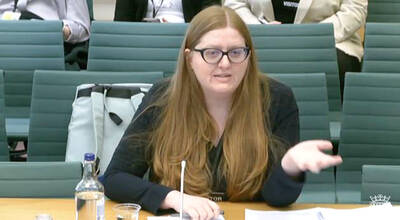
CONDITIONAL: The PRC imposes secret requirements that the funding it provides cannot be spent in states with diplomatic relations with Taiwan, Emma Reilly said China has been bribing UN officials to obtain “special benefits” and to block funding from countries that have diplomatic ties with Taiwan, a former UN employee told the British House of Commons on Tuesday. At a House of Commons Foreign Affairs Committee hearing into “international relations within the multilateral system,” former Office of the UN High Commissioner for Human Rights (OHCHR) employee Emma Reilly said in a written statement that “Beijing paid bribes to the two successive Presidents of the [UN] General Assembly” during the two-year negotiation of the Sustainable Development Goals. Another way China exercises influence within the UN Secretariat is

LANDSLIDES POSSIBLE: The agency advised the public to avoid visiting mountainous regions due to more expected aftershocks and rainfall from a series of weather fronts A series of earthquakes over the past few days were likely aftershocks of the April 3 earthquake in Hualien County, with further aftershocks to be expected for up to a year, the Central Weather Administration (CWA) said yesterday. Based on the nation’s experience after the quake on Sept. 21, 1999, more aftershocks are possible over the next six months to a year, the agency said. A total of 103 earthquakes of magnitude 4 on the local magnitude scale or higher hit Hualien County from 5:08pm on Monday to 10:27am yesterday, with 27 of them exceeding magnitude 5. They included two, of magnitude

Taiwan’s first drag queen to compete on the internationally acclaimed RuPaul’s Drag Race, Nymphia Wind (妮妃雅), was on Friday crowned the “Next Drag Superstar.” Dressed in a sparkling banana dress, Nymphia Wind swept onto the stage for the final, and stole the show. “Taiwan this is for you,” she said right after show host RuPaul announced her as the winner. “To those who feel like they don’t belong, just remember to live fearlessly and to live their truth,” she said on stage. One of the frontrunners for the past 15 episodes, the 28-year-old breezed through to the final after weeks of showcasing her unique


 RSS
RSS