


Four robotic vehicles finished a Pentagon-sponsored race across the Mojave desert and achieved a technological milestone by conquering steep drop-offs, obstacles and tunnels over a rugged 212km course without a single human command.
The vehicles, guided by sophisticated software, gave scientists hope that robots could one day wage battles without endangering soldiers.
"The impossible has been achieved," cried Stanford University's Sebastian Thrun, after the university's customized Volkswagen crossed first on Saturday. Students cheered, hoisting Thrun atop their shoulders.
Also finishing was a converted red Hummer named H1ghlander and a Humvee called Sandstorm from Carnegie Mellon University. The Stanford robot dubbed Stanley overtook the top-seeded H1ghlander at the 164km mark.
"I'm on top of the world," said Carnegie Mellon robotics professor William "Red" Whittaker, who said a mechanical glitch allowed Stanley to pass H1ghlander.
The sentimental favorite, a Ford Escape Hybrid by students in Metarie, Louisiana, was the fourth vehicle to finish Saturday. The team lost about a week of practice and some lost their homes when Hurricane Katrina blew into the Gulf Coast.
The Pentagon's Defense Advanced Research Projects Agency, or DARPA, plans to award US$2 million to the fastest vehicle to cover the race in less than 10 hours. The taxpayer-funded race was intended to spur development of robots that could be used on the battlefield without remote controls.
The race announcer did not immediately declare a winner because 22 of the 23 robots left the starting line at staggered times at dawn, racing against the clock rather than each other. Stanley finished in less than 7 1/2 hours.
Race officials planned to resume the race yesterday so the sole remaining vehicle, a mammoth six-wheel truck, could compete in daylight.
The so-called Grand Challenge race is part of the Pentagon's effort to cut the risk of casualties by fulfilling a congressional mandate to have a third of all military ground vehicles unmanned by 2015.
Last year's much-hyped inaugural robot race ended without a winner when all the self-navigating vehicles broke down shortly after leaving the starting gate. Carnegie Mellon's Sandstorm chugged the farthest at 12km.
Of the 23 robots that competed on Saturday, 18 vehicles failed to navigate the entire 212km course, but most still managed to beat Sandstorm's mileage last year.
The unmanned vehicles must use their computer brains and sensing devices to follow a programmed route and avoid hitting obstacles that may doom their chances.
Vehicles have to drive on rough, winding desert roads and dry lake beds filled with overhanging brush and man-made obstacles. The machines also must traverse a narrow 2km mountain pass.
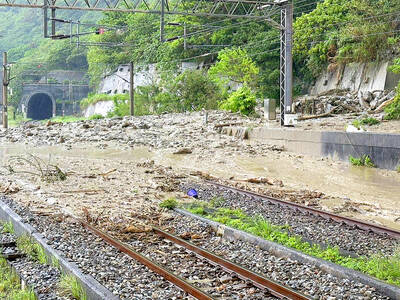
ROLLER-COASTER RIDE: More than five earthquakes ranging from magnitude 4.4 to 5.5 on the Richter scale shook eastern Taiwan in rapid succession yesterday afternoon Back-to-back weather fronts are forecast to hit Taiwan this week, resulting in rain across the nation in the coming days, the Central Weather Administration said yesterday, as it also warned residents in mountainous regions to be wary of landslides and rockfalls. As the first front approached, sporadic rainfall began in central and northern parts of Taiwan yesterday, the agency said, adding that rain is forecast to intensify in those regions today, while brief showers would also affect other parts of the nation. A second weather system is forecast to arrive on Thursday, bringing additional rain to the whole nation until Sunday, it
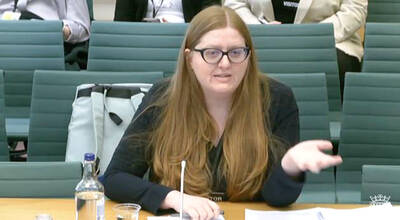
CONDITIONAL: The PRC imposes secret requirements that the funding it provides cannot be spent in states with diplomatic relations with Taiwan, Emma Reilly said China has been bribing UN officials to obtain “special benefits” and to block funding from countries that have diplomatic ties with Taiwan, a former UN employee told the British House of Commons on Tuesday. At a House of Commons Foreign Affairs Committee hearing into “international relations within the multilateral system,” former Office of the UN High Commissioner for Human Rights (OHCHR) employee Emma Reilly said in a written statement that “Beijing paid bribes to the two successive Presidents of the [UN] General Assembly” during the two-year negotiation of the Sustainable Development Goals. Another way China exercises influence within the UN Secretariat is

LANDSLIDES POSSIBLE: The agency advised the public to avoid visiting mountainous regions due to more expected aftershocks and rainfall from a series of weather fronts A series of earthquakes over the past few days were likely aftershocks of the April 3 earthquake in Hualien County, with further aftershocks to be expected for up to a year, the Central Weather Administration (CWA) said yesterday. Based on the nation’s experience after the quake on Sept. 21, 1999, more aftershocks are possible over the next six months to a year, the agency said. A total of 103 earthquakes of magnitude 4 on the local magnitude scale or higher hit Hualien County from 5:08pm on Monday to 10:27am yesterday, with 27 of them exceeding magnitude 5. They included two, of magnitude

Taiwan’s first drag queen to compete on the internationally acclaimed RuPaul’s Drag Race, Nymphia Wind (妮妃雅), was on Friday crowned the “Next Drag Superstar.” Dressed in a sparkling banana dress, Nymphia Wind swept onto the stage for the final, and stole the show. “Taiwan this is for you,” she said right after show host RuPaul announced her as the winner. “To those who feel like they don’t belong, just remember to live fearlessly and to live their truth,” she said on stage. One of the frontrunners for the past 15 episodes, the 28-year-old breezed through to the final after weeks of showcasing her unique


 RSS
RSS