


President Chen Shui-bian (陳水扁) yesterday offered to deliver a special report to the Legislative Yuan to seek support for his administration's arms-procurement package, which has been blocked for months by the pan-blue opposition.
"Investing in national defense is investing in long-term peace," Chen said in a speech at National Taiwan University. "I'd like to explain more about the arms-procurement bill ... to the Legislative Yuan and, if possible, to Chinese Nationalist Party [KMT] Chairman Ma Ying-jeou (馬英九)."
"We don't intend to enter an arms race with China," Chen said. "However, improving our weapons and facilities should be an ongoing process. The three bills regarding arms procurement were drafted before I took office in 2000. Political parties have to be persistent."
A presidential address to the legislature would be unprecedented. The president is the head of the state who appoints a premier, who ordinarily delivers government policies to the legislature.
In response, Legislative Speaker Wang Jin-pyng (
Moreover, Wang said, it would not be appropriate for the president to give a report on a single issue, such as the arms procurement plan, since the president does not answer to the lawmaking body.
The legislature could, however, invite Chen to deliver a broader "state of the nation" address if it wanted to, Wang said.
But even if all lawmakers agreed to extend such an invitation, Wang said that the president would have to deliver the report when the legislature meets in the first half of the year, in accordance with the Constitution.
Article Four of the Additional Articles of the Constitution states: "When the Legislative Yuan convenes each year, it may hear a report on the state of the nation by the president."
Wang, however, said that he will respect the joint decision made by all caucuses if they agree to hear the president's briefing during the second half of the year.
Wang promised to call a cross-party meeting to discuss the matter if any caucus files a request.
If approved, Wang said that the legislature would arrange for the president to deliver the report at a plenary legislative session, rather than a national affairs forum, to show the utmost respect for the head of state.
The forum is held to let lawmakers voice their opinions on issues and air their grievances.
Democratic Progressive Party (DPP) caucus whip William Lai (賴清德) yesterday said his caucus will file a request today to invite the president to brief the legislature, and that he hopes that opposition parties will support their proposition.
Responding to the KMT caucus' request that the president take questions from lawmakers in addition to delivering the report, Lai said such a request was unconstitutional.
"If they wish to question the president on the legislative floor, I'm calling on the KMT to amend the Constitution and change the government system to the presidential system," he said.
A previous attempt by Chen to address the legislature broke down over Chen's refusal to take questions from lawmakers after his speech.
People First Party (PFP) caucus whip Hwang Yih-jiau (黃義交) said it is not necessary for the president to brief the legislature on the arms-procurement plan because he believes that the president's professional knowledge of the issue is not superior to that of Minister of National Defense Lee Jye (李傑).
Hwang said his caucus will not support the DPP's proposal to invite the president to deliver a report.
also see story:
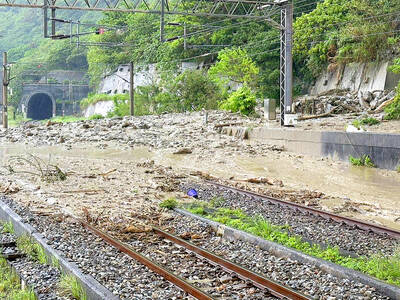
ROLLER-COASTER RIDE: More than five earthquakes ranging from magnitude 4.4 to 5.5 on the Richter scale shook eastern Taiwan in rapid succession yesterday afternoon Back-to-back weather fronts are forecast to hit Taiwan this week, resulting in rain across the nation in the coming days, the Central Weather Administration said yesterday, as it also warned residents in mountainous regions to be wary of landslides and rockfalls. As the first front approached, sporadic rainfall began in central and northern parts of Taiwan yesterday, the agency said, adding that rain is forecast to intensify in those regions today, while brief showers would also affect other parts of the nation. A second weather system is forecast to arrive on Thursday, bringing additional rain to the whole nation until Sunday, it

CONDITIONAL: The PRC imposes secret requirements that the funding it provides cannot be spent in states with diplomatic relations with Taiwan, Emma Reilly said China has been bribing UN officials to obtain “special benefits” and to block funding from countries that have diplomatic ties with Taiwan, a former UN employee told the British House of Commons on Tuesday. At a House of Commons Foreign Affairs Committee hearing into “international relations within the multilateral system,” former Office of the UN High Commissioner for Human Rights (OHCHR) employee Emma Reilly said in a written statement that “Beijing paid bribes to the two successive Presidents of the [UN] General Assembly” during the two-year negotiation of the Sustainable Development Goals. Another way China exercises influence within the UN Secretariat is
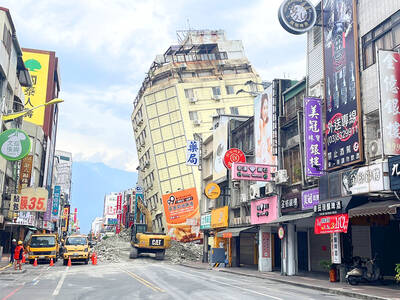
LANDSLIDES POSSIBLE: The agency advised the public to avoid visiting mountainous regions due to more expected aftershocks and rainfall from a series of weather fronts A series of earthquakes over the past few days were likely aftershocks of the April 3 earthquake in Hualien County, with further aftershocks to be expected for up to a year, the Central Weather Administration (CWA) said yesterday. Based on the nation’s experience after the quake on Sept. 21, 1999, more aftershocks are possible over the next six months to a year, the agency said. A total of 103 earthquakes of magnitude 4 on the local magnitude scale or higher hit Hualien County from 5:08pm on Monday to 10:27am yesterday, with 27 of them exceeding magnitude 5. They included two, of magnitude

Taiwan’s first drag queen to compete on the internationally acclaimed RuPaul’s Drag Race, Nymphia Wind (妮妃雅), was on Friday crowned the “Next Drag Superstar.” Dressed in a sparkling banana dress, Nymphia Wind swept onto the stage for the final, and stole the show. “Taiwan this is for you,” she said right after show host RuPaul announced her as the winner. “To those who feel like they don’t belong, just remember to live fearlessly and to live their truth,” she said on stage. One of the frontrunners for the past 15 episodes, the 28-year-old breezed through to the final after weeks of showcasing her unique


 RSS
RSS