


In a move to stabilize consumer prices and combat looming inflation, the nation's central bank yesterday raised the benchmark interest rate by 0.125 percentage points for the fifth consecutive quarter.
"The central bank's priority is to stabilize consumer prices and then help boost economic development," Perng Fai-nan (
The monetary policy-making body announced that the rediscount rate charged to commercial lenders would be hiked to 2.125 percent. It also jacked up both the secured accommodations rate and unsecured loan rate to 2.50 percent and 4.375 percent, respectively.
"Now real interest rates are still on the negative side, but this is not a rational phenomenon. We decided to take a gradual approach to steer monetary policy back to the neutral stance," Perng said.
Real interest rates are equivalent to interest rates minus the rate of inflation, as measured by the rise in the consumer price index (CPI).
For the first eight months of the year, Taiwan's CPI rose 2.13 percent over the same period last year, as frequent typhoons have led to price hikes for vegetables and fruit, and global crude oil price increases have prompted domestic refiners to boost gas prices at the pumps.
Last month alone, inflation soared to a seven-year high of 3.56 percent, 0.76 percent higher than July, according to the Directorate General of Budget, Accounting and Statistics (DGBAS).
Despite the alarming figure, Perng said the core CPI growth -- excluding vegetables, fruit and energy costs -- remained stable at 0.69 percent between January and August, exerting less inflationary pressure.
However, if electricity and oil prices are hiked by the year-end, the CPI is likely to climb again, he added.
Economists said the central bank's interest rate hikes will not influence the nation's economic growth, investment or the property market, as the range is considered small.
"Apparently, the central bank wants to tackle inflationary concerns first, after both persistently high prices for oil and farm produce have driven up consumer prices," said Chen Miao (
Prices of agricultural products may drop soon as the typhoon season is about to end, so it is the oil prices that would continue to weigh on consumer prices, said Wu Chung-shu (吳中書), a researcher at Academia Sinica.
Oil prices have been lingering around US$65 per barrel recently, and went up further yesterday after a report showed that Hurricane Katrina caused a larger-than-expected decline in US inventories.
Crude oil for delivery next month rose US$0.5, or 0.8 percent, to US$65.59 a barrel on the New York Mercantile Exchange yesterday. Oil is up 50 percent from a year ago, after reaching a record US$70.85 in the end of last month.
The central bank yesterday reiterated its policy on currencies, saying it will enter the foreign-exchange market to "maintain order" if seasonal or irregular factors cause excessive volatility.
According to the bank, the nation's trade surplus has significantly dropped this year, with the total surplus standing at US$1.17 billion, down 79.1 percent from a year earlier.
That, coupled with people's increased overseas travel expenditures and insurers' rising investment in foreign markets, has caused the New Taiwan dollar to depreciate slightly against the greenback recently.
As of Wednesday, the NT dollar has appreciated by 6.01 percent against the US dollar this year from a year ago, by 4.67 percent against the Japanese yen, and by 2.64 percent against the euro, the central bank said.
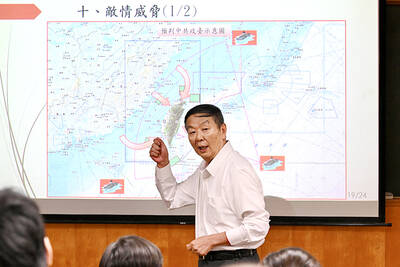
RETHINK? The defense ministry and Navy Command Headquarters could take over the indigenous submarine project and change its production timeline, a source said Admiral Huang Shu-kuang’s (黃曙光) resignation as head of the Indigenous Submarine Program and as a member of the National Security Council could affect the production of submarines, a source said yesterday. Huang in a statement last night said he had decided to resign due to national security concerns while expressing the hope that it would put a stop to political wrangling that only undermines the advancement of the nation’s defense capabilities. Taiwan People’s Party Legislator Vivian Huang (黃珊珊) yesterday said that the admiral, her older brother, felt it was time for him to step down and that he had completed what he

Taiwan has experienced its most significant improvement in the QS World University Rankings by Subject, data provided on Sunday by international higher education analyst Quacquarelli Symonds (QS) showed. Compared with last year’s edition of the rankings, which measure academic excellence and influence, Taiwanese universities made great improvements in the H Index metric, which evaluates research productivity and its impact, with a notable 30 percent increase overall, QS said. Taiwanese universities also made notable progress in the Citations per Paper metric, which measures the impact of research, achieving a 13 percent increase. Taiwanese universities gained 10 percent in Academic Reputation, but declined 18 percent
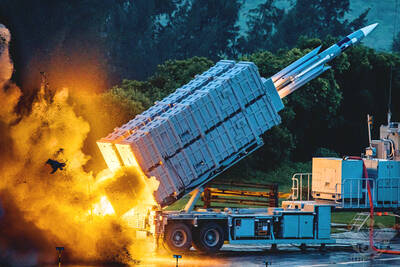
UNDER DISCUSSION: The combatant command would integrate fast attack boat and anti-ship missile groups to defend waters closest to the coastline, a source said The military could establish a new combatant command as early as 2026, which would be tasked with defending Taiwan’s territorial waters 24 nautical miles (44.4km) from the nation’s coastline, a source familiar with the matter said yesterday. The new command, which would fall under the Naval Command Headquarters, would be led by a vice admiral and integrate existing fast attack boat and anti-ship missile groups, along with the Naval Maritime Surveillance and Reconnaissance Command, said the source, who asked to remain anonymous. It could be launched by 2026, but details are being discussed and no final timetable has been announced, the source
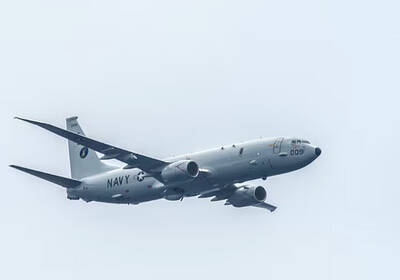
CHINA REACTS: The patrol and reconnaissance plane ‘transited the Taiwan Strait in international airspace,’ the 7th Fleet said, while Taipei said it saw nothing unusual The US 7th Fleet yesterday said that a US Navy P-8A Poseidon flew through the Taiwan Strait, a day after US and Chinese defense heads held their first talks since November 2022 in an effort to reduce regional tensions. The patrol and reconnaissance plane “transited the Taiwan Strait in international airspace,” the 7th Fleet said in a news release. “By operating within the Taiwan Strait in accordance with international law, the United States upholds the navigational rights and freedoms of all nations.” In a separate statement, the Ministry of National Defense said that it monitored nearby waters and airspace as the aircraft


 RSS
RSS