


US President George W. Bush was meeting with his defense and foreign policy teams yesterday at his Texas ranch, from where he will look at world hotspots from Baghdad to Pyongyang.
Vice President Dick Cheney and top-rung advisers, including Defense Secretary Donald Rumsfeld and Secretary of State Condoleezza Rice, were coming for the talks. Issues were to range from ongoing violence in Iraq and standoffs with Iran and North Korea over their nuclear programs to anti-US sentiment abroad, especially in the Middle East.
Keeping with tradition, Bush is spending this month at the ranch in Crawford.
The unhurried pace of this one-stoplight town stands in sharp contrast to events across the globe: suicide bombings in Iraq; on-again, off-again negotiations with the reclusive North Korea; Iran's decision to restart sensitive nuclear work; and next week's pullout of some 9,000 Jewish settlers in the Gaza Strip and West Bank.
APPROVAL RATINGS
Bush's update on defense and foreign-policy issues comes at a time when his approval ratings are hovering below 50 percent.
An AP-Ipsos poll conducted from Aug. 1 to Aug. 3 showed Bush's overall job approval was at 42 percent, with 55 percent disapproving. That's about where his approval rating has been all summer, but slightly lower than it was when the year began.
His approval on his handling of Iraq stood at 38 percent.
Iraq, where the death toll of US troops has topped 1,840, is likely to take center stage.
The administration is hoping that progress on the political front will help deflate violence and allow the US and its partners to begin withdrawing troops next year.
Rumsfeld said success in drafting a new Iraqi constitution is critical toward persuading the majority of Iraqis that the "new Iraq is worth fighting for."
But a deadlock has arisen over the drafting of the charter, which is supposed to be completed by this Monday.
Rumsfeld has not publicly voiced his thoughts on when US forces may be able to come home in large numbers -- a decision that hinges on the level of violence and the capabilities of Iraqi security forces, which now number 178,000.
FINAL REPORT
A joint US-Iraqi committee that is identifying areas to revert to Iraqi control will submit its final report by the end of next month.
That is the first step toward what General George Casey, the top commander in Iraq, has said could lead to a "fairly substantial" reduction in the 138,000-strong US force by the spring and summer of next year.
Casey has not disclosed numbers, but Pentagon officials have mentioned a reduction figure of 20,000 to 30,000 troops. That would still leave about 100,000 Americans in Iraq well into next year.
But first the Pentagon will likely have to increase the number of US troops above the current 138,000 to improve security for a planned October referendum and a December election, when a burst of insurgent violence is expected, Rumsfeld spokesman Lawrence Di Rita said this week.
In January, when Iraq held its first elections, troop levels were raised as high as 160,000, mainly by overlapping some units arriving in Iraq to begin a one-year tour with those who were ending their yearlong tours.
Di Rita said that this time commanders could also ask for volunteers to serve extended tours or send some US-based troops to Iraq to augment the force during the fall election period.
The White House says Rumsfeld will brief the president on the Quadrennial Defense Review, a congressionally mandated top-to-bottom review of defense strategy and plans. The review, begun earlier this year, will be completed around January, in time for the February budget submission.
also see story
Mourning mom's vigil gains support
US pushes at China's edges
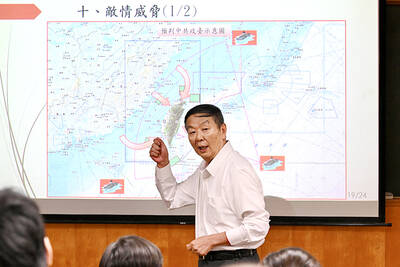
RETHINK? The defense ministry and Navy Command Headquarters could take over the indigenous submarine project and change its production timeline, a source said Admiral Huang Shu-kuang’s (黃曙光) resignation as head of the Indigenous Submarine Program and as a member of the National Security Council could affect the production of submarines, a source said yesterday. Huang in a statement last night said he had decided to resign due to national security concerns while expressing the hope that it would put a stop to political wrangling that only undermines the advancement of the nation’s defense capabilities. Taiwan People’s Party Legislator Vivian Huang (黃珊珊) yesterday said that the admiral, her older brother, felt it was time for him to step down and that he had completed what he

Taiwan has experienced its most significant improvement in the QS World University Rankings by Subject, data provided on Sunday by international higher education analyst Quacquarelli Symonds (QS) showed. Compared with last year’s edition of the rankings, which measure academic excellence and influence, Taiwanese universities made great improvements in the H Index metric, which evaluates research productivity and its impact, with a notable 30 percent increase overall, QS said. Taiwanese universities also made notable progress in the Citations per Paper metric, which measures the impact of research, achieving a 13 percent increase. Taiwanese universities gained 10 percent in Academic Reputation, but declined 18 percent
UNDER DISCUSSION: The combatant command would integrate fast attack boat and anti-ship missile groups to defend waters closest to the coastline, a source said The military could establish a new combatant command as early as 2026, which would be tasked with defending Taiwan’s territorial waters 24 nautical miles (44.4km) from the nation’s coastline, a source familiar with the matter said yesterday. The new command, which would fall under the Naval Command Headquarters, would be led by a vice admiral and integrate existing fast attack boat and anti-ship missile groups, along with the Naval Maritime Surveillance and Reconnaissance Command, said the source, who asked to remain anonymous. It could be launched by 2026, but details are being discussed and no final timetable has been announced, the source
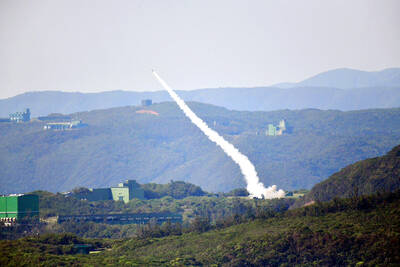
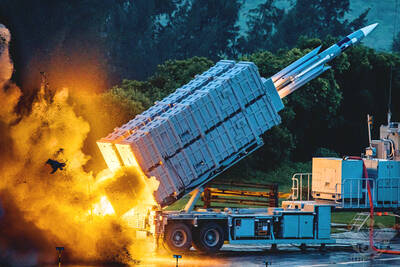
SHOT IN THE ARM: The new system can be integrated with Avenger and Stinger missiles to bolster regional air defense capabilities, a defense ministry report said Domestically developed Land Sword II (陸射劍二) missiles were successfully launched and hit target drones during a live-fire exercise at the Jiupeng Military Base in Pingtung County yesterday. The missiles, developed by the Chungshan Institute of Science and Technology (CSIST), were originally scheduled to launch on Tuesday last week, after the Tomb Sweeping Day holiday long weekend, but were postponed to yesterday due to weather conditions. Local residents and military enthusiasts gathered outside the base to watch the missile tests, with the first one launching at 9:10am. The Land Sword II system, which is derived from the Sky Sword II (天劍二) series, was turned


 RSS
RSS