


President Chen Shui-bian (
Chen made the remarks yesterday in an inauguration ceremony of a steam fruit-disinfecting facility held in Tainan County's Yujing Township (玉井), in response to the recent news that a delegation from the Taiwan Provincial Farmers' Association has reached a consensus with the Beijing-based Association for Economic and Trade Exchange Across the Taiwan Strait on the issue of Taiwan's fruit exports.
Tainan's Yujing Township is nicknamed the "home of mangoes" and is noted for its high-quality fruit.
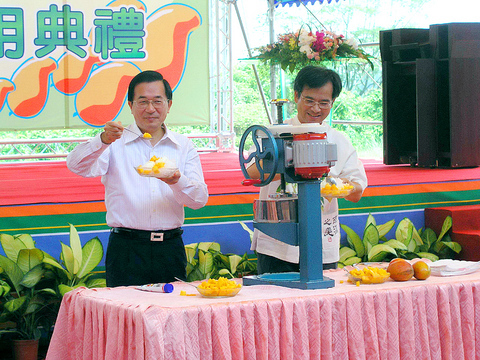
PHOTO: LIN MENG-TING, TAIPEI TIMES
In his speech, Chen called on fruit farmers to have confidence in Taiwan's fruit, pointing out that the qualify of Taiwan's mangoes are so good that they can fetch US$4 per kilogram in Japan, far more than their selling price of just US$0.70 per kilogram in China.
"In fact, Japan accounts for 44 percent of our mango exports, Singapore account for 15.1 percent and China only account for less than one percent," Chen said. "Therefore, it does not make any sense to say that only by selling fruit to China can Taiwan's farmers survive," Chen said. "Everyone should be confident in our produce. Now that we can market our fruit to Japan at a good price, we should not sell them to China at such a cheap price."
Chen also called on farmers to have faith in the Taiwan External Trade Development Council (TAITRA), the major trade organization in charge of exports, including those to China.
Chen said that he already made a clear declaration about Taiwan's produce for export on June 15, while attending an inauguration of Taiwan's papaya exports to Japan.
"I've designated TAITRA to serve as the organization for managing the export of Taiwan's produce, and our local farmers' associations are in charge of coordinating produce supplies," Chen said. "TAITRA is responsible for marketing of Taiwan's produce to the world."
Chen praised TAITRA's experience in international trade and businesses negotiation and said it is perfectly capable of marketing Taiwan's produce worldwide, just as it has marketed Taiwan's computers -- which accounts for most of the world's manufacturing market share.
"I believe that the TAITRA can also attain the goal of `good service, good price and good profit,'" Chen added.
Chen clearly noted that only the government has the power to oversee negotiations on Taiwan's fruit trade.
"Any negotiations about Taiwan's produce exports that involve governmental authority such as custom duties, quarantines, customs clearance and inspections have to be authorized by the government, with TAITRA's assistance," Chen said.
"An agreement is not official if individuals or groups talk privately with China, no matter what conclusion they reach," Chen said.
The steam fruit-disinfecting facility in Yujing Township was built at a cost of NT$130 million (US$4.1 million) and is the fourth such facility in the nation. It became commercially operational July 1 after receiving certificates issued by Japanese quarantine authorities on June 24. The facility is designed to efficiently eliminate the mango's principal pest, the fruit fly. Built with financial assistance from Japan's Mitsubishi Group, the plant, capable of processing at least 9 tonnes of fruit per day, is expected to help increase exports of mangoes, papayas and other fruit from Tainan County to Japan.
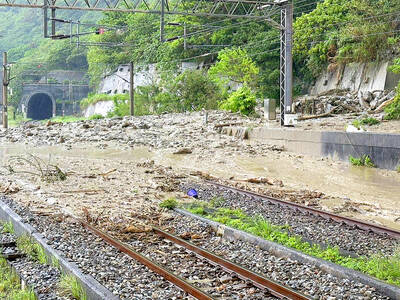
ROLLER-COASTER RIDE: More than five earthquakes ranging from magnitude 4.4 to 5.5 on the Richter scale shook eastern Taiwan in rapid succession yesterday afternoon Back-to-back weather fronts are forecast to hit Taiwan this week, resulting in rain across the nation in the coming days, the Central Weather Administration said yesterday, as it also warned residents in mountainous regions to be wary of landslides and rockfalls. As the first front approached, sporadic rainfall began in central and northern parts of Taiwan yesterday, the agency said, adding that rain is forecast to intensify in those regions today, while brief showers would also affect other parts of the nation. A second weather system is forecast to arrive on Thursday, bringing additional rain to the whole nation until Sunday, it

CONDITIONAL: The PRC imposes secret requirements that the funding it provides cannot be spent in states with diplomatic relations with Taiwan, Emma Reilly said China has been bribing UN officials to obtain “special benefits” and to block funding from countries that have diplomatic ties with Taiwan, a former UN employee told the British House of Commons on Tuesday. At a House of Commons Foreign Affairs Committee hearing into “international relations within the multilateral system,” former Office of the UN High Commissioner for Human Rights (OHCHR) employee Emma Reilly said in a written statement that “Beijing paid bribes to the two successive Presidents of the [UN] General Assembly” during the two-year negotiation of the Sustainable Development Goals. Another way China exercises influence within the UN Secretariat is
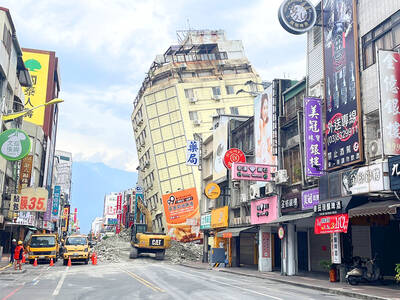
LANDSLIDES POSSIBLE: The agency advised the public to avoid visiting mountainous regions due to more expected aftershocks and rainfall from a series of weather fronts A series of earthquakes over the past few days were likely aftershocks of the April 3 earthquake in Hualien County, with further aftershocks to be expected for up to a year, the Central Weather Administration (CWA) said yesterday. Based on the nation’s experience after the quake on Sept. 21, 1999, more aftershocks are possible over the next six months to a year, the agency said. A total of 103 earthquakes of magnitude 4 on the local magnitude scale or higher hit Hualien County from 5:08pm on Monday to 10:27am yesterday, with 27 of them exceeding magnitude 5. They included two, of magnitude

Taiwan’s first drag queen to compete on the internationally acclaimed RuPaul’s Drag Race, Nymphia Wind (妮妃雅), was on Friday crowned the “Next Drag Superstar.” Dressed in a sparkling banana dress, Nymphia Wind swept onto the stage for the final, and stole the show. “Taiwan this is for you,” she said right after show host RuPaul announced her as the winner. “To those who feel like they don’t belong, just remember to live fearlessly and to live their truth,” she said on stage. One of the frontrunners for the past 15 episodes, the 28-year-old breezed through to the final after weeks of showcasing her unique


 RSS
RSS