


UN experts yesterday called for the urgent testing of a flock of migratory birds in China after they found an outbreak of deadly avian flu was more lethal than previously thought.
A total of 5,000 birds have died in a bird sanctuary in northwestern Qinghai Province, five times more than previously reported, according to officials from the World Health Organization (WHO) and the Food and Agriculture Organization (FAO) just back from visiting the area.
"This is the first time we've seen large numbers of migratory birds dying from bird flu [in the world]," said Julie Hall, the WHO official in charge of communicable diseases in China.
"So the virus has obviously changed to be more pathogenic to animals. What it means to humans we don't know," she told reporters in Beijing.
Some of the species infected in the outbreak discovered last month had not been affected by previous outbreaks in the region.
The officials expressed concern that China has tested only five of the 189 species of birds on the island and only 12 birds in total, all of them dead -- even though live birds pose a greater threat.
"I'm not so concerned about migratory birds if they just get very sick and die, but what concerns me the most is if we have many birds that are asymptomatic and they fly from here to 1,000km away," WHO China representative Henk Bekedam said.
That could affect other wild birds and domesticated animals, potentially devastating poultry industries.
The migratory birds are still on the island but will begin flying to other parts of China and to neighboring countries in August and September, presenting only "a small window of opportunity" to test them, experts said.
Chinese authorities have cordoned off a 50km radius around the "highly contaminated" nature reserve, restricting access and relocating residents, Hall said.
However, no cull has been carried out, as is often done with domesticated flocks, because some species are endangered, experts said.
"There [also] would obviously be logistical issues in trying to catch and kill them all," Hall said.
The five species known to be infected are bar-headed geese, great black-headed gulls, brown-headed gulls, ruddy shelducks and great cormorants.
Hall called for the immediate testing or electronic tagging of the animals to see which are infected and to trace where they are going.
"This is vital if we are to give an early warning to other countries before they come," she said.
The birds are expected to fly to the south and the west soon, but their migratory patterns are not clear, so other areas could also be under threat, FAO China representative Noureddin Mona said.
No human cases have been reported so far, but the fact the virus has now spread to new bird species could pose a greater risk for humans, Hall said.
"The more virus that's around, the more experience it has to experiment what it's like inside a human ... and the more chances it has to learn how to go from human to human," Hall said.
The H5N1 strain of bird flu has so far been mainly transmitted between animals, but it has also killed 54 people in Thailand, Vietnam and Cambodia since 2003.
WHO officials expressed concern that only two people have been tested in the outbreak, saying anyone who has been in contact should be tested.
They are also urging China to supply virus sequencing information to the international community "as quickly as possible," so experts can determine whether the virus has become more pathogenic to birds as well as humans.
"It's very important to understand what this virus is. Is it resembling one we had last year in China, different from one in Vietnam?" Bekedam said.

Taiwan has experienced its most significant improvement in the QS World University Rankings by Subject, data provided on Sunday by international higher education analyst Quacquarelli Symonds (QS) showed. Compared with last year’s edition of the rankings, which measure academic excellence and influence, Taiwanese universities made great improvements in the H Index metric, which evaluates research productivity and its impact, with a notable 30 percent increase overall, QS said. Taiwanese universities also made notable progress in the Citations per Paper metric, which measures the impact of research, achieving a 13 percent increase. Taiwanese universities gained 10 percent in Academic Reputation, but declined 18 percent

Chinese President Xi Jinping (習近平) yesterday met with former president Ma Ying-jeou (馬英九) at the Great Hall of the People in Beijing, with Xi’s opening statement once more emphasizing that people on both sides of the Taiwan Strait are Chinese and that foreign intervention cannot change their inevitable unification. Xi said that 5,000 years of history of zhonghua minzu (中華民族, ethnic Chinese group) have seen their ancestors move to Taiwan to establish new lives, while also documenting them fighting side-by-side against foreign forces and finally freeing Taiwan. “Both sides are Chinese,” and there are no issues that cannot be worked through, he
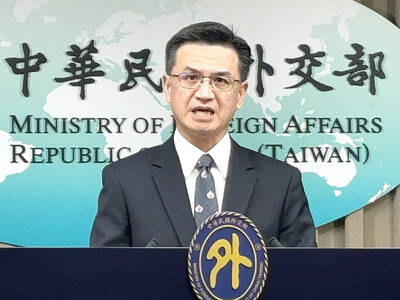
BULLY TACTICS: Beijing has continued its incursions into Taiwan’s airspace even as Xi Jinping talked about Taiwan being part of the Chinese family and nation China should stop its coercion of Taiwan and respect mainstream public opinion in Taiwan about sovereignty if its expression of goodwill is genuine, the Ministry of Foreign Affairs (MOFA) said yesterday. Ministry spokesman Jeff Liu (劉永健) made the comment in response to media queries about a meeting between former president Ma Ying-jeou (馬英九) and Chinese President Xi Jinping (習近平) the previous day. Ma voiced support for the so-called “1992 consensus,” while Xi said that although the two sides of the Taiwan Strait have “different systems,” this does not change the fact that they are “part of the same country,” and that “external

UNDER DISCUSSION: The combatant command would integrate fast attack boat and anti-ship missile groups to defend waters closest to the coastline, a source said The military could establish a new combatant command as early as 2026, which would be tasked with defending Taiwan’s territorial waters 24 nautical miles (44.4km) from the nation’s coastline, a source familiar with the matter said yesterday. The new command, which would fall under the Naval Command Headquarters, would be led by a vice admiral and integrate existing fast attack boat and anti-ship missile groups, along with the Naval Maritime Surveillance and Reconnaissance Command, said the source, who asked to remain anonymous. It could be launched by 2026, but details are being discussed and no final timetable has been announced, the source


 RSS
RSS