


Six months after the devastating Dec. 26 earthquake and tsunami that killed 178,000 people in 11 countries and left another 50,000 missing and presumed dead, some Asian nations yesterday held ceremonies to mourn those lost, while the survivors struggled to pick up the pieces.
In Sri Lanka, where a deal with Tamil Tigers to distribute tsunami aid in rebel-held areas has only been signed this week, the scale of the tragedy continues to haunt survivors, many of whom have yet to rebuild their homes and lives.
Thailand's tourist beaches that once saw throngs of foreigners, were eerily quiet yesterday, with luggage still buried in the sand by the tsunami and posters for missing victims hanging on palm trees as grim reminders of what happened.
In hardest-hit Indonesia, where Aceh province bore the brunt of the earthquake and deadly waves -- killing at least 131,029 with another 37,066 missing and presumed dead -- people had gathered a day earlier on Saturday in the shadow of a tsunami-battered mosque to remember their dead.
In Sri Lanka's rebel-controlled Vakarai hamlet, about 60km northeast from the eastern Batticaloa town, volunteers collected anything and everything from the rubble created by the tsunami for an exhibition marking the tsunami anniversary.
School bags, copy books, shoes, tea cups, television parts are all brought to the area's government school for an exhibition which the organizers said would help survivors to bring out their suppressed feelings and grieve in the open.
Shanthi Sivanesan, Gender and Protection Project Officer of British-based Oxfam, said the exhibition is also aimed at instilling determination among the survivors to earn back their belongings lost to the tsunami.
"We have two motives here. The chief among them is to bring out the psychological pressure out of the survivors who are still suffering inside. We will have psycho-social workers at this center to counsel them," Sivanesan said.
"This pair of shoes, my daughter liked most" read an inscription written near a shoe.
"We can be what we were before," read another.
In some areas, an uncertain future and day-to-day problems seemed to take priority over any commemoration.
About 268 persons from 73 families living in an abandoned rice store complex near Battacaloa wonder where they will go when the land they have squatted on is taken over by the government to build a medical school.
"The university told us today that we will have to vacate the building soon and if that happens we will have to go to the streets," said Kandiah Thangavel, 59, a displaced fisherman.
In Indonesia's Aceh, Saturday's ceremony marking six months since the Dec. 26 disaster was also a time to remember the dead, with prayers from the Koran and recollections of a young tsunami survivor, Nada Lutfiah, who lost her parents in the calamity.
The fourth-grader had received a letter from a third-grader in Michigan expressing hope that her family had survived. But she had to write back with the awful truth.
"Unfortunately, my family -- father, mother, brother and sister -- are gone," Lutfiah said, reading from her letter. "Now, I'm alone."
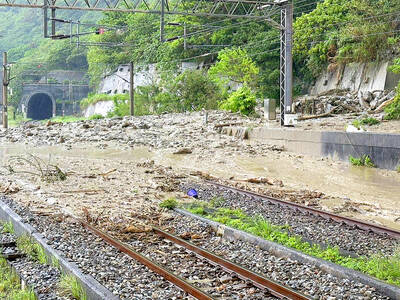
ROLLER-COASTER RIDE: More than five earthquakes ranging from magnitude 4.4 to 5.5 on the Richter scale shook eastern Taiwan in rapid succession yesterday afternoon Back-to-back weather fronts are forecast to hit Taiwan this week, resulting in rain across the nation in the coming days, the Central Weather Administration said yesterday, as it also warned residents in mountainous regions to be wary of landslides and rockfalls. As the first front approached, sporadic rainfall began in central and northern parts of Taiwan yesterday, the agency said, adding that rain is forecast to intensify in those regions today, while brief showers would also affect other parts of the nation. A second weather system is forecast to arrive on Thursday, bringing additional rain to the whole nation until Sunday, it

CONDITIONAL: The PRC imposes secret requirements that the funding it provides cannot be spent in states with diplomatic relations with Taiwan, Emma Reilly said China has been bribing UN officials to obtain “special benefits” and to block funding from countries that have diplomatic ties with Taiwan, a former UN employee told the British House of Commons on Tuesday. At a House of Commons Foreign Affairs Committee hearing into “international relations within the multilateral system,” former Office of the UN High Commissioner for Human Rights (OHCHR) employee Emma Reilly said in a written statement that “Beijing paid bribes to the two successive Presidents of the [UN] General Assembly” during the two-year negotiation of the Sustainable Development Goals. Another way China exercises influence within the UN Secretariat is
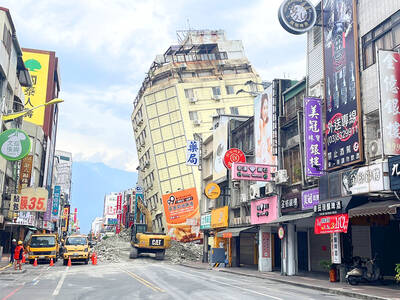
LANDSLIDES POSSIBLE: The agency advised the public to avoid visiting mountainous regions due to more expected aftershocks and rainfall from a series of weather fronts A series of earthquakes over the past few days were likely aftershocks of the April 3 earthquake in Hualien County, with further aftershocks to be expected for up to a year, the Central Weather Administration (CWA) said yesterday. Based on the nation’s experience after the quake on Sept. 21, 1999, more aftershocks are possible over the next six months to a year, the agency said. A total of 103 earthquakes of magnitude 4 on the local magnitude scale or higher hit Hualien County from 5:08pm on Monday to 10:27am yesterday, with 27 of them exceeding magnitude 5. They included two, of magnitude

Taiwan’s first drag queen to compete on the internationally acclaimed RuPaul’s Drag Race, Nymphia Wind (妮妃雅), was on Friday crowned the “Next Drag Superstar.” Dressed in a sparkling banana dress, Nymphia Wind swept onto the stage for the final, and stole the show. “Taiwan this is for you,” she said right after show host RuPaul announced her as the winner. “To those who feel like they don’t belong, just remember to live fearlessly and to live their truth,” she said on stage. One of the frontrunners for the past 15 episodes, the 28-year-old breezed through to the final after weeks of showcasing her unique


 RSS
RSS