


On the last day of its current session, the Legislative Yuan yesterday passed a long-anticipated bailout-funds bill that amends the Resolution Trust Committee Fund Regulatory Provisions (金融重建基金設置及管理條例), as well as passing next year's budget for the government's five-year, NT$500 billion public-construction package.
While the resolution trust fund has been expanded to NT$110 billion (US$3.5 billion), next year's budget for the 10-project package is about NT$90.5 billion. A NT$2.2 billion budget for the 2008 Taiwan Expo was scrapped, however.
Disappointed with the number of bills passed by the legislature in this session, Premier Frank Hsieh (謝長廷) yesterday asked the legislature to sit in an extraordinary session, preferably in late July, to pass key legislation such as the long-stalled arms-procurement bill and a bill confirming President Chen Shui-bian's (陳水扁) nominees for the Control Yuan.
Hsieh visited Legislative Speaker Wang Jin-pyng (王金平) in accordance to extend his gratitude for the lawmaking body's efforts over the past three months.
Many things happened during the session, including the passage of China's "Anti-Secession" Law, the National Assembly elections and preliminaries for mayoral and county commissioner elections at the end of the year, Hsieh said.
The lawmaking body now enters a summer recess as media attention switches to the proceedings of the National Assembly, which met on Monday to begin its sole task of ratifying a constitutional amendment package passed by the legislature last August.
Meanwhile, the Democratic Progressive Party (DPP) and Taiwan Solidarity Union (TSU) legislative caucuses yesterday criticized the legislature for passing a record-low number of bills this session, with only 39 bills, two budget requests, the abolition of two outdated pieces of legislation and three legislative resolutions.
DPP caucus whip Lai Ching-te (賴清德) attributed the poor performance of the legislature to the opposition-dominated Procedure Committee, which he said had boycotted the government's priority bills, to the Chinese Nationalist Party (KMT) for "closing the door" to cross-party negotiations and to legislative committees for spending too little time reviewing bills.
Lai also accused Wang of "conniving" with opposition parties to block bills in the Procedure Committee and shutting down negotiations. In response, Wang said the legislature had good reason to pass fewer bills this session because the session was shorter.
TSU caucus whip Lo Chih-ming (羅志明) said the DPP had accomplished nothing, despite "cooperating" with the People First Party (PFP).
"PFP Chairman James Soong (宋楚瑜) promised to help the DPP with its priority bills, but the DPP's dream of Soong delivering on his promise was shattered when they were repeatedly hindered by the pan-blue controlled Procedure Committee," Lo said.
Lo also voiced TSU caucus opposition to Chen's call for a review on tax policy and raising value-added tax by 1 to 2 percentage points, saying that policies lacking carefully thought out supplementary plans would not win the support of opposition parties.
Lo said Chen's proposal would not help bring in more tax revenue but instead worsen the government's financial plight and force industries to relocate overseas.
also see story:
Lawmakers OK more bail-out funds
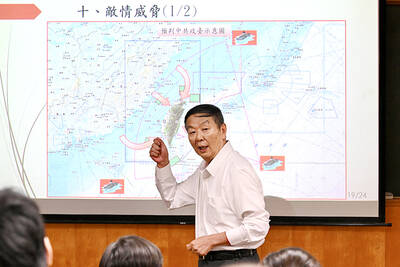
RETHINK? The defense ministry and Navy Command Headquarters could take over the indigenous submarine project and change its production timeline, a source said Admiral Huang Shu-kuang’s (黃曙光) resignation as head of the Indigenous Submarine Program and as a member of the National Security Council could affect the production of submarines, a source said yesterday. Huang in a statement last night said he had decided to resign due to national security concerns while expressing the hope that it would put a stop to political wrangling that only undermines the advancement of the nation’s defense capabilities. Taiwan People’s Party Legislator Vivian Huang (黃珊珊) yesterday said that the admiral, her older brother, felt it was time for him to step down and that he had completed what he

Taiwan has experienced its most significant improvement in the QS World University Rankings by Subject, data provided on Sunday by international higher education analyst Quacquarelli Symonds (QS) showed. Compared with last year’s edition of the rankings, which measure academic excellence and influence, Taiwanese universities made great improvements in the H Index metric, which evaluates research productivity and its impact, with a notable 30 percent increase overall, QS said. Taiwanese universities also made notable progress in the Citations per Paper metric, which measures the impact of research, achieving a 13 percent increase. Taiwanese universities gained 10 percent in Academic Reputation, but declined 18 percent
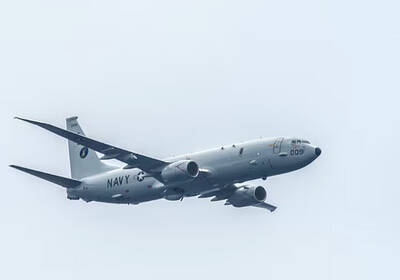
CHINA REACTS: The patrol and reconnaissance plane ‘transited the Taiwan Strait in international airspace,’ the 7th Fleet said, while Taipei said it saw nothing unusual The US 7th Fleet yesterday said that a US Navy P-8A Poseidon flew through the Taiwan Strait, a day after US and Chinese defense heads held their first talks since November 2022 in an effort to reduce regional tensions. The patrol and reconnaissance plane “transited the Taiwan Strait in international airspace,” the 7th Fleet said in a news release. “By operating within the Taiwan Strait in accordance with international law, the United States upholds the navigational rights and freedoms of all nations.” In a separate statement, the Ministry of National Defense said that it monitored nearby waters and airspace as the aircraft

UNDER DISCUSSION: The combatant command would integrate fast attack boat and anti-ship missile groups to defend waters closest to the coastline, a source said The military could establish a new combatant command as early as 2026, which would be tasked with defending Taiwan’s territorial waters 24 nautical miles (44.4km) from the nation’s coastline, a source familiar with the matter said yesterday. The new command, which would fall under the Naval Command Headquarters, would be led by a vice admiral and integrate existing fast attack boat and anti-ship missile groups, along with the Naval Maritime Surveillance and Reconnaissance Command, said the source, who asked to remain anonymous. It could be launched by 2026, but details are being discussed and no final timetable has been announced, the source


 RSS
RSS