


New Zealanders will pay an extra NZ$2.90 (US$2.14) a week for electricity, gasoline and gas when the country becomes the first in the world to introduce a carbon tax to address global warming.
It is expected to add about 6 percent to household energy prices and 9 percent for most businesses but will help the economy in the long run, according to Pete Hodgson, the minister responsible for climate change policy.
Hodgson set the tax on Wednesday at NZ$11 per tonne of carbon emitted. It will come into effect in two years.
"If we are going to tackle climate change, we need to start taking environmental costs into account in the economic choices we make," he said.
The tax, planned after New Zealand signed up to the Kyoto protocol, would make polluting energy sources such as coal and oil more expensive than cleaner ones such as hydro, wind and solar, he said.
Experiment
The experiment will be watched closely by bigger countries which are also committed to reducing carbon emissions but are failing to reduce energy demand.
The government estimates the tax will raise about NZ$360 million a year but has said it will not increase revenues.
"It will be balanced by other tax changes so there is no net increase in government revenue," a government spokesman told reporters yesterday.
The most energy-intensive businesses will be exempted so that they are not forced to shut or relocate.
In return, companies such as Comalco, which uses 15 percent of the country's power, and Carter Holt Harvey, the country's biggest sawmill, must commit to reducing carbon emissions.
New Zealand, which produces about 29 percent of its electricity from gas- or coal-fired power stations, has a record of introducing the idea of green taxes but not implementing them.
In 2003, the government had planned to impose a methane tax on farmers because flatulence of cows and sheep was responsible for more than one-half of New Zealand's total greenhouse gas emissions.
But that was abandoned after criticism from farmers, who labeled it a "fart tax."
Mixed reaction
Reaction to the carbon tax was mixed yesterday.
"It's good to see there are no surprises," said Tom Campbell, the managing director of Comalco's aluminum smelting operations.
A government spokesman said the tax would have long term benefits for the economy.
"If New Zealand does nothing ... our emissions will continue to rise as will the future cost of reducing them. If we can curb our growth in greenhouse gas emissions now, we will be better placed to make a smooth transition to more challenging commitments after 2012," he said.
Other countries, especially in Europe, have energy taxes which are weighted against producers, but New Zealand is believed to be the first to ask the public to pay directly for the costs of reducing global warming.
Proposals for a Europe-wide carbon tax were abandoned in the 1990s.
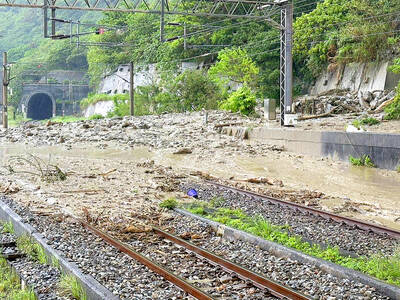
ROLLER-COASTER RIDE: More than five earthquakes ranging from magnitude 4.4 to 5.5 on the Richter scale shook eastern Taiwan in rapid succession yesterday afternoon Back-to-back weather fronts are forecast to hit Taiwan this week, resulting in rain across the nation in the coming days, the Central Weather Administration said yesterday, as it also warned residents in mountainous regions to be wary of landslides and rockfalls. As the first front approached, sporadic rainfall began in central and northern parts of Taiwan yesterday, the agency said, adding that rain is forecast to intensify in those regions today, while brief showers would also affect other parts of the nation. A second weather system is forecast to arrive on Thursday, bringing additional rain to the whole nation until Sunday, it

CONDITIONAL: The PRC imposes secret requirements that the funding it provides cannot be spent in states with diplomatic relations with Taiwan, Emma Reilly said China has been bribing UN officials to obtain “special benefits” and to block funding from countries that have diplomatic ties with Taiwan, a former UN employee told the British House of Commons on Tuesday. At a House of Commons Foreign Affairs Committee hearing into “international relations within the multilateral system,” former Office of the UN High Commissioner for Human Rights (OHCHR) employee Emma Reilly said in a written statement that “Beijing paid bribes to the two successive Presidents of the [UN] General Assembly” during the two-year negotiation of the Sustainable Development Goals. Another way China exercises influence within the UN Secretariat is
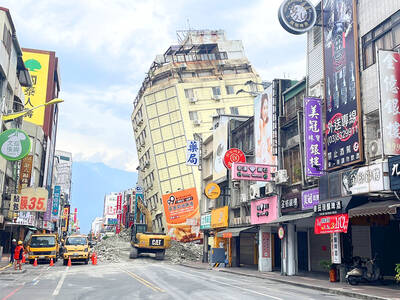
LANDSLIDES POSSIBLE: The agency advised the public to avoid visiting mountainous regions due to more expected aftershocks and rainfall from a series of weather fronts A series of earthquakes over the past few days were likely aftershocks of the April 3 earthquake in Hualien County, with further aftershocks to be expected for up to a year, the Central Weather Administration (CWA) said yesterday. Based on the nation’s experience after the quake on Sept. 21, 1999, more aftershocks are possible over the next six months to a year, the agency said. A total of 103 earthquakes of magnitude 4 on the local magnitude scale or higher hit Hualien County from 5:08pm on Monday to 10:27am yesterday, with 27 of them exceeding magnitude 5. They included two, of magnitude

Taiwan’s first drag queen to compete on the internationally acclaimed RuPaul’s Drag Race, Nymphia Wind (妮妃雅), was on Friday crowned the “Next Drag Superstar.” Dressed in a sparkling banana dress, Nymphia Wind swept onto the stage for the final, and stole the show. “Taiwan this is for you,” she said right after show host RuPaul announced her as the winner. “To those who feel like they don’t belong, just remember to live fearlessly and to live their truth,” she said on stage. One of the frontrunners for the past 15 episodes, the 28-year-old breezed through to the final after weeks of showcasing her unique


 RSS
RSS