


The UN Office at Geneva (UNOG) refused yesterday to grant Taiwanese journalists media accreditation to cover the World Health Assembly (WHA), the World Health Organization's (WHO) highest governing body, and said it did so because Taiwan is not a state recognized by the UN General Assembly.
With the WHA slated to take place at the UN building in Geneva, the Palais des Nations, from May 16 to May 25, UNOG is in charge of media accreditation for the event.
On its Web site explaining the media accreditation process, UNOG said it required all journalists to present two forms of valid ID for photo identification.
"Valid ID must include a current passport from a State recognized by the United Nations General Assembly, along with a press card, work ID, driver's license or other form of photo ID," UNOG said.
The UN Department of Public Information (UNDPI), the office said, must be satisfied that the individual applying for accreditation is a bona fide media professional and represents a bona fide media organizations.
Bona fide media organizations, the office went on to explain, are those "formally registered as a media organization in a country recognized by the United Nations General Assembly."
When contacted by this newspaper yesterday, a UNOG official said only journalists holding passports of UN member states or observers and working for media organizations in such countries or places will get accreditation.
Reporters failing either of the requirements will be refused accreditation, the official added, citing UN resolution 2758 to explain why Taiwanese reporters are denied access to WHA proceedings.
In a resolution adopted in 1971, entitled "Restoration of the lawful rights of the People's Republic of China in the United Nations," the General Assembly decided to "expel forthwith the representatives of Chiang Kai-shek (蔣介石) from the place which they unlawfully occupy at the United Nations and in all the organizations related to it."
Elena Ponomareva, chief of the press and external relations section at the UNOG, told this newspaper that the UN does not recognize Taiwan as a state and that Taiwanese passports are merely considered "local passports."
The WHO headquarters in Geneva had been in charge of media accreditation for coverage of the WHA till 2003. In 2003, Taiwanese journalists had no problem getting press passes to cover the assembly proceedings.
However, the UNOG took over media accreditation for coverage of the WHA event last year and waffled over whether to grant Taiwanese reporters press passes a few days before the assembly.
Last year, only two Taiwanese journalists, one holding a British passport and the other a US passport, obtained press passes from the UNOG to cover the WHA. Other Taiwanese reporters had to sit in the public gallery.
This year, by stating its terms of issuing press badges to reporters on its Web site, the UNOG has made it clear that Taiwanese journalists would not be accredited to cover the WHA.
According to the terms, all journalists working for Taiwanese media organizations will be barred from covering the WHA, no matter what passports they hold.
When asked whether the terms on the Web site were listed to prevent last year's hassles with Taiwanese reporters, a UNOG official said the office was simply trying to improve its Web site.
Meanwhile, Taiwanese diplomats in Geneva, France and New York are trying to persuade the UN to issue press badges to Taiwanese journalists working for private media organizations in Taiwan, according to government officials.
Also see story:
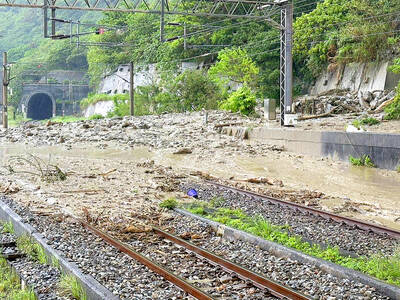
ROLLER-COASTER RIDE: More than five earthquakes ranging from magnitude 4.4 to 5.5 on the Richter scale shook eastern Taiwan in rapid succession yesterday afternoon Back-to-back weather fronts are forecast to hit Taiwan this week, resulting in rain across the nation in the coming days, the Central Weather Administration said yesterday, as it also warned residents in mountainous regions to be wary of landslides and rockfalls. As the first front approached, sporadic rainfall began in central and northern parts of Taiwan yesterday, the agency said, adding that rain is forecast to intensify in those regions today, while brief showers would also affect other parts of the nation. A second weather system is forecast to arrive on Thursday, bringing additional rain to the whole nation until Sunday, it

CONDITIONAL: The PRC imposes secret requirements that the funding it provides cannot be spent in states with diplomatic relations with Taiwan, Emma Reilly said China has been bribing UN officials to obtain “special benefits” and to block funding from countries that have diplomatic ties with Taiwan, a former UN employee told the British House of Commons on Tuesday. At a House of Commons Foreign Affairs Committee hearing into “international relations within the multilateral system,” former Office of the UN High Commissioner for Human Rights (OHCHR) employee Emma Reilly said in a written statement that “Beijing paid bribes to the two successive Presidents of the [UN] General Assembly” during the two-year negotiation of the Sustainable Development Goals. Another way China exercises influence within the UN Secretariat is
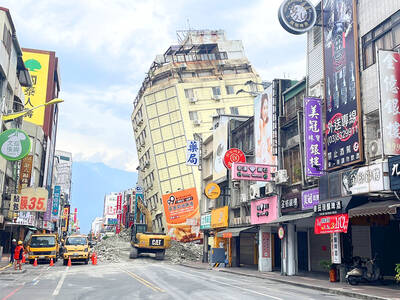
LANDSLIDES POSSIBLE: The agency advised the public to avoid visiting mountainous regions due to more expected aftershocks and rainfall from a series of weather fronts A series of earthquakes over the past few days were likely aftershocks of the April 3 earthquake in Hualien County, with further aftershocks to be expected for up to a year, the Central Weather Administration (CWA) said yesterday. Based on the nation’s experience after the quake on Sept. 21, 1999, more aftershocks are possible over the next six months to a year, the agency said. A total of 103 earthquakes of magnitude 4 on the local magnitude scale or higher hit Hualien County from 5:08pm on Monday to 10:27am yesterday, with 27 of them exceeding magnitude 5. They included two, of magnitude

Taiwan’s first drag queen to compete on the internationally acclaimed RuPaul’s Drag Race, Nymphia Wind (妮妃雅), was on Friday crowned the “Next Drag Superstar.” Dressed in a sparkling banana dress, Nymphia Wind swept onto the stage for the final, and stole the show. “Taiwan this is for you,” she said right after show host RuPaul announced her as the winner. “To those who feel like they don’t belong, just remember to live fearlessly and to live their truth,” she said on stage. One of the frontrunners for the past 15 episodes, the 28-year-old breezed through to the final after weeks of showcasing her unique


 RSS
RSS