


Pope Benedict XVI pledged yesterday to work to unify all Christians, reach out to other religions and continue implementing the Second Vatican Council as he outlined his goals and made clear his pontificate would follow closely the trajectory of his predecessor, Pope John Paul II.
Benedict, the former Cardinal Joseph Ratzinger, listed top priorities of his pontificate in a lengthy message read in Latin to cardinals gathered in the Sistine Chapel for the first Mass celebrated by the 265th leader of the Roman Catholic Church.
He said his "primary task" would be to work without fail to reunify all Christians and that sentiment alone was not enough.
"Concrete acts that enter souls and move consciences are needed," he said.
He said he wanted to continue "an open and sincere dialogue" with other religions and would do everything in his power to improve the ecumenical cause.
The message was clearly designed to show that Benedict was intent on following many of the groundbreaking paths charted by Pope John Paul II, who had made reaching out to other religions and trying to heal the 1,000-year-old schism in Christianity a hallmark of his pontificate.
John Paul, with Benedict as his doctrinal enforcer, supported council reforms but cracked down on what both men considered excesses spawned by the changes, including calls for priests to be allowed to marry and admission of women into the priesthood.
The Vatican's hard-line enforcer of church orthodoxy under John Paul II for almost 25 years, Benedict had gone into the two-day conclave one of the favorites. He emerged Tuesday as the oldest pontiff at the time of his election in 275 years and the first Germanic pope in almost a millennium.
A wildly cheering crowd of more than 100,000 welcomed Benedict when he stepped onto the balcony of St. Peter's Basilica as dusk fell Tuesday and gave his first blessing as pope.
Pilgrims on St. Peter's Square shouted "Benedetto!" and "Viva il Papa," waved national flags, hugged their neighbors and jumped in joy. Many shed tears of bliss; some wept in disappointment.
Benedict turned 78 on Saturday, the oldest Pope elected since Clement XII in 1730. His age clearly was a factor among cardinals who favored a "transitional" Pope who could skillfully lead the church as it absorbs John Paul II's legacy, rather than a younger cardinal who could wind up with another long pontificate.
A conservative on issues such as homosexuality, the ordination of women and lifting the celibacy requirement for priests, Benedict has led the Vatican's Congregation for the Doctrine of the Faith -- a position he used to discipline church dissidents and uphold church policy against attempts at reform by liberals and activist priests.
Joy over the selection of a new pope immediately mixed with worries that Benedict could polarize a global church.
also see story:
New Pope Benedict XVI to follow a conservative path
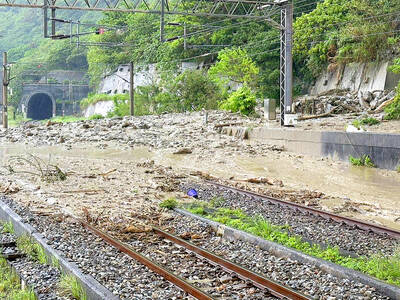
ROLLER-COASTER RIDE: More than five earthquakes ranging from magnitude 4.4 to 5.5 on the Richter scale shook eastern Taiwan in rapid succession yesterday afternoon Back-to-back weather fronts are forecast to hit Taiwan this week, resulting in rain across the nation in the coming days, the Central Weather Administration said yesterday, as it also warned residents in mountainous regions to be wary of landslides and rockfalls. As the first front approached, sporadic rainfall began in central and northern parts of Taiwan yesterday, the agency said, adding that rain is forecast to intensify in those regions today, while brief showers would also affect other parts of the nation. A second weather system is forecast to arrive on Thursday, bringing additional rain to the whole nation until Sunday, it
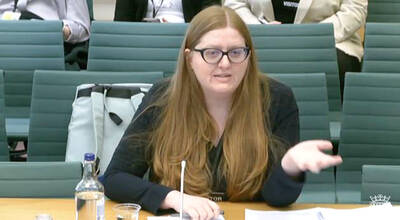
CONDITIONAL: The PRC imposes secret requirements that the funding it provides cannot be spent in states with diplomatic relations with Taiwan, Emma Reilly said China has been bribing UN officials to obtain “special benefits” and to block funding from countries that have diplomatic ties with Taiwan, a former UN employee told the British House of Commons on Tuesday. At a House of Commons Foreign Affairs Committee hearing into “international relations within the multilateral system,” former Office of the UN High Commissioner for Human Rights (OHCHR) employee Emma Reilly said in a written statement that “Beijing paid bribes to the two successive Presidents of the [UN] General Assembly” during the two-year negotiation of the Sustainable Development Goals. Another way China exercises influence within the UN Secretariat is

LANDSLIDES POSSIBLE: The agency advised the public to avoid visiting mountainous regions due to more expected aftershocks and rainfall from a series of weather fronts A series of earthquakes over the past few days were likely aftershocks of the April 3 earthquake in Hualien County, with further aftershocks to be expected for up to a year, the Central Weather Administration (CWA) said yesterday. Based on the nation’s experience after the quake on Sept. 21, 1999, more aftershocks are possible over the next six months to a year, the agency said. A total of 103 earthquakes of magnitude 4 on the local magnitude scale or higher hit Hualien County from 5:08pm on Monday to 10:27am yesterday, with 27 of them exceeding magnitude 5. They included two, of magnitude

Taiwan’s first drag queen to compete on the internationally acclaimed RuPaul’s Drag Race, Nymphia Wind (妮妃雅), was on Friday crowned the “Next Drag Superstar.” Dressed in a sparkling banana dress, Nymphia Wind swept onto the stage for the final, and stole the show. “Taiwan this is for you,” she said right after show host RuPaul announced her as the winner. “To those who feel like they don’t belong, just remember to live fearlessly and to live their truth,” she said on stage. One of the frontrunners for the past 15 episodes, the 28-year-old breezed through to the final after weeks of showcasing her unique


 RSS
RSS