


A US Department of Defense mission arrives in Taipei today for a three-day visit that could open the way for the US purchase of Taiwanese weapons technology for the first time.
The delegation -- five civilian defense officials from the US army, air force and navy -- will meet with Ministry of National Defense officials and industry representatives in an attempt to identify weapons technology that Taiwanese companies can supply to the US, said the head of the Pentagon office involved in the trip. The trip is sponsored by the American Institute in Taiwan.
The visit is part of a 25-year-old Pentagon procedure known as the Foreign Comparative Testing program, which locates foreign technology that can boost the US military and save money by replacing more costly US equipment. This is the first time that the program has sent a delegation to Taiwan.
The trip is one of several the program makes each year "to work with our allies and partners on potential opportunities for exchanging technology and equipment," the acting director of the comparative testing program, Dan Cundiff, told the Taipei Times on the eve of the trip.
"We work with other countries on mature technologies and equipment they may have that may be of value to the Department of Defense in our war-fighting systems, and at the same time it promotes international armaments cooperation with our friendly allies," he said.
Cundiff stressed that the trip is not a buying mission, but the start of a long process that can identify technologies for eventual US purchase. Once home, his agency reports its findings to the various military services, which have their own shopping list and which then select technologies for evaluation.
The process can take two to three years before any decision to purchase is made.
Cundiff would not give details of any specific technology, weapons or systems that the US might be interested in, or what might eventually be purchased, saying that he did not want to raise expectations "beyond our ability to deliver."
He did say that his agency and Taiwan officials had exchanged e-mail messages before the trip on "potential areas of interest," but not on specific weapons equipment.
However, Cundiff pointed out that the technology might prove valuable for the Special Operations Command in Tampa, Florida, which handles supplies, acquisition and logistics for US commands around the globe, and which is now the leading military agency for combating terrorism.
Asked why the mission decided to come to Taiwan at this juncture, Cundiff said, "we look at what's best-in-class for equipment used in our war-fighting systems. Since we haven't been to Taiwan, we thought it would be good to visit and see what they have to offer."
He would not comment on earlier press reports that the mission would bring with it a list of more than 300 items that US forces might want -- from aircraft components, ammunition and laptop computers to satellite telephones and infrared equipment.
While the US military has never bought war technology from Taiwan through this program, the army once spent three years testing advanced battery cells and batteries made by NexCell of Taiwan.
However, after testing those and other batteries from 1999 to 2002, the army decided to buy batteries made by Moli Energy of Canada instead.
The army bought up to 30,000 of the Moli batteries for US$15 million starting in 2003, and another 100,000 units for the five years following that.
Since the comparative testing program commenced in 1980, it has led to the purchase of US$6 billion in goods from other countries.
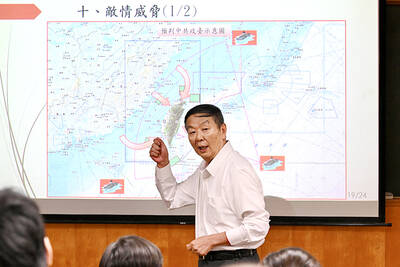
RETHINK? The defense ministry and Navy Command Headquarters could take over the indigenous submarine project and change its production timeline, a source said Admiral Huang Shu-kuang’s (黃曙光) resignation as head of the Indigenous Submarine Program and as a member of the National Security Council could affect the production of submarines, a source said yesterday. Huang in a statement last night said he had decided to resign due to national security concerns while expressing the hope that it would put a stop to political wrangling that only undermines the advancement of the nation’s defense capabilities. Taiwan People’s Party Legislator Vivian Huang (黃珊珊) yesterday said that the admiral, her older brother, felt it was time for him to step down and that he had completed what he

Taiwan has experienced its most significant improvement in the QS World University Rankings by Subject, data provided on Sunday by international higher education analyst Quacquarelli Symonds (QS) showed. Compared with last year’s edition of the rankings, which measure academic excellence and influence, Taiwanese universities made great improvements in the H Index metric, which evaluates research productivity and its impact, with a notable 30 percent increase overall, QS said. Taiwanese universities also made notable progress in the Citations per Paper metric, which measures the impact of research, achieving a 13 percent increase. Taiwanese universities gained 10 percent in Academic Reputation, but declined 18 percent
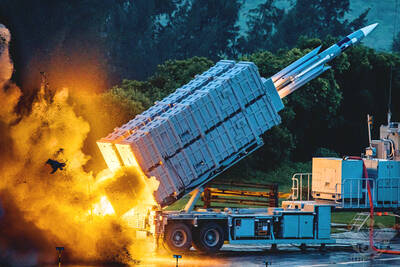
UNDER DISCUSSION: The combatant command would integrate fast attack boat and anti-ship missile groups to defend waters closest to the coastline, a source said The military could establish a new combatant command as early as 2026, which would be tasked with defending Taiwan’s territorial waters 24 nautical miles (44.4km) from the nation’s coastline, a source familiar with the matter said yesterday. The new command, which would fall under the Naval Command Headquarters, would be led by a vice admiral and integrate existing fast attack boat and anti-ship missile groups, along with the Naval Maritime Surveillance and Reconnaissance Command, said the source, who asked to remain anonymous. It could be launched by 2026, but details are being discussed and no final timetable has been announced, the source
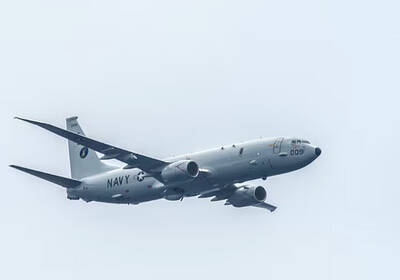
CHINA REACTS: The patrol and reconnaissance plane ‘transited the Taiwan Strait in international airspace,’ the 7th Fleet said, while Taipei said it saw nothing unusual The US 7th Fleet yesterday said that a US Navy P-8A Poseidon flew through the Taiwan Strait, a day after US and Chinese defense heads held their first talks since November 2022 in an effort to reduce regional tensions. The patrol and reconnaissance plane “transited the Taiwan Strait in international airspace,” the 7th Fleet said in a news release. “By operating within the Taiwan Strait in accordance with international law, the United States upholds the navigational rights and freedoms of all nations.” In a separate statement, the Ministry of National Defense said that it monitored nearby waters and airspace as the aircraft


 RSS
RSS