


Secretary of State Condoleezza Rice and her spokesmen were evasive Friday when asked about reports that the US and Japan will announce Saturday that they jointly regard Taiwan as a mutual security concern, a move seen as potentially committing both countries to act in the event of a Chinese attack on Taiwan.
The plan was first revealed in the Friday edition of the Washington Post in a report from Tokyo.
The Post report said that in the most significant change to the US-Japan Security Alliance in a decade, "Japan will join the Bush administration in identifying security in the Taiwan Strait as a `common strategic objective.'"
The decision is scheduled to be announced, the report said, after a meeting in Washington of the two countries' foreign and defense ministers -- ? Rice, Defense Secretary Donald Rumsfeld, Foreign Minister Nobutaka Machimura and Minister of State for Defense Yoshinori Ono.
Rice and Machimura were to hold a half-hour bilateral meeting yesterday morning followed by a meeting of all four officials constituting the US-Japan Security Consultative Committee. It is the first meeting of the consultative organization since Dec. 16, 2002.
Asked Friday about the meeting and the report, Rice said only that the discussion will be about "how we continue to promote peace and security in the region."
"Of course, the cross-straits [sic] issue is an issue of concern in the Asia Pacific," Rice said. "The policy of the US is quite clear. We have a one-China policy we recognize on the basis of the three communiques. We also have responsibilities under the Taiwan Relations Act."
She also said Washington has cautioned both sides against attempts to change the status quo unilaterally.
"And our efforts to maintain stability in the region count very much on American adherence and that of our allies, of which Japan is certainly an ally, that the cross-straits [sic] problem would be resolved peacefully," Rice said, in response to a reporter's question during a press conference with Dutch foreign minister Bernard Bot in the State Department.
She also said that the US and Japan "enjoy very deep and broad relations in an alliance to try and help bring and maintain peace and stability in the Asia Pacific region."
State Department spokesman Richard Boucher said that yesterday's meeting "will have a full and complete discussion of security in the region, as well as US-Japan relations."
"We are not extending the US-Japan Mutual Security Treaty," Boucher insisted. "We're having discussions within the scope of that treaty about areas in the region ... and more generally in terms of our interests there."
In terms of individual issues, Boucher said "Taiwan Straits [sic], perhaps, will come up." Pressed about what Japan may do, Boucher retorted, "as far as issues of what exact role they play depends on the Japanese government, and they'll have to answer those."
The Washington Post report quotes Japanese officials as noting that the country's constitution limits the level of assistance that Japan could offer in the event of a US confrontation with China over Taiwan.
However, it says yesterday's joint statement "could help lay the groundwork for the Japanese to extend as much cooperation as they legally can, including logistical support such as transportation and medical rescue operations behind the lines of combat."
It also quotes Shinzo Abe, the acting secretary general of Japan's ruling Liberal Democratic Party as saying, "It would be wrong for us to send a signal to China that the US and Japan will watch and tolerate China's military invasion of Taiwan."
"If the situation surrounding Japan threatens our security, Japan can provide US forces with support," Abe was quoted as saying.
The US-Japan meeting comes as Tokyo is reconsidering its defense posture and the use of its self-defense forces, and as Washington is rethinking its force posture in East Asia to put more reliance on such allies as Japan.
This week, the Japanese Cabinet approved and sent to the Diet a bill to ease the rules for using missile defense against incoming ballistic missiles.
Such a defense would employ warships equipped with the Aegis missile interception system and PAC 3 surface-to-air missiles.
While Taiwan's Legislative Yuan is still dealing with whether to approve funds for a massive US arms sales deal including the PAC 3's, Washington has refused to sell the Aegis-equipped warships to Taiwan in deference to China's objections.
Under current law, Japan cannot send its Aegis vessels to the Taiwan Strait area to come to Taiwan's defense, but Tokyo has been involved in an internal debate in recent years over whether or not to relax that restriction.
Also see stories:
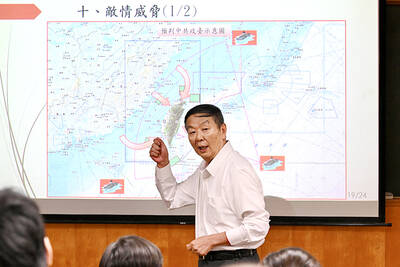
RETHINK? The defense ministry and Navy Command Headquarters could take over the indigenous submarine project and change its production timeline, a source said Admiral Huang Shu-kuang’s (黃曙光) resignation as head of the Indigenous Submarine Program and as a member of the National Security Council could affect the production of submarines, a source said yesterday. Huang in a statement last night said he had decided to resign due to national security concerns while expressing the hope that it would put a stop to political wrangling that only undermines the advancement of the nation’s defense capabilities. Taiwan People’s Party Legislator Vivian Huang (黃珊珊) yesterday said that the admiral, her older brother, felt it was time for him to step down and that he had completed what he
Taiwan has experienced its most significant improvement in the QS World University Rankings by Subject, data provided on Sunday by international higher education analyst Quacquarelli Symonds (QS) showed. Compared with last year’s edition of the rankings, which measure academic excellence and influence, Taiwanese universities made great improvements in the H Index metric, which evaluates research productivity and its impact, with a notable 30 percent increase overall, QS said. Taiwanese universities also made notable progress in the Citations per Paper metric, which measures the impact of research, achieving a 13 percent increase. Taiwanese universities gained 10 percent in Academic Reputation, but declined 18 percent
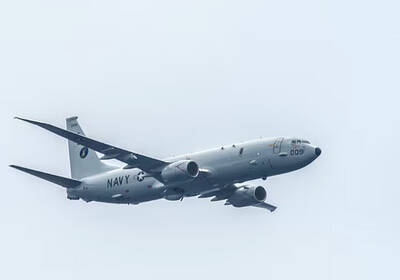
CHINA REACTS: The patrol and reconnaissance plane ‘transited the Taiwan Strait in international airspace,’ the 7th Fleet said, while Taipei said it saw nothing unusual The US 7th Fleet yesterday said that a US Navy P-8A Poseidon flew through the Taiwan Strait, a day after US and Chinese defense heads held their first talks since November 2022 in an effort to reduce regional tensions. The patrol and reconnaissance plane “transited the Taiwan Strait in international airspace,” the 7th Fleet said in a news release. “By operating within the Taiwan Strait in accordance with international law, the United States upholds the navigational rights and freedoms of all nations.” In a separate statement, the Ministry of National Defense said that it monitored nearby waters and airspace as the aircraft
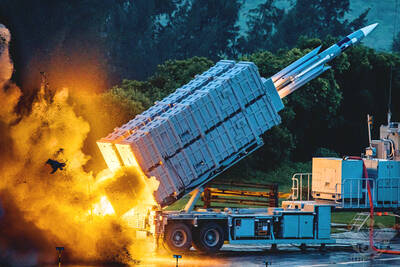
UNDER DISCUSSION: The combatant command would integrate fast attack boat and anti-ship missile groups to defend waters closest to the coastline, a source said The military could establish a new combatant command as early as 2026, which would be tasked with defending Taiwan’s territorial waters 24 nautical miles (44.4km) from the nation’s coastline, a source familiar with the matter said yesterday. The new command, which would fall under the Naval Command Headquarters, would be led by a vice admiral and integrate existing fast attack boat and anti-ship missile groups, along with the Naval Maritime Surveillance and Reconnaissance Command, said the source, who asked to remain anonymous. It could be launched by 2026, but details are being discussed and no final timetable has been announced, the source


 RSS
RSS