


Credited with facilitating dialogue with China despite the cross-strait impasse, top negotiator Koo Chen-fu (辜振甫) managed in death to bring the two sides together again publically, if only with a brief handshake after his memorial service had ended.
President Chen Shui-bian (陳水扁) did not meet the Chinese delegation yesterday, though he did invite their superior to visit Taiwan. The envoys waited until the memorial service had concluded before arriving to offer their condolences to the Koo family in private.
Acting Straits Exchange Foundation (SEF) Chairman and Mainland Affairs Council (MAC) Vice Chairman Johnnason Liu (劉德勳) and SEF Deputy Secretary-General Jan Jyh-horng (詹志宏) shook hands with Association for Relations Across the Taiwan Strait (ARATS) vice chairman and deputy director of China's Taiwan Affairs Office Sun Yafu (孫亞夫) and ARATS secretary-general Li Yafei (李亞飛) as they were ushered past reporters into the Sun Yat-sen Memorial Hall through a side door.
"These few years, I've felt more and more acutely that the development of cross-strait ties, the maintenance of peace across the Taiwan Strait depends on effort from both sides," Sun later told the press before departing for Beijing yesterday afternoon.
"We watched the memorial service on television, and we remembered Koo's life together with the people of Taiwan. We felt the respect the public had for Koo and his contributions to cross-strait affairs," he said.
Li added that ARATS and the SEF should resume their relationship on the basis of the "1992 consensus" soon. The so-called "1992 consensus" remains a point of considerable disagreement between Taiwan and China.
The memorial service seemed particularly somber given the light drizzle, cold weather and the droves of mourners dressed in black, but Chen did aim for a conciliatory tone.
During his address, Chen formally invited Koo's Chinese counterpart, ARATS chairman Wang Daohan (
"If we can shelve our differences and work to achieve consensus, to actively seek reconciliation, dialogue and negotiations and to increase mutual trust, then we will be able to increase agreements and lessen disagreements," Chen said.
Koo was chairman of the semi-official Straits Exchange Foundation (SEF) before he died last month from kidney cancer. Koo and Wang held the landmark "Koo-Wang Talks" in 1993 and later in 1998.
Unable to attend the memorial in person, Wang sent Sun and Li as his personal envoys.
Pressed by reporters, MAC Vice Chairman and spokesman Chiu Tai-san (
The last time SEF and ARATS officials made contact was six years ago, when a meeting was convened to discuss plans for Wang to visit Taiwan, a visit that has yet to take place.
Chiu said Liu had relayed the invitation for Wang to Sun and Li. He said that both sides had expressed goodwill and that he felt Sun and Li had found their trip to be satisfactory. He also said Liu told the delegation that if Wang, 90, wanted to visit Taiwan, then the government would be willing to arrange for a private jet and medical personnel to assist him.
In response to Chen's invitation, Sun told reporters he would "relay everything I have seen, heard, and felt in Taiwan to Wang" when he returned to China.
"I trust that Sun and Li's trip to Taiwan will have a positive impact on cross-strait ties in the future," Chiu said.
At the service, Chen spoke on the cross-strait stalemate and said Taiwan harbored goodwill towards China.
"Koo once said that the hardest part of a performance is the final scene, when you turn to leave the stage, those last few steps before exiting. Your departing appearance must be beautiful and graceful," Chen said.
"The cross-strait impasse is very much like a performance -- it has to come to an end at some point. Leaders on both sides of the Strait must use wisdom and creativity to solve cross-strait difficulties," he said.
MAC Chairman Joseph Wu (吳釗燮) said upon leaving the memorial service yesterday that the Chinese delegation's visit to Taiwan was "a good thing" but cautioned that there was much to do.
"Although there are signs of improved ties right now, there is still room for improvement on the military and diplomatic fronts," he said.
Also in attendance yesterday were Chinese Nationalist Party (KMT) Chairman Lien Chan (連戰), who delivered an address, People First Party (PFP) Chairman James Soong (宋楚瑜), Democratic Progressive Party Chairman Su Tseng-chang (蘇貞昌), Presidential Office Secretary-General Yu Shyi-kun, Vice President Annette Lu (呂秀蓮), Premier Frank Hsieh (謝長廷) and American Institute in Taiwan Director Douglas Paal.
Also see story:
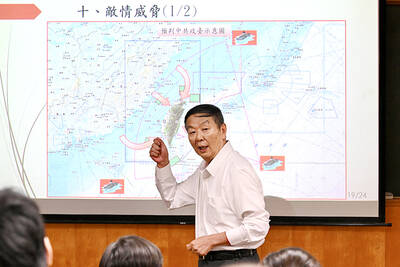
RETHINK? The defense ministry and Navy Command Headquarters could take over the indigenous submarine project and change its production timeline, a source said Admiral Huang Shu-kuang’s (黃曙光) resignation as head of the Indigenous Submarine Program and as a member of the National Security Council could affect the production of submarines, a source said yesterday. Huang in a statement last night said he had decided to resign due to national security concerns while expressing the hope that it would put a stop to political wrangling that only undermines the advancement of the nation’s defense capabilities. Taiwan People’s Party Legislator Vivian Huang (黃珊珊) yesterday said that the admiral, her older brother, felt it was time for him to step down and that he had completed what he
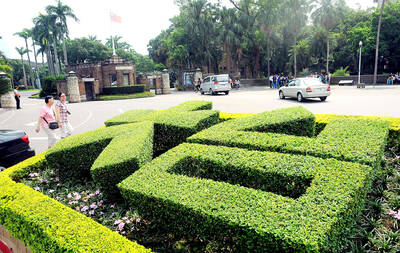
Taiwan has experienced its most significant improvement in the QS World University Rankings by Subject, data provided on Sunday by international higher education analyst Quacquarelli Symonds (QS) showed. Compared with last year’s edition of the rankings, which measure academic excellence and influence, Taiwanese universities made great improvements in the H Index metric, which evaluates research productivity and its impact, with a notable 30 percent increase overall, QS said. Taiwanese universities also made notable progress in the Citations per Paper metric, which measures the impact of research, achieving a 13 percent increase. Taiwanese universities gained 10 percent in Academic Reputation, but declined 18 percent
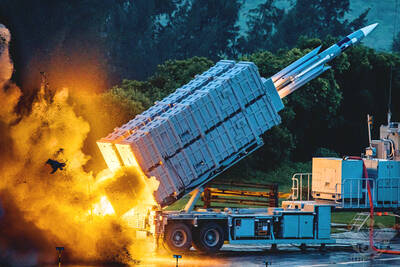
UNDER DISCUSSION: The combatant command would integrate fast attack boat and anti-ship missile groups to defend waters closest to the coastline, a source said The military could establish a new combatant command as early as 2026, which would be tasked with defending Taiwan’s territorial waters 24 nautical miles (44.4km) from the nation’s coastline, a source familiar with the matter said yesterday. The new command, which would fall under the Naval Command Headquarters, would be led by a vice admiral and integrate existing fast attack boat and anti-ship missile groups, along with the Naval Maritime Surveillance and Reconnaissance Command, said the source, who asked to remain anonymous. It could be launched by 2026, but details are being discussed and no final timetable has been announced, the source
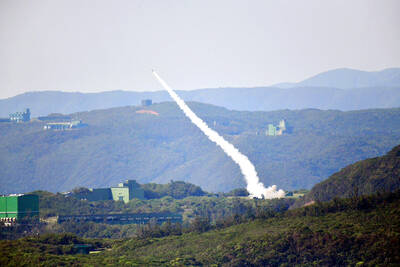
SHOT IN THE ARM: The new system can be integrated with Avenger and Stinger missiles to bolster regional air defense capabilities, a defense ministry report said Domestically developed Land Sword II (陸射劍二) missiles were successfully launched and hit target drones during a live-fire exercise at the Jiupeng Military Base in Pingtung County yesterday. The missiles, developed by the Chungshan Institute of Science and Technology (CSIST), were originally scheduled to launch on Tuesday last week, after the Tomb Sweeping Day holiday long weekend, but were postponed to yesterday due to weather conditions. Local residents and military enthusiasts gathered outside the base to watch the missile tests, with the first one launching at 9:10am. The Land Sword II system, which is derived from the Sky Sword II (天劍二) series, was turned


 RSS
RSS