


The world's nations -- united in shock over the Indian Ocean tsunami -- agreed yesterday to work together to better guard against natural disasters, with steps ranging from stronger building codes to expanded monitoring of nature's upheavals.
In a first concrete step, four weeks after an earthquake and tsunami killed more than 200,000 people in 11 nations, the World Conference on Disaster Reduction laid groundwork for the Indian Ocean's first tsunami early-warning system, expected to be in place next year.
The five-day, 168-nation UN conference concluded -- after dozens of workshops and a final night of closed-door negotiations -- by adopting a "framework for action" to reduce disaster losses in the next 10 years.
This is "one of the most critical challenges" facing the world, a final declaration said, because cyclones, floods, earthquakes and other events set back human progress, especially in poor nations.
Some were disappointed that conference documents were nonbinding, committed no new money to risk reduction, and set no hard targets for assessing progress.
Japan, for example, had proposed setting a goal of cutting water-related disaster deaths in half by 2015, but the US delegation and others opposed such ideas.
The International Red Cross said it would continue to advocate firm targets and more aid for poor countries' disaster readiness.
"The international community has 2005 to make concrete its promises," said the relief agency's Eva von Oelreich.
The chief UN official here, Jan Egeland, said he believed the 10-year action plan could halve disaster casualties by 2015.
The conference in Kobe brought together 4,000 diplomats, development specialists, scientists, economists, aid workers and others to try channeling experience and resources into building better human defenses against the worst of nature.
Each day delegates could see the need -- in the latest news footage from coastlines ravaged by the giant waves spawned by the Dec. 26 earthquake near Indonesia's Sumatra island.
"It heightened our awareness of the importance of stepping up our joint efforts," said Marco Ferrari of Switzerland, drafting committee chairman for the conference.
In sideline meetings, richer nations pledged at least US$8 million toward the estimated US$30 million cost of an Indian Ocean tsunami early-warning network, like the one long in place in the Pacific. With UN coordination, they hope to deploy the alert system by mid-next year.
In the past 10 years, natural disasters have killed almost 700,000 people, affected more than 2.5 billion people and cost an estimated US$690 billion in losses, according to Belgium's university-based Center for Research on the Epidemiology of Disasters.
The 24-page action plan urges states and international organizations to consider and "implement as appropriate" a lengthy series of steps to reduce vulnerability and guard against natural hazards.
They range from establishing national disaster agencies, developing risk maps, and collecting better statistics on disaster impact, to building disaster-resistant hospitals and schools.
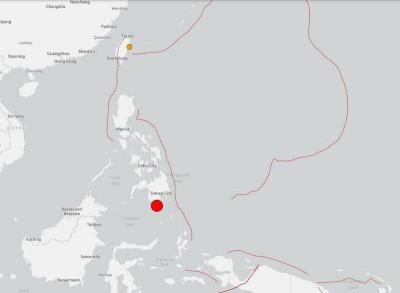
A magnitude 7.8 earthquake struck off the southern coast of Mindanao in the Philippines at 7:38am today, prompting the US Tsunami Warning System to issue an alert for neighboring countries, including Taiwan. The system issued a purple alert indicating a "tsunami threat." The potential threat zone includes Taiwan, the Philippines, Papua New Guinea, Yap and Palau. Philippine authorities were assessing the damage from the quake, with the office of civil defense seeking to verifying initial reports that 15 people had been killed and 129 injured in the region, mostly from falling debris. Arlene Hollero, disaster chief of Maasim town in the Philippines' Sarangani Province,
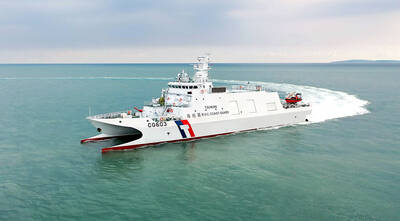
‘GRAY ZONE’ PRESSURE: Beijing’s activities are intended to create the deceitful impression that China has jurisdiction over the area around Taiwan, the CGA said Taiwan’s rights over its territorial waters and exclusive economic zone must not be violated by any country, the Mainland Affairs Council said yesterday, adding that it will not accept any unprovoked actions. The council issued the remarks in response to the China Coast Guard conducting maritime enforcement drills near eastern Taiwan and claiming to fully exercise China’s maritime administrative law enforcement authority. The Coast Guard Administration (CGA) has been closely monitoring the situation and is taking concrete steps to defend the nation’s sovereignty and secure its waters, the council said. China has no sovereign rights over the waters off eastern

RESILIENCE: Taiwan plays a key role in semiconductors, energy, information infrastructure and advanced manufacturing, AIT Director Raymond Greene said Taiwan’s continued investment in deterrence and resilience remains vital, especially in uncrewed systems and other emerging technologies, American Institute in Taiwan (AIT) Director Raymond Greene said yesterday. Greene made the remarks at the annual National Strategic Summit on Supply Chain Resilience held by the Research Institute for Democracy, Society and Emerging Technology (DSET), a government-backed think tank. As Taiwan last year became the US’ fourth-largest trading partner and supply chain security is becoming more important, cooperation in emerging technologies continues to deepen between the two countries, he said. The US is committed to accelerating innovation, building key infrastructure, strengthening cooperation

RIGHT DIRECTION: Taiwan’s efforts to prevent forced labor include a proposal to ‘fully prohibit’ employers from withholding workers’ documents, an official said Taiwan is to establish a mechanism to restrict imports of goods linked to forced labor, the Executive Yuan said yesterday, after the US proposed imposing additional tariffs on Taiwanese goods over labor concerns. “The Ministry of Labor and the Ministry of Economic Affairs are to establish an interministerial review procedure,” Executive Yuan spokesperson Michelle Lee (李慧芝) said at a news briefing in Taipei. “The government is to use the Foreign Trade Act [貿易法] as the legal basis to restrict imports of goods produced with forced labor” and bring its supply chain governance more in line with international standards on human rights, resilience


 RSS
RSS