


With speculation mounting on the makeup of the next Cabinet, President Chen Shui-bian (
Presidential Office spokesman Chen Wen-tsung (陳文宗) confirmed Lee was at the Presidential Office yesterday, on Chen's invitation. The three-hour lunch meeting was private.
The meeting, like Chen's meeting with Kaohsiung Mayor Frank Hsieh (謝長廷), Vice President Annette Lu (呂秀蓮) and Presidential Office Secretary-General Su Tseng-chang (蘇貞昌) on Monday, ignited media attention because of the expected vacancy in the premier's post. Premier Yu Shyi-kun and all Cabinet members will resign in a customary post-election ritual after the current legislative session concludes on Jan. 21.
Rumors have circulated for the last couple of weeks about the possibility of Chen Shui-bian forming a coalition Cabinet with one or more opposition parties. Senior government officials, however, including Yu himself, have been tight-lipped about the pending reshuffle.
Chen Wen-tsung yesterday said nothing relating to the premier's post nor personnel issues were discussed during the president's meeting with Lee.
It remains unclear if Lee, the spiritual leader of the Taiwan Solidarity Union (TSU), the Democratic Progressive Party's political ally, has made any recommendations on the makeup of the new Cabinet.
Chen Wen-tsung said that during the meeting Lee talked about his just-completed trip to Japan.
Lee returned on Sunday from a seven-day "sightseeing trip" to Japan. He told a crowd of well-wishers upon arrival at CKS In-ternational Airport that Taiwan-Japanese relations had been advancing quietly and that bilateral ties were now in the best shape since the two countries severed formal diplomatic relations in 1972.
Chen also exchanged views with Lee on the domestic political situation and on how to improve coordination with the opposition camp, Chen Wen-tsung said.
In his New Year's address, the president had highlighted reconciliation, consultation and dialogue between the ruling and the opposition parties as important goals.
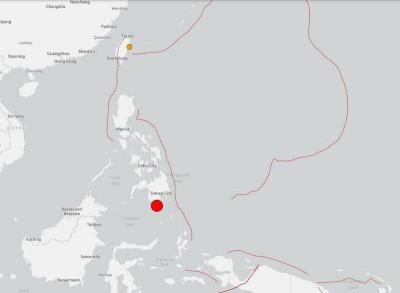
A magnitude 7.8 earthquake struck off the southern coast of Mindanao in the Philippines at 7:38am today, prompting the US Tsunami Warning System to issue an alert for neighboring countries, including Taiwan. The system issued a purple alert indicating a "tsunami threat." The potential threat zone includes Taiwan, the Philippines, Papua New Guinea, Yap and Palau. Philippine authorities were assessing the damage from the quake, with the office of civil defense seeking to verifying initial reports that 15 people had been killed and 129 injured in the region, mostly from falling debris. Arlene Hollero, disaster chief of Maasim town in the Philippines' Sarangani Province,
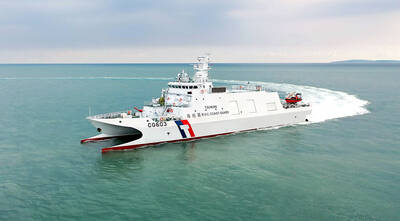
‘GRAY ZONE’ PRESSURE: Beijing’s activities are intended to create the deceitful impression that China has jurisdiction over the area around Taiwan, the CGA said Taiwan’s rights over its territorial waters and exclusive economic zone must not be violated by any country, the Mainland Affairs Council said yesterday, adding that it will not accept any unprovoked actions. The council issued the remarks in response to the China Coast Guard conducting maritime enforcement drills near eastern Taiwan and claiming to fully exercise China’s maritime administrative law enforcement authority. The Coast Guard Administration (CGA) has been closely monitoring the situation and is taking concrete steps to defend the nation’s sovereignty and secure its waters, the council said. China has no sovereign rights over the waters off eastern

RESILIENCE: Taiwan plays a key role in semiconductors, energy, information infrastructure and advanced manufacturing, AIT Director Raymond Greene said Taiwan’s continued investment in deterrence and resilience remains vital, especially in uncrewed systems and other emerging technologies, American Institute in Taiwan (AIT) Director Raymond Greene said yesterday. Greene made the remarks at the annual National Strategic Summit on Supply Chain Resilience held by the Research Institute for Democracy, Society and Emerging Technology (DSET), a government-backed think tank. As Taiwan last year became the US’ fourth-largest trading partner and supply chain security is becoming more important, cooperation in emerging technologies continues to deepen between the two countries, he said. The US is committed to accelerating innovation, building key infrastructure, strengthening cooperation

RIGHT DIRECTION: Taiwan’s efforts to prevent forced labor include a proposal to ‘fully prohibit’ employers from withholding workers’ documents, an official said Taiwan is to establish a mechanism to restrict imports of goods linked to forced labor, the Executive Yuan said yesterday, after the US proposed imposing additional tariffs on Taiwanese goods over labor concerns. “The Ministry of Labor and the Ministry of Economic Affairs are to establish an interministerial review procedure,” Executive Yuan spokesperson Michelle Lee (李慧芝) said at a news briefing in Taipei. “The government is to use the Foreign Trade Act [貿易法] as the legal basis to restrict imports of goods produced with forced labor” and bring its supply chain governance more in line with international standards on human rights, resilience


 RSS
RSS