


International Business Machines, whose first IBM PC in 1981 moved personal computing out of the hobby shop and into the corporate and consumer mainstream, has put the business up for sale, people close to the deal said Thursday.
While IBM long ago ceded the lead in the personal computer market to Dell and Hewlett-Packard so it could focus instead on the more lucrative corporate server and computer services business, a sale would nonetheless mark the end of an era in an industry that it helped invent. The sale would include the entire range of desktop, laptop and notebook computers made by IBM.
The retreat from the business may be the ultimate acknowledgement that the personal computer has become a staple of everyday life, a commodity product, yielding very slim profits. The companies that make the most money from PCs these days are Microsoft and Intel -- whose software and chips are the standard for most of the personal computers sold, regardless of the maker.
Indeed, in the 23 years since IBM lent its prowess in mainframe computers to the production of desktop machines, it has been widely criticized for having destined the machines to commodity status by giving Microsoft and Intel rights to those standards. And although Apple Computer holds only about 2 percent of the computing market, it has been able to command relatively high prices and richer profits because it has controlled the software and hardware that goes into its machines.
According to the executives, IBM is in serious negotiations with Lenovo, China's largest maker of personal computers, and at least one other potential buyer for the unit. Lenovo was formerly known as Legend.
A spokesman for IBM, Edward Barbini, said Thursday night, "IBM has a policy of not confirming or denying rumors."
A sale of the personal computer business would be a step away from IBM's traditional emphasis on the size of its revenues as a measure of its corporate clout. The PC business represents about 12 percent of IBM's annual revenue of US$92 billion.
For nearly a decade, though, some industry analysts have urged IBM to get out of the personal computer business as it made only a modest profit or lost money. For this year, analysts have expected a pretax profit of less than US$100 million. IBM executives long resisted that course, arguing that personal computers were one of the technology products its corporate customers wanted. IBM held onto the business on the theory that it helped IBM hold on to customers.
But in the most recent quarter, IBM ranked a distant third in worldwide PC sales, with 5.6 percent of the market, according to Gartner, the market research firm. Dell was the leader with 16.8 percent of the world market and Hewlett-Packard had 15 percent.
A sale now, if it were to happen, would be consistent with the strategy pursued by Samuel J. Palmisano, who became IBM's chief executive in early 2002. He has sold off hardware businesses where profits were slender and growth prospects were limited, like its hard-disk drive business, which was sold to Hitachi.
Instead, Palmisano has bet on expanding the company's services business, automating a full array of operations -- from product design to sales order processing -- for corporate customers. IBM now casts itself as a company that not simply sells technology but serves as a consulting partner to help its customers use technology to increase the efficiency and competitiveness of their businesses. As part of that strategy, IBM bought PricewaterhouseCoopers Consulting for US$3.5 billion, in a deal that closed in Oct. 2002.
"Palmisano's getting out of businesses that aren't growth opportunities and concentrating on what IBM does best," said Mark Stahlman, an analyst at Carris & Co. "PCs are not where the growth is."
To trim costs, IBM has steadily retreated from the actual manufacture of its PCs. In January 2002, the company sold its desktop PC manu-facturing operations in the US and Europe to Sanmina-SCI. IBM now confines its role in PCs to design and product development out of its offices in Raleigh, North Carolina, with all of its IBM-branded desktop or notebook computers made by contract manufacturers around the world.
Leslie Fiering, a research vice president at Gartner, has predicted consolidation in the PC industry over the next few years.
"Exiting the market may be the only logical choice for global vendors bleeding profits and struggling for share," she wrote in a recent research report. And she noted that Hewlett-Packard, a broad-based technology company for which PCs are only a portion of a much larger business, might face pressures similar to IBM's.
"The PC divisions of HP and IBM are vulnerable to being spun off if their drag on margins and profitability are deemed too great by their parent companies," she wrote.
Meanwhile, she noted, Asian vendors like Lenovo "appear well positioned to leverage their strong local-market standing and low-cost operating models into a global presence."
If IBM's personal computer business ends up being sold to Lenovo, it would continue the migration of high-technology manufacturing to China and Taiwan. In the semiconductor industry, Intel and IBM still have big factories in the US, and AMD has a leading-edge plant in Germany.
But more and more chip-making is done in the contract factories, like Taiwan Semiconductor Manufacturing Co., and new foundries sprouting up in China.
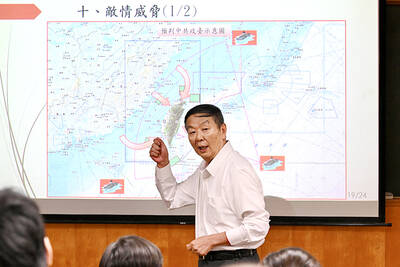
RETHINK? The defense ministry and Navy Command Headquarters could take over the indigenous submarine project and change its production timeline, a source said Admiral Huang Shu-kuang’s (黃曙光) resignation as head of the Indigenous Submarine Program and as a member of the National Security Council could affect the production of submarines, a source said yesterday. Huang in a statement last night said he had decided to resign due to national security concerns while expressing the hope that it would put a stop to political wrangling that only undermines the advancement of the nation’s defense capabilities. Taiwan People’s Party Legislator Vivian Huang (黃珊珊) yesterday said that the admiral, her older brother, felt it was time for him to step down and that he had completed what he
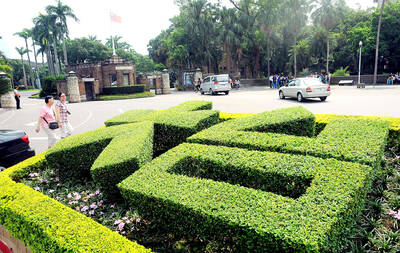
Taiwan has experienced its most significant improvement in the QS World University Rankings by Subject, data provided on Sunday by international higher education analyst Quacquarelli Symonds (QS) showed. Compared with last year’s edition of the rankings, which measure academic excellence and influence, Taiwanese universities made great improvements in the H Index metric, which evaluates research productivity and its impact, with a notable 30 percent increase overall, QS said. Taiwanese universities also made notable progress in the Citations per Paper metric, which measures the impact of research, achieving a 13 percent increase. Taiwanese universities gained 10 percent in Academic Reputation, but declined 18 percent
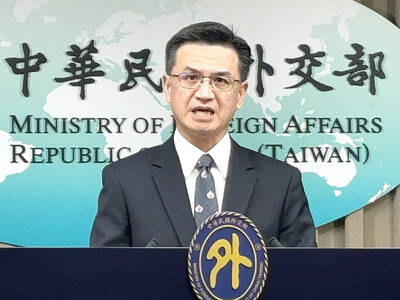
BULLY TACTICS: Beijing has continued its incursions into Taiwan’s airspace even as Xi Jinping talked about Taiwan being part of the Chinese family and nation China should stop its coercion of Taiwan and respect mainstream public opinion in Taiwan about sovereignty if its expression of goodwill is genuine, the Ministry of Foreign Affairs (MOFA) said yesterday. Ministry spokesman Jeff Liu (劉永健) made the comment in response to media queries about a meeting between former president Ma Ying-jeou (馬英九) and Chinese President Xi Jinping (習近平) the previous day. Ma voiced support for the so-called “1992 consensus,” while Xi said that although the two sides of the Taiwan Strait have “different systems,” this does not change the fact that they are “part of the same country,” and that “external
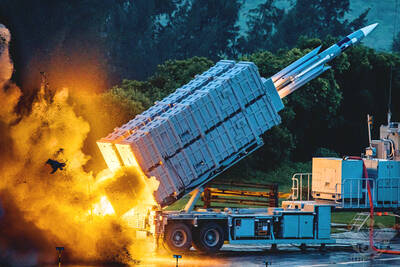
UNDER DISCUSSION: The combatant command would integrate fast attack boat and anti-ship missile groups to defend waters closest to the coastline, a source said The military could establish a new combatant command as early as 2026, which would be tasked with defending Taiwan’s territorial waters 24 nautical miles (44.4km) from the nation’s coastline, a source familiar with the matter said yesterday. The new command, which would fall under the Naval Command Headquarters, would be led by a vice admiral and integrate existing fast attack boat and anti-ship missile groups, along with the Naval Maritime Surveillance and Reconnaissance Command, said the source, who asked to remain anonymous. It could be launched by 2026, but details are being discussed and no final timetable has been announced, the source


 RSS
RSS