


Signaling a major breakthrough in strained US-Taiwan trade relations, the US Trade Representative's (USTR) office could remove Taiwan from its Special 301 "priority watch list" of intellectual property rights violators as early as next week, the Taipei Times has learned.
A decision could be announced next Thursday, a US trade official said in an exclusive interview.
This comes as a senior Taiwanese delegation, headed by Vice Minister of Economic Affairs Steve Chen (陳瑞隆), wound up two days of intensive negotiations in Washington under the Trade and Investment Framework Agreement (TIFA) between the two countries. The session got the TIFA talks on track after a six-year lapse.
Aggressive Taiwanese legislative and executive actions over the past year appears to have settled most of the major trade issues disturbing trade relations between the two sides, according to assessments of the Washington discussions by officials from Taiwan and the US.
The "primary remaining issue" relates to the protection of pharmaceutical patents in Taiwan, according to the US official.
But Chen pointed out that Taiwan has drafted an amendment to its pharmaceutical law to provide exclusivity of patent data, which would provide five years' protection for new chemical entities and three years' protection for other entities.
"This amendment is still in the Legislative Yuan and we will try our best to push it through," Chen told the Taipei Times.
The US official said there are "still some shoes that have to drop" in the pharmaceutical area, but added that Washington is "comfortable" that Taiwan is "taking the steps that have to be taken."
While the US considers the pharmaceutical issue to be part of the intellectual property rights issue, Washington is happy with Taiwan's actions over the past year in dealing with other piracy issues that got Taiwan placed on the Special 301 priority watch list some four years ago.
On IPR, Chen noted that in September Taiwan amended the Copyright Law (
"We are genuinely impressed with the efforts of the Taiwan[ese] government," the US trade official said.
"There is no getting around that Taiwan has done a tremendous amount of IPR in the past year or so. The efforts are paying dividends. We do recognize that," he said.
Significantly, some US industry groups that have long complained about piracy of copyrighted material are now "asking that Taiwan be removed from the priority watch list," the US official said.
"They have said that Taiwan has done a good job in different areas," he said.
Such recommendations are likely to play a big role as the USTR office makes its final decision on the Special 301 list.
The USTR in October issued a notice in the official Federal Register asking for comments on Taiwan's IPR performance, and the comments were returned by the beginning of last month.
The USTR has been studying the comments ever since while deciding on their action.
As a result of the comments and what the US officials heard during this week's two days of TIFA talks, the US trade agency will consult with the industries that had earlier complained about Taiwan's performance, and then make its decision.
"We'll say, `Here's what Taiwan is saying in response to your concerns. Does this allay your fears or not?'" the US official said.
But he indicated that the decision is likely to be favorable to Taiwan.
The USTR will announce its decision "within the next couple of weeks," and could do so as early as next Thursday, the US official said.
The TIFA talks have apparently come close to settling two other areas that have strained US-Taiwan trade relations, Chen said.
Those are telecommunications and agricultural -- mainly rice -- imports.
On telecommunications, the US has urged Taiwan to set up an independent regulatory agency.
In response, Chen noted, Taiwan has drawn up plans for a National Communications Commission that will be set up as soon as the Legislative Yuan passes a law providing a legal basis for the agency.
"We will try to push the passage of this law as soon as possible," Chen said.
On rice imports, Taiwan has "agreed in principle with the idea of adopting a country quota system for some of the rice imported into Taiwan," Chen told the Taipei Times.
"That is something the US would like to see. Since we agree, this is not an issue any more," Chen said.
Meanwhile, the US official expressed hope that the next TIFA talks will be held by next summer in Taiwan.
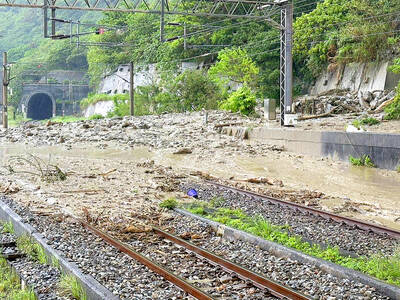
ROLLER-COASTER RIDE: More than five earthquakes ranging from magnitude 4.4 to 5.5 on the Richter scale shook eastern Taiwan in rapid succession yesterday afternoon Back-to-back weather fronts are forecast to hit Taiwan this week, resulting in rain across the nation in the coming days, the Central Weather Administration said yesterday, as it also warned residents in mountainous regions to be wary of landslides and rockfalls. As the first front approached, sporadic rainfall began in central and northern parts of Taiwan yesterday, the agency said, adding that rain is forecast to intensify in those regions today, while brief showers would also affect other parts of the nation. A second weather system is forecast to arrive on Thursday, bringing additional rain to the whole nation until Sunday, it

CONDITIONAL: The PRC imposes secret requirements that the funding it provides cannot be spent in states with diplomatic relations with Taiwan, Emma Reilly said China has been bribing UN officials to obtain “special benefits” and to block funding from countries that have diplomatic ties with Taiwan, a former UN employee told the British House of Commons on Tuesday. At a House of Commons Foreign Affairs Committee hearing into “international relations within the multilateral system,” former Office of the UN High Commissioner for Human Rights (OHCHR) employee Emma Reilly said in a written statement that “Beijing paid bribes to the two successive Presidents of the [UN] General Assembly” during the two-year negotiation of the Sustainable Development Goals. Another way China exercises influence within the UN Secretariat is

LANDSLIDES POSSIBLE: The agency advised the public to avoid visiting mountainous regions due to more expected aftershocks and rainfall from a series of weather fronts A series of earthquakes over the past few days were likely aftershocks of the April 3 earthquake in Hualien County, with further aftershocks to be expected for up to a year, the Central Weather Administration (CWA) said yesterday. Based on the nation’s experience after the quake on Sept. 21, 1999, more aftershocks are possible over the next six months to a year, the agency said. A total of 103 earthquakes of magnitude 4 on the local magnitude scale or higher hit Hualien County from 5:08pm on Monday to 10:27am yesterday, with 27 of them exceeding magnitude 5. They included two, of magnitude

Taiwan’s first drag queen to compete on the internationally acclaimed RuPaul’s Drag Race, Nymphia Wind (妮妃雅), was on Friday crowned the “Next Drag Superstar.” Dressed in a sparkling banana dress, Nymphia Wind swept onto the stage for the final, and stole the show. “Taiwan this is for you,” she said right after show host RuPaul announced her as the winner. “To those who feel like they don’t belong, just remember to live fearlessly and to live their truth,” she said on stage. One of the frontrunners for the past 15 episodes, the 28-year-old breezed through to the final after weeks of showcasing her unique


 RSS
RSS