


Arms hunter Charles Duelfer's report, in concluding Iraq might have resumed weapons-building "after sanctions were removed," left out the crucial fact that the UN Security Council had planned controls over Baghdad for years to come, UN officials say.
The council, led by the US, had decreed that inspections and disarmament of Iraq were to be followed by tough, open-ended monitoring.
"It's been a little disturbing," said Demetrius Perricos, chief UN weapons inspector. "All the arguments say that when sanctions ended, Saddam Hussein would have had a free hand. By the council's own resolutions that wasn't so."
In his Oct. 6 report, CIA adviser Duelfer discredited US President George W. Bush's stated rationale for invading Iraq, saying his Iraq Survey Group found no weapons of mass destruction there. But he suggested Iraq might still have posed a threat.
Saddam "wanted to recreate Iraq's WMD capability -- which was essentially destroyed in 1991 -- after sanctions were removed," the report said, though adding that no such formal plan was uncovered.
This Duelfer finding became a new focus for the Bush administration. Vice President Dick Cheney said on Oct. 7, "As soon as the sanctions were lifted, [Saddam] had every intention of going back" to weapons-building.
An academic expert on the Iraq inspections regime was among those disputing this, noting that lifting the UN embargo would not have opened that door. "This is not the case under Resolution 687 and later ones," said Yale University's James Sutterlin.
Years of Security Council resolutions preceding last year's US-British invasion mandated that UN arms monitors would remain in Iraq once Baghdad's WMD programs were shut down -- as Duelfer now acknowledges they were in the 1990s. With unusual powers and the best technology, the monitors in this second stage would "prevent Iraq from developing new capabilities," said a blueprint for the Ongoing Monitoring and Verification program.
Resolutions also stipulated that UN trade sanctions would not be lifted until the monitoring program was in place, and lifted then only for civilian goods.
The Security Council, where Washington has a veto, would decide how long to keep monitoring in place. Perricos said it was expected to last years. "You couldn't have disarmament and stop monitoring afterward," he said.
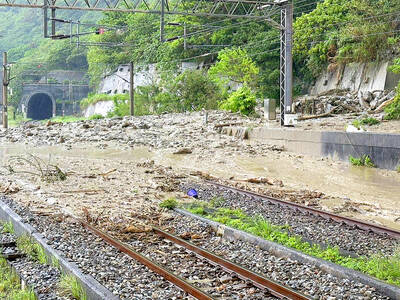
ROLLER-COASTER RIDE: More than five earthquakes ranging from magnitude 4.4 to 5.5 on the Richter scale shook eastern Taiwan in rapid succession yesterday afternoon Back-to-back weather fronts are forecast to hit Taiwan this week, resulting in rain across the nation in the coming days, the Central Weather Administration said yesterday, as it also warned residents in mountainous regions to be wary of landslides and rockfalls. As the first front approached, sporadic rainfall began in central and northern parts of Taiwan yesterday, the agency said, adding that rain is forecast to intensify in those regions today, while brief showers would also affect other parts of the nation. A second weather system is forecast to arrive on Thursday, bringing additional rain to the whole nation until Sunday, it

CONDITIONAL: The PRC imposes secret requirements that the funding it provides cannot be spent in states with diplomatic relations with Taiwan, Emma Reilly said China has been bribing UN officials to obtain “special benefits” and to block funding from countries that have diplomatic ties with Taiwan, a former UN employee told the British House of Commons on Tuesday. At a House of Commons Foreign Affairs Committee hearing into “international relations within the multilateral system,” former Office of the UN High Commissioner for Human Rights (OHCHR) employee Emma Reilly said in a written statement that “Beijing paid bribes to the two successive Presidents of the [UN] General Assembly” during the two-year negotiation of the Sustainable Development Goals. Another way China exercises influence within the UN Secretariat is
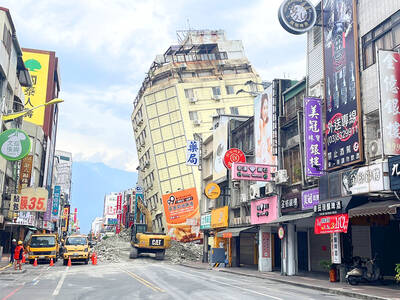
LANDSLIDES POSSIBLE: The agency advised the public to avoid visiting mountainous regions due to more expected aftershocks and rainfall from a series of weather fronts A series of earthquakes over the past few days were likely aftershocks of the April 3 earthquake in Hualien County, with further aftershocks to be expected for up to a year, the Central Weather Administration (CWA) said yesterday. Based on the nation’s experience after the quake on Sept. 21, 1999, more aftershocks are possible over the next six months to a year, the agency said. A total of 103 earthquakes of magnitude 4 on the local magnitude scale or higher hit Hualien County from 5:08pm on Monday to 10:27am yesterday, with 27 of them exceeding magnitude 5. They included two, of magnitude

Taiwan’s first drag queen to compete on the internationally acclaimed RuPaul’s Drag Race, Nymphia Wind (妮妃雅), was on Friday crowned the “Next Drag Superstar.” Dressed in a sparkling banana dress, Nymphia Wind swept onto the stage for the final, and stole the show. “Taiwan this is for you,” she said right after show host RuPaul announced her as the winner. “To those who feel like they don’t belong, just remember to live fearlessly and to live their truth,” she said on stage. One of the frontrunners for the past 15 episodes, the 28-year-old breezed through to the final after weeks of showcasing her unique


 RSS
RSS