


The Russian parliament on Friday voted to ratify the Kyoto treaty, bringing the international climate-change protocol to within months of coming into effect.
The lower house of the parliament, or duma, yesterday voted 334 to 73 to approve the treaty. This means that the protocol's 126 signatories have eight years to cut their emissions of six greenhouse gases to 5.2 percent below 1990 levels.
The treaty needs 55 industrialized nations, representing 55 percent of the world's greenhouse gas emissions, to sign it before it can come into effect.
The US, responsible for 36 percent of emissions in 1990, and Australia have already refused to sign up to the measure, meaning Russia had to ratify the treaty to save it from collapse. The move will be seen as a sign that Moscow is keen to curry favor with Brussels after bruising attacks from the EU over its human-rights abuses in recent months.
The bill now must pass through the more pliant upper house of parliament, the federation council, and then be signed into law by President Vladimir Putin, the bill's main advocate. The duma, where the pro-Putin United Russia party commands a two-thirds majority, was perhaps the only possible impediment to the bill becoming law. The treaty will come into effect 90 days after it is ratified by Russia.
Putin prevaricated over the bill, saying that Russia would only sign it if it was in the national interest and suggesting it would need modifying. His key advisor on the issue, Andrei Illarionov, made Russia's vital ratification of the pact seem unlikely when he described it as an "economic Auschwitz," insisting it would cripple economic development.
However, Putin publicly announced he would ratify the treaty after a meeting with EU officials in May, on the same day as the EU dropped its objections to Russia joining the WTO.
Mikhail Delyagin, head of the Institute for Globalization Problems and a former government economic advisor, said the move was "a purely political step." He said the EU's emphasis on human rights could have led to a "storm of criticism in Europe" over Putin's recent political reforms, enabling him to appoint regional governors and further increasing his strength in parliament.
"Signing Kyoto is a bone thrown to Europe to make them shut up," he said.
The US, flying in the face of snowballing world opinion, said on Friday it would not follow Russia's lead and ratify the Kyoto protocol on global warming.
"We have no intention of signing or ratifying it. We have not changed our views," a defiant deputy State Department spokesman Adam Ereli said after the EU and environmentalists across the globe hailed Moscow's decision and urged Washington to follow suit.
Heading the chorus of delight after the Russian Cabinet approved the Kyoto pact and sent it to lawmakers for ratification was the EU, which has been battling to save the accord thrown into disarray by the US walkout.
"This is a huge success for the international fight against climate change," declared European Commission President Romano Prodi. "Today, President Putin has sent a strong signal of his commitment and sense of responsibility."
Australia repeated its lack of interest in following Russia's lead and joining every other rich country other than the US in signing the pact.
The environment minister, Ian Campbell, claimed the government of Australian Prime Minister John Howard was opposed to the effort to slow global climate change because it didn't go far enough.
"What Australia wants to do is engage the major emitters in a comprehensive agreement," Campbell told national broadcaster ABC.
Australia is one of only three countries allowed to raise emissions under the Kyoto rubric. It was set a very generous target of achieving 108 per cent of 1990 emissions by 2010 after it threatened to boycott negotiations.
On a per capita basis, Australia is the world's biggest generator of greenhouse gases. The US is the biggest polluter overall.
International environmental lobby group Greenpeace urged Howard to think again about Kyoto now that Russia has become a signatory.
"It's shameful the prime minister refuses to ratify this while the world is proceeding with this important step," Greenpeace spokesman Danny Kennedy said. "Kyoto is just a small step in reducing greenhouse gas emissions. As an Australian citizen I'm embarrassed."
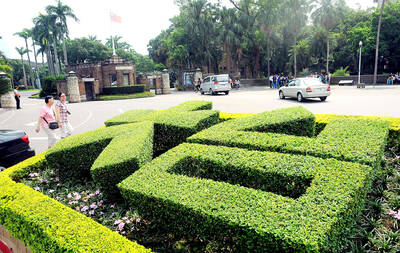
Taiwan has experienced its most significant improvement in the QS World University Rankings by Subject, data provided on Sunday by international higher education analyst Quacquarelli Symonds (QS) showed. Compared with last year’s edition of the rankings, which measure academic excellence and influence, Taiwanese universities made great improvements in the H Index metric, which evaluates research productivity and its impact, with a notable 30 percent increase overall, QS said. Taiwanese universities also made notable progress in the Citations per Paper metric, which measures the impact of research, achieving a 13 percent increase. Taiwanese universities gained 10 percent in Academic Reputation, but declined 18 percent

Chinese President Xi Jinping (習近平) yesterday met with former president Ma Ying-jeou (馬英九) at the Great Hall of the People in Beijing, with Xi’s opening statement once more emphasizing that people on both sides of the Taiwan Strait are Chinese and that foreign intervention cannot change their inevitable unification. Xi said that 5,000 years of history of zhonghua minzu (中華民族, ethnic Chinese group) have seen their ancestors move to Taiwan to establish new lives, while also documenting them fighting side-by-side against foreign forces and finally freeing Taiwan. “Both sides are Chinese,” and there are no issues that cannot be worked through, he
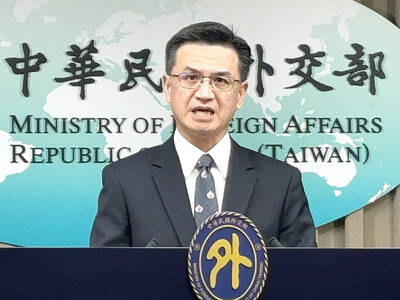
BULLY TACTICS: Beijing has continued its incursions into Taiwan’s airspace even as Xi Jinping talked about Taiwan being part of the Chinese family and nation China should stop its coercion of Taiwan and respect mainstream public opinion in Taiwan about sovereignty if its expression of goodwill is genuine, the Ministry of Foreign Affairs (MOFA) said yesterday. Ministry spokesman Jeff Liu (劉永健) made the comment in response to media queries about a meeting between former president Ma Ying-jeou (馬英九) and Chinese President Xi Jinping (習近平) the previous day. Ma voiced support for the so-called “1992 consensus,” while Xi said that although the two sides of the Taiwan Strait have “different systems,” this does not change the fact that they are “part of the same country,” and that “external
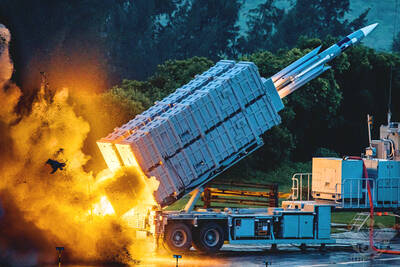
UNDER DISCUSSION: The combatant command would integrate fast attack boat and anti-ship missile groups to defend waters closest to the coastline, a source said The military could establish a new combatant command as early as 2026, which would be tasked with defending Taiwan’s territorial waters 24 nautical miles (44.4km) from the nation’s coastline, a source familiar with the matter said yesterday. The new command, which would fall under the Naval Command Headquarters, would be led by a vice admiral and integrate existing fast attack boat and anti-ship missile groups, along with the Naval Maritime Surveillance and Reconnaissance Command, said the source, who asked to remain anonymous. It could be launched by 2026, but details are being discussed and no final timetable has been announced, the source


 RSS
RSS