


A poll released yesterday that suggests a majority of people believed the Chinese Nationalist Party (KMT) could win the 2008 presidential election, but only if they discard an adherence to the "one China" policy, Taipei City Councilor and legislative candidate Lin Chin-chang (
Lin vowed to form a "movement to abandon the one China policy alliance" in order for the KMT to win voter support.
"I have sent my campaign ideas to senior party members, such as KMT Chairman Lien Chan (連戰) and General Secretary Lin Fung-cheng (林豐正). So far, nobody told me not to do so," Lin said at a press conference yesterday.
The survey, conducted by the Taiwan Real Survey Company Ltd on Lin Chin-chang's behalf revealed that 20.74 percent of respondents said that they would vote for Democratic Progressive Party (DPP) candidates in the year-end legislative elections, 14.57 percent for KMT candidates, 5.12 percent for People First Party (PFP) candidates and 2.74 percent for the Taiwan Solidarity Union (TSU).
The majority of those surveyed -- 44.03 percent -- still had not decided who they would support.
With regard to which party would win a majority of seats in the legislature in the December elections, 34.6 percent believed the DPP would prevail, while only 16.13 percent believed the KMT would do so. At 47.57 percent, the majority of respondents said they were still undecided.
On which party "loves Taiwan most," the DPP ranked the highest at 20.74 percent, followed by the KMT at 10.17 percent. The TSU ranked 4.63 percent and the PFP 2.15 percent in that category.
Asked whether the KMT should abandon the "one China" principle in order to win the 2008 presidential election, 39.5 percent of the respondents said yes, while 32.6 percent did not agree, while 27.9 percent declined to answer.
In addition, 49 percent of the interviewees believed the DPP's coming into power was directly linked to its adherence to a "Taiwan-centered consciousness," while 33 percent disagreed. Eighteen percent refused to answer.
With little over a month before the legislative elections, it is crucial that the KMT sway swing voters in their direction, Lin Ching-chang said. The key is convincing voters that the party is in line with mainstream public opinion, he said.
The "one China" policy supports the country's eventual reunification with China under the name the "Republic of China," he said.
He made news earlier this month when he mailed a package representing the "burden" of the policy to China and asked the KMT to abandon its adherence to it.
The candidate said survey results showed that about 40 percent of respondents believe that if the KMT drops the "one China" policy to focus on Taiwan, the party will be able to regain its position as the governing party.
Ironically, 35 percent of those who responded positively to the KMT's proposed policy shift claimed to be either TSU or DPP supporters, Taiwan Real Survey Co's general manager Kao Shih-yuan (
The survey also asked participants about their opinion on Taiwan's independence versus unification with China. Just over 17 percent said they support independence, while 5.4 said they favor unification.
The telephone survey was conducted from Oct. 11 to Oct. 12 from a random sampling of people nationwide. Results were based on the responses of 1,088 participants, with a 2.97 percent margin of error..
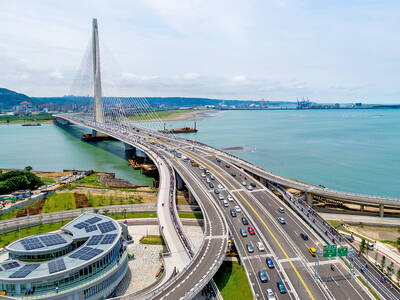
The Ministry of Transportation and Communications yesterday inaugurated the Danjiang Bridge across the Tamsui River in New Taipei City, saying that the structure would be an architectural icon and traffic artery for Taiwan. Feted as a major engineering achievement, the Danjiang Bridge is 920m long, 211m tall at the top of its pylon, and is the longest single-pylon asymmetric cable-stayed bridge in the world, the government’s Web site for the structure said. It was designed by late Iraqi-British architect Zaha Hadid. The structure, with a maximum deck of 70m, accommodates road and light rail traffic, and affords a 200m navigation channel for boats,
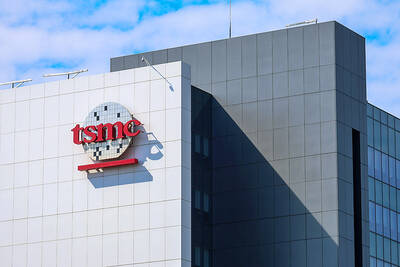
Taiwan Semiconductor Manufacturing Co (TSMC, 台積電), the world’s largest foundry service provider, yesterday said that global semiconductor revenue is projected to hit US$1.5 trillion in 2030, after the figure exceeds US$1 trillion this year, as artificial intelligence (AI) demand boosts consumption of token and compute power. “We are still at the beginning of the AI revolution, but we already see a significant impact across the whole semiconductor ecosystem,” TSMC deputy cochief operating officer Kevin Zhang (張曉強) said at the company’s annual technology symposium in Hsinchu City. “It is fair to say that in the past decade, smartphones and other mobile devices were
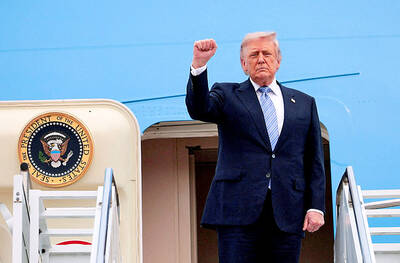
US-CHINA SUMMIT: MOFA welcomed US reassurance of no change in its Taiwan policy; Trump said he did not comment when Xi talked of opposing independence US President Donald Trump yesterday said he has not made a decision on whether to move forward with a major arms package for Taiwan after hearing concerns about it from Chinese President Xi Jinping (習近平). Trump’s comments on Taiwan came as he flew back to Washington after wrapping up critical talks in which both leaders said important progress was made in stabilizing US-China relations even as deep differences persist between the world’s two biggest powers on Iran and Taiwan. “I will make a determination,” Trump said, adding: “I’ll be making decisions. But, you know, I think the last thing we need right
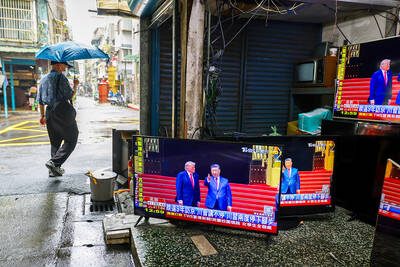
TAIWAN ISSUE: US treasury secretary Scott Bessent said on the first day of meetings that ‘it wouldn’t be a US-China summit without the Taiwan issue coming up’ There were no surprises on the first day of the summit between US President Donald Trump and Chinese President Xi Jinping (習近平), the Mainland Affairs Council (MAC) said yesterday, as the government reiterated that cross-strait stability is crucial to the Asia-Pacific region, as well as the world. As the two presidents met for a highly anticipated summit yesterday, Chinese state media reported that Xi warned Trump that missteps regarding Taiwan could push their two countries into “conflict.” Trump arrived in China with accolades for his host, calling Xi a “great leader” and “friend,” and extending an invitation to visit the White House


 RSS
RSS