


Senior Presidential Advisor Koo Kwang-ming (辜寬敏) on Friday said that he had privately received positive responses from Bush administration officials in Washington over full-page ads he placed in newspapers on Monday calling on the US to abandon its "one China" policy.
A US China expert warned, however, that the Bush administration may be shifting its sympathies to Beijing.
Koo is in Washington lobbying for a new Taiwanese Constitution and independence.
On Friday Koo addressed a conference on constitutional reform sponsored by the Center for Taiwan International Relations and other Taiwanese organizations. It was held in a Senate office building.
In an interview during a break in the conference, which former president Lee Teng-hui (李登輝) had earlier addressed via videoconference, Koo told the Taipei Times that officials and Republican Party leaders he met had "personally" supported the message in the newspaper ads, but could not say so publicly because of pressure from China. Koo declined to say who he spoke with.
"Almost all of them said [the ad] was very good. But in consideration of the reaction from China, they cannot accept my opinion," he said.
Asked whether the officials he spoke with agreed with the ad, Koo said, "Yes, personally. Not all of them, but some of them."
The intent of the ads, Koo said, was to go over the heads of the administration and communicate directly with the American people, because talking to officials was "useless."
He told reporters that he was planning more ads to influence American public opinion.
In the ads, Koo berated the Bush administration for opposing Taiwan's election-day referendum and pressuring President Chen Shui-bian (
Koo warned of eventual conflict between the US and Taiwan if Washington did not change its "one China" policy.
"Sooner or later, I believe that the policy will be changed. Democracy in Taiwan is reaching higher and higher, while the United States still keeps the same position as 30 years ago. So there is a gap growing day by day," Koo said.
"Eventually the gap will be very clear and we will have a very serious conflict between the United States and Taiwan [if US policy does not change]. That is a very miserable situation that we are going to have," he said.
He said that Taiwan "must fight against the United States, because the United States says, `you must not do this, you must not do that,' just like China tries to exert the same pressure on Taiwan."
Koo also took heart from the fact that the State Department "criticized" the ads, saying that this meant the "the ads have had some influence on the department. That's good."
During the conference, a senior US Congress researcher said that the Bush administration would never support an independent Taiwan, short of an unprovoked Chinese military attack.
The researcher, Larry Niksch, the top China expert at the Congressional Research Service, warned that the administration might put Taiwan under pressure to negotiate with China and "accept some part of the one-China principle" as Washington's relations with China improve. He said there would be more such pressure "sooner rather than later."
China's importance to the administration is growing, Niksch said, noting that since January the administration had softened its position on Chinese interference in Hong Kong.
He also said that the force of the "six assurances" which former US president Ronald Reagan gave to Taiwan in 1982, including a pledge not to pressure Taiwan into talks with China, could be weakened by the administration.
As a counter to any attempt to impose a "one country, two systems" solution on Taiwan, Niksch urged Taiwan to float an alternative solution internationally as soon as possible -- based perhaps on the EU or the British Commonwealth.
Also See Story:
US support weakening, confab told
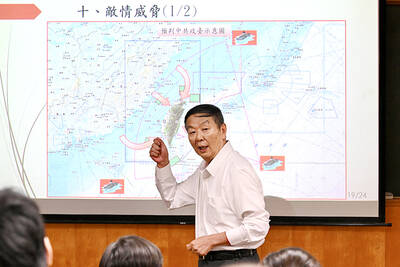
RETHINK? The defense ministry and Navy Command Headquarters could take over the indigenous submarine project and change its production timeline, a source said Admiral Huang Shu-kuang’s (黃曙光) resignation as head of the Indigenous Submarine Program and as a member of the National Security Council could affect the production of submarines, a source said yesterday. Huang in a statement last night said he had decided to resign due to national security concerns while expressing the hope that it would put a stop to political wrangling that only undermines the advancement of the nation’s defense capabilities. Taiwan People’s Party Legislator Vivian Huang (黃珊珊) yesterday said that the admiral, her older brother, felt it was time for him to step down and that he had completed what he
Taiwan has experienced its most significant improvement in the QS World University Rankings by Subject, data provided on Sunday by international higher education analyst Quacquarelli Symonds (QS) showed. Compared with last year’s edition of the rankings, which measure academic excellence and influence, Taiwanese universities made great improvements in the H Index metric, which evaluates research productivity and its impact, with a notable 30 percent increase overall, QS said. Taiwanese universities also made notable progress in the Citations per Paper metric, which measures the impact of research, achieving a 13 percent increase. Taiwanese universities gained 10 percent in Academic Reputation, but declined 18 percent
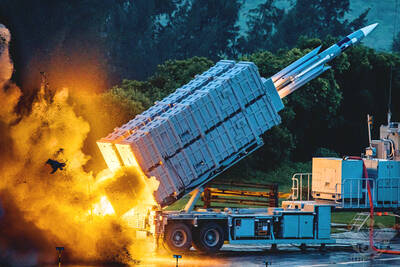
UNDER DISCUSSION: The combatant command would integrate fast attack boat and anti-ship missile groups to defend waters closest to the coastline, a source said The military could establish a new combatant command as early as 2026, which would be tasked with defending Taiwan’s territorial waters 24 nautical miles (44.4km) from the nation’s coastline, a source familiar with the matter said yesterday. The new command, which would fall under the Naval Command Headquarters, would be led by a vice admiral and integrate existing fast attack boat and anti-ship missile groups, along with the Naval Maritime Surveillance and Reconnaissance Command, said the source, who asked to remain anonymous. It could be launched by 2026, but details are being discussed and no final timetable has been announced, the source
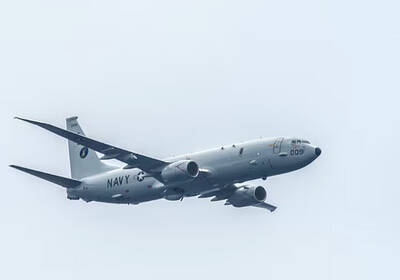
CHINA REACTS: The patrol and reconnaissance plane ‘transited the Taiwan Strait in international airspace,’ the 7th Fleet said, while Taipei said it saw nothing unusual The US 7th Fleet yesterday said that a US Navy P-8A Poseidon flew through the Taiwan Strait, a day after US and Chinese defense heads held their first talks since November 2022 in an effort to reduce regional tensions. The patrol and reconnaissance plane “transited the Taiwan Strait in international airspace,” the 7th Fleet said in a news release. “By operating within the Taiwan Strait in accordance with international law, the United States upholds the navigational rights and freedoms of all nations.” In a separate statement, the Ministry of National Defense said that it monitored nearby waters and airspace as the aircraft


 RSS
RSS