


The US Trade Representative office is planning to take the first step this week toward possibly easing or ending the biggest trade dispute between Washington and Taiwan -- protracted friction over intellectual piracy.
The US trade office will issue a public notice later in the week seeking the public's comments on whether it should remove Taiwan from Washington's "Special 301" priority watch list, a trade office spokesman said.
Taiwan has been on the list, which monitors violations of intellectual property rights, for three-and-a-half years.
Washington has accused Taipei of not doing enough to stamp out piracy of movies, music, software and industrially copyrighted items.
The notice will appear in the Federal Register as part of the agency's so-called "out-of-cycle review" of Taiwan's status under the trade law, the spokesman said. The Federal Register is the official daily compendium of all major US regulatory actions.
The US placed Taiwan on the priority list in April 2001, and has renewed that designation annually ever since.
While the US trade office has conducted out-of-cycle reviews in the fall in recent years to see if Taiwan should be dropped from the list, this year is believed to be the first time the review has gone as far as an official Federal Register notice.
Inclusion on the priority list does not carry any penalties, but it could lead to trade sanctions if the situation fails to improve, and impact on bilateral relations. Intellectual property rights is one of the thorniest issues in US-Taiwan trade relations.
Although the US trade office kept Taiwan on the priority list when it issued its annual report in May, it heaped praise on the progress the nation had made to stamp out pirated goods.
But it also bemoaned the fact that pirates had responded by finding creative ways to keep selling their wares.
US officials said at the time that they were impressed by the legislation Taiwan had passed in recent years to clamp down on piracy, as well as the country's enhanced enforcement efforts.
In July, assistant US trade representative Charles Freeman flew to Taiwan for talks with senior economic officials after the nation's renewed efforts to combat piracy convinced Washington that the time might be ripe for a renewal of high-level talks, which were broken off in late 2002 owing to a lack of progress.
After his talks in Taipei, Freeman was described as being impressed by the nation's efforts to protect copyright. He also expressed his willingness to resume high-level talks.
Such talks would be aimed at signing an agreement on a trade and investment framework, which could be the first step toward a bilateral free trade agreement between Taipei and Washington.
Freeman was also quoted as saying that, as a result of his trip to Taiwan, he would review the situation to see if the nation should be removed from the Special 301 watch list.
In June, representatives of the American Chamber of Commerce in Taipei went on their annual trip to Washington for meetings with US officials, members of Congress and think tanks.
The delegation members said that they had found an improvement in the "tone" of Taiwan's trade policies aimed at solving the piracy dispute since President Chen Shui-bian's (
Referring to a meeting between delegation members and Premier Yu Shyi-kun before their trip, the body's executive director, Richard Vuylsteke, told reporters in Washington that "my impression from the premier is that they are working hard to make sure" that Freeman's visit "is a productive one."
Taiwan has experienced its most significant improvement in the QS World University Rankings by Subject, data provided on Sunday by international higher education analyst Quacquarelli Symonds (QS) showed. Compared with last year’s edition of the rankings, which measure academic excellence and influence, Taiwanese universities made great improvements in the H Index metric, which evaluates research productivity and its impact, with a notable 30 percent increase overall, QS said. Taiwanese universities also made notable progress in the Citations per Paper metric, which measures the impact of research, achieving a 13 percent increase. Taiwanese universities gained 10 percent in Academic Reputation, but declined 18 percent

Chinese President Xi Jinping (習近平) yesterday met with former president Ma Ying-jeou (馬英九) at the Great Hall of the People in Beijing, with Xi’s opening statement once more emphasizing that people on both sides of the Taiwan Strait are Chinese and that foreign intervention cannot change their inevitable unification. Xi said that 5,000 years of history of zhonghua minzu (中華民族, ethnic Chinese group) have seen their ancestors move to Taiwan to establish new lives, while also documenting them fighting side-by-side against foreign forces and finally freeing Taiwan. “Both sides are Chinese,” and there are no issues that cannot be worked through, he
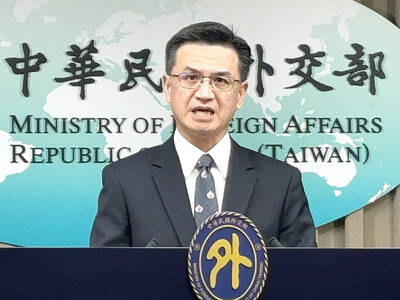
BULLY TACTICS: Beijing has continued its incursions into Taiwan’s airspace even as Xi Jinping talked about Taiwan being part of the Chinese family and nation China should stop its coercion of Taiwan and respect mainstream public opinion in Taiwan about sovereignty if its expression of goodwill is genuine, the Ministry of Foreign Affairs (MOFA) said yesterday. Ministry spokesman Jeff Liu (劉永健) made the comment in response to media queries about a meeting between former president Ma Ying-jeou (馬英九) and Chinese President Xi Jinping (習近平) the previous day. Ma voiced support for the so-called “1992 consensus,” while Xi said that although the two sides of the Taiwan Strait have “different systems,” this does not change the fact that they are “part of the same country,” and that “external

UNDER DISCUSSION: The combatant command would integrate fast attack boat and anti-ship missile groups to defend waters closest to the coastline, a source said The military could establish a new combatant command as early as 2026, which would be tasked with defending Taiwan’s territorial waters 24 nautical miles (44.4km) from the nation’s coastline, a source familiar with the matter said yesterday. The new command, which would fall under the Naval Command Headquarters, would be led by a vice admiral and integrate existing fast attack boat and anti-ship missile groups, along with the Naval Maritime Surveillance and Reconnaissance Command, said the source, who asked to remain anonymous. It could be launched by 2026, but details are being discussed and no final timetable has been announced, the source


 RSS
RSS