


The dispute surrounding the March 19 Shooting Truth Investigation Special Committee Statute (
Officials at the Judicial Yuan, meanwhile, said that there was no precedent for a temporary injunction order.
"There never has been a temporary injunction order issued in this kind of situation, and now the laws do no have any related regulations. But if the people asking for a constitutional interpretation make such a request, I believe the Grand Justices will deal with the request," Judicial Yuan Secretary-General Fan Kuang-chun (
The continuing political battle between the pan-green camp and the pan-blue camp over the statute produced yet another casualty yesterday: People First Party (PFP) Legislator Cheng Chih-lung, who failed to turn up at the voting two days ago.
The PFP announced yesterday that it would kick Cheng out of the party because it believed Cheng missed the voting because of influence from the pan-greens.
Despite losing the vote on the reconsideration request two days ago, the Democratic Progressive Party (DPP) and Taiwan Solidarity Union (TSU) caucuses have not given up in their efforts to prevent the statute from becoming effective.
According to DPP Legislator Yu Ching (
The Germany's Federal Constitutional Court Act (Bundesverfassungsgerichtsgesetz) stipulates that in a dispute the Federal Constitutional Court may deal with a matter provisionally by means of a temporary injunction if this is urgently needed to avert serious detriment, ward off imminent force or to protect the common well-being.
"The caucus is making a reasonable demand by asking for a temporary injunction statute. Even though Taiwan's written laws do not stipulate such a concept, the Grand Justices should still consider the possibility," Yu said.
The DPP and TSU caucuses also applied for a constitutional interpretation of the statute, although it has yet to be promulgated by the president. The procedure for a constitutional interpretation begins only after a bill is promulgated by the president, and usually takes about six months to a year.
"The statute overrides the power the Constitution bestows on the Legislative Yuan and violates the power of other constitutional agencies. It has violated the principle of separation of powers, so we are asking for a constitutional interpretation," Ker said.
But the pan-blue camp attacked the pan-green camp's attempt to suspend the statute as "disrespect to the Constitution."
"The laws in our country do not include such a term as `temporary injunction,' and the DPP has created this term only to blur the focus and interfere with the investigation," PFP caucus whip Liu Wen-hsiung (
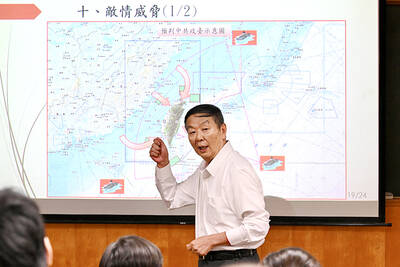
RETHINK? The defense ministry and Navy Command Headquarters could take over the indigenous submarine project and change its production timeline, a source said Admiral Huang Shu-kuang’s (黃曙光) resignation as head of the Indigenous Submarine Program and as a member of the National Security Council could affect the production of submarines, a source said yesterday. Huang in a statement last night said he had decided to resign due to national security concerns while expressing the hope that it would put a stop to political wrangling that only undermines the advancement of the nation’s defense capabilities. Taiwan People’s Party Legislator Vivian Huang (黃珊珊) yesterday said that the admiral, her older brother, felt it was time for him to step down and that he had completed what he

Taiwan has experienced its most significant improvement in the QS World University Rankings by Subject, data provided on Sunday by international higher education analyst Quacquarelli Symonds (QS) showed. Compared with last year’s edition of the rankings, which measure academic excellence and influence, Taiwanese universities made great improvements in the H Index metric, which evaluates research productivity and its impact, with a notable 30 percent increase overall, QS said. Taiwanese universities also made notable progress in the Citations per Paper metric, which measures the impact of research, achieving a 13 percent increase. Taiwanese universities gained 10 percent in Academic Reputation, but declined 18 percent
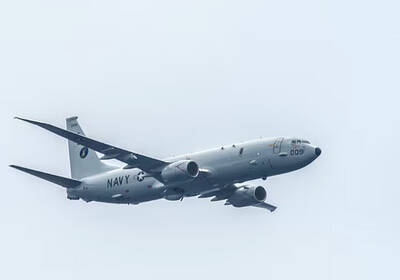
CHINA REACTS: The patrol and reconnaissance plane ‘transited the Taiwan Strait in international airspace,’ the 7th Fleet said, while Taipei said it saw nothing unusual The US 7th Fleet yesterday said that a US Navy P-8A Poseidon flew through the Taiwan Strait, a day after US and Chinese defense heads held their first talks since November 2022 in an effort to reduce regional tensions. The patrol and reconnaissance plane “transited the Taiwan Strait in international airspace,” the 7th Fleet said in a news release. “By operating within the Taiwan Strait in accordance with international law, the United States upholds the navigational rights and freedoms of all nations.” In a separate statement, the Ministry of National Defense said that it monitored nearby waters and airspace as the aircraft

UNDER DISCUSSION: The combatant command would integrate fast attack boat and anti-ship missile groups to defend waters closest to the coastline, a source said The military could establish a new combatant command as early as 2026, which would be tasked with defending Taiwan’s territorial waters 24 nautical miles (44.4km) from the nation’s coastline, a source familiar with the matter said yesterday. The new command, which would fall under the Naval Command Headquarters, would be led by a vice admiral and integrate existing fast attack boat and anti-ship missile groups, along with the Naval Maritime Surveillance and Reconnaissance Command, said the source, who asked to remain anonymous. It could be launched by 2026, but details are being discussed and no final timetable has been announced, the source


 RSS
RSS