


The UN Correspondents Associa-tion (UNCA) is preparing for a showdown with UN officials on Wednesday over its intention to hold a video-conference with Pres-ident Chen Shui-bian (陳水扁), despite efforts by China and the UN to prevent the electronic meeting from taking place on UN property.
UNCA president Anthony Jenkins told the Taipei Times that the issue at stake was freedom of the press and that his association plans to proceed with the videoconference.
Having received two letters from the UN secretariat pledging to block the conference, Jenkins was drafting a letter to UN Secretary-General Kofi Annan on Friday to make the case that China has no right to stand in the way of press activity.
In the letters to Jenkins, Shashi Tharoor, the UN Under-Secretary-General for Communications and Public Information, cited UN Resolution 2758 as legal justification for blocking Chen's videoconference. That was the 1971 resolution that switched the UN's China seat from Chiang Kai-shek's (
In a telephone interview from New York, Jenkins said he will be arguing that the resolution does not apply and that the issue is not a legal one at any rate.
The UNCA plans to hold the conference in the association's clubroom inside the UN headquarters. Tharoor has suggested the press conference take place at the Millennium Plaza Hotel across the street from the UN.
In one letter, Tharoor wrote that "the issue of Taiwan is an extremely grave one in which the Secretariat is bound by the unambiguous resolution of the General Assembly. Inviting the presence, even `virtual,' at the United Nations, of the head of this purported `state' is no ordinary matter.
"In this context, if such a meeting were to take place on UN premises, it would place UNCA members in the position of creating the news rather than reporting it, of becoming political agents rather than objective observers," Tharoor wrote.
The UNCA board rejected this argument out of hand and voted to go ahead with the conference.
It felt that "the Secretariat trying to tell us who we can meet with is an unacceptable infringement of the freedom of the press," Jenkins said.
But, Jenkins noted, "clearly the Secretariat is under enormous pressure from Beijing on this issue."
The press conference, if it takes place, will coincide with the introduction of a resolution by 26 countries asking that the matter of Taiwan's membership be put on the agenda, a proposition that Jenkins says will fail.
How the Secretariat might block the teleconference is another matter. Previously, when the UNCA tried to have Andrew Hsia, the head of the Taipei Economic and Cultural Office in New York, participate in a panel discussion on Taiwan's membership bid in the UN building, security guards prevented them from entering the premises.
This time, without Taiwan representatives present, the correspondents cannot be barred from entering the building. But Jenkins noted that in 1989, when the association tried to hold a press conference with a group of Chinese dissidents after the Tiananmen Square Massacre, the Secretariat, at the behest of Beijing, locked the UNCA club door and prevented them from entering. Jenkins suggests that this is what may happen this time.
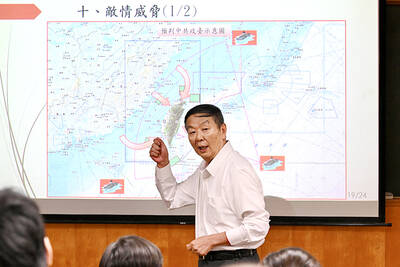
RETHINK? The defense ministry and Navy Command Headquarters could take over the indigenous submarine project and change its production timeline, a source said Admiral Huang Shu-kuang’s (黃曙光) resignation as head of the Indigenous Submarine Program and as a member of the National Security Council could affect the production of submarines, a source said yesterday. Huang in a statement last night said he had decided to resign due to national security concerns while expressing the hope that it would put a stop to political wrangling that only undermines the advancement of the nation’s defense capabilities. Taiwan People’s Party Legislator Vivian Huang (黃珊珊) yesterday said that the admiral, her older brother, felt it was time for him to step down and that he had completed what he

Taiwan has experienced its most significant improvement in the QS World University Rankings by Subject, data provided on Sunday by international higher education analyst Quacquarelli Symonds (QS) showed. Compared with last year’s edition of the rankings, which measure academic excellence and influence, Taiwanese universities made great improvements in the H Index metric, which evaluates research productivity and its impact, with a notable 30 percent increase overall, QS said. Taiwanese universities also made notable progress in the Citations per Paper metric, which measures the impact of research, achieving a 13 percent increase. Taiwanese universities gained 10 percent in Academic Reputation, but declined 18 percent
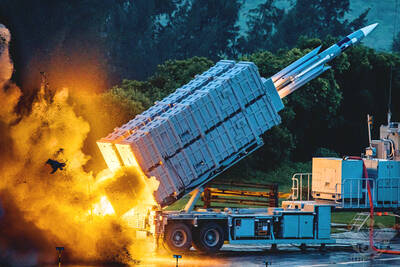
UNDER DISCUSSION: The combatant command would integrate fast attack boat and anti-ship missile groups to defend waters closest to the coastline, a source said The military could establish a new combatant command as early as 2026, which would be tasked with defending Taiwan’s territorial waters 24 nautical miles (44.4km) from the nation’s coastline, a source familiar with the matter said yesterday. The new command, which would fall under the Naval Command Headquarters, would be led by a vice admiral and integrate existing fast attack boat and anti-ship missile groups, along with the Naval Maritime Surveillance and Reconnaissance Command, said the source, who asked to remain anonymous. It could be launched by 2026, but details are being discussed and no final timetable has been announced, the source
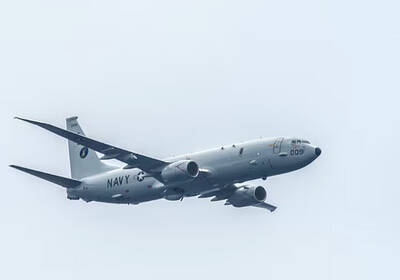
CHINA REACTS: The patrol and reconnaissance plane ‘transited the Taiwan Strait in international airspace,’ the 7th Fleet said, while Taipei said it saw nothing unusual The US 7th Fleet yesterday said that a US Navy P-8A Poseidon flew through the Taiwan Strait, a day after US and Chinese defense heads held their first talks since November 2022 in an effort to reduce regional tensions. The patrol and reconnaissance plane “transited the Taiwan Strait in international airspace,” the 7th Fleet said in a news release. “By operating within the Taiwan Strait in accordance with international law, the United States upholds the navigational rights and freedoms of all nations.” In a separate statement, the Ministry of National Defense said that it monitored nearby waters and airspace as the aircraft


 RSS
RSS