


Out of fear of provoking a backlash from ethnic minorities, the Cabinet late last night said it had not yet decided to merge three agencies dealing with ethnic affairs into a single agency.
"We have not yet reached the final decision, although it's one of the many options," said Yeh Jiunn-rong (葉俊榮), the head of the Cabinet's Research, Development and Evaluation Commission, the agency handling the restructuring. "We're not in a hurry to come to a conclusion because we still have one to two weeks to hammer out a well-thought-out plan."
Shih Nun-jeh (
"We thought it'd be a better idea to combine the three councils dealing with ethnic issues into one that highlights the importance of ethnic equality and human rights," he said.
The Cabinet on Wednesday will release draft amendments to the Organic Law of the Executive Yuan (
The move comes after the legislature passed the Standard Organic Law of Central Government Agencies (
The law limits the number of Cabinet ministries to 13, the number of commissions to four and independent institutions to five -- a total of 22 agencies.
The Cabinet had earlier proposed to reduce its 35 agencies to 26, including 15 ministries, six commissions and five independent institutions.
In addition to eight particular ministries mandated by the Organic Law of the Executive Yuan, the five new ministries would cover public health, agriculture, culture, labor and maritime affairs.
The four commissions would include the present Mainland Affairs Council, a new national development council and a technology council.
The five independent entities would be the Central Bank and the National Palace Museum (unchanged), a new financial supervisory board, a new national communications commission and a revamped Aviation Safety Council.
Government reform was one of President Chen Shui-bian's (陳水扁) key campaign promises.
To expedite the process, the Cabinet has set up a 25-member taskforce under the supervision of the Research, Development and Evaluation Commission.
The Cabinet in April 2002 approved three draft bills that would facilitate the restructuring of the Cabinet.
The Standard Organic Law of Central Government Agencies provides a legal basis for the central government to establish independent institutions.
Meanwhile, a separate bill, the Law Governing the Total Number of Civil Servants Employed by Central Government Agencies (中央政府機關總員額法), would set a ceiling for the total number of public servants working in the five branches of the central government, the Presidential Office, the National Security Council and the National Assembly at 200,500.

Chinese President Xi Jinping (習近平) yesterday met with former president Ma Ying-jeou (馬英九) at the Great Hall of the People in Beijing, with Xi’s opening statement once more emphasizing that people on both sides of the Taiwan Strait are Chinese and that foreign intervention cannot change their inevitable unification. Xi said that 5,000 years of history of zhonghua minzu (中華民族, ethnic Chinese group) have seen their ancestors move to Taiwan to establish new lives, while also documenting them fighting side-by-side against foreign forces and finally freeing Taiwan. “Both sides are Chinese,” and there are no issues that cannot be worked through, he
Taiwan has experienced its most significant improvement in the QS World University Rankings by Subject, data provided on Sunday by international higher education analyst Quacquarelli Symonds (QS) showed. Compared with last year’s edition of the rankings, which measure academic excellence and influence, Taiwanese universities made great improvements in the H Index metric, which evaluates research productivity and its impact, with a notable 30 percent increase overall, QS said. Taiwanese universities also made notable progress in the Citations per Paper metric, which measures the impact of research, achieving a 13 percent increase. Taiwanese universities gained 10 percent in Academic Reputation, but declined 18 percent
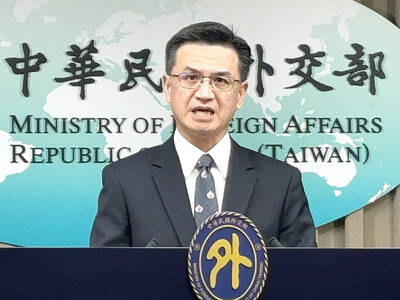
BULLY TACTICS: Beijing has continued its incursions into Taiwan’s airspace even as Xi Jinping talked about Taiwan being part of the Chinese family and nation China should stop its coercion of Taiwan and respect mainstream public opinion in Taiwan about sovereignty if its expression of goodwill is genuine, the Ministry of Foreign Affairs (MOFA) said yesterday. Ministry spokesman Jeff Liu (劉永健) made the comment in response to media queries about a meeting between former president Ma Ying-jeou (馬英九) and Chinese President Xi Jinping (習近平) the previous day. Ma voiced support for the so-called “1992 consensus,” while Xi said that although the two sides of the Taiwan Strait have “different systems,” this does not change the fact that they are “part of the same country,” and that “external

UNDER DISCUSSION: The combatant command would integrate fast attack boat and anti-ship missile groups to defend waters closest to the coastline, a source said The military could establish a new combatant command as early as 2026, which would be tasked with defending Taiwan’s territorial waters 24 nautical miles (44.4km) from the nation’s coastline, a source familiar with the matter said yesterday. The new command, which would fall under the Naval Command Headquarters, would be led by a vice admiral and integrate existing fast attack boat and anti-ship missile groups, along with the Naval Maritime Surveillance and Reconnaissance Command, said the source, who asked to remain anonymous. It could be launched by 2026, but details are being discussed and no final timetable has been announced, the source


 RSS
RSS