


The US military was to allow journalists inside a review hearing for a second day yesterday to observe as a three-member panel considered the case of another detainee among hundreds accused of ties to al-Qaeda or the Taliban militia that used to rule Afghanistan.
During hearings Thursday, two Afghan detainees pleaded for their freedom, both saying they were with Taliban forces but never fought against US troops.
The first detainee, 31, spoke quietly through a Pashto interpreter to declare he had a Taliban-issued rifle but wasn't involved in battle. "I wasn't going to fight anyone," he said.
The other prisoner, 49, said through an interpreter that he was a wood seller who was forced to join the Islamic militia. "The Taliban came to my house and they took me," said the man, who had a full gray beard and closely shorn hair.
The hearings, held in a windowless 3m-by-6m room in a trailer, were the ninth and 10th since the tribunal process began last week to determine whether some 585 prisoners at the US military prison should continue to be held as "enemy combatants."
The hearings are the first opportunity detainees have had to formally plead their cases since they began arriving at Guantanamo in January 2002. But human rights lawyers criticize the hearings as a sham, pointing out detainees are not allowed lawyers and saying the officers hearing cases can't be considered impartial.
The detainees wore orange garb as they sat before the panels, hands and feet bound and chained to a metal ring in the floor.
Journalists were barred from releasing detainees' names or taking photos. They were allowed to see about an hour of the first hearing Thursday, and more than a half hour of the second before the proceedings were closed so panel members could review classified information.
During the second hearing, the 49-year-old Afghan said the Taliban forced him to go to the city of Kunduz, where he was held in a compound with an armed guard posted outside.
"We could not leave the compound," the man said. "They were sending people by numbers to fight," he said, adding that he was never called.
The detainee asked to call three witnesses to support his argument that he was forced to join the Taliban, but the tribunal president refused, saying that wasn't relevant.
Both Afghan detainees said they had surrendered to a Northern Alliance commander, Abdul Rashid Dostum, an Uzbek strongman.
After surrendering, the 49-year-old said he and other captives were brought to Shiberghan, where the Northern Alliance loaded them into shipping containers and closed the doors. "In that container, some of the people died because it was too hot," he said.
The 31-year-old Afghan acknowledged he had a Taliban-issued Kalashnikov rifle but said it was given to him "forcefully." "They were giving [rifles] to everybody," he said.
Asked by a tribunal official whether he had surrendered in a car with a Taliban leader, he said "yes."
The review panels have the power to recommend reversing assessments that detainees are "enemy combatants," a classification that gives them fewer legal protections than prisoner-of-war status. The initial decisions have yet to be announced; officials say they could be by next week.
The process is separate from military commissions that are to try an initial group of four detainees on war crimes conspiracy and other charges. Pretrial hearings for those cases are planned later this month.
The military convened the Combatant Status Review Tribunals in response to a Supreme Court ruling in June that prisoners have a right to challenge their detention in US courts.
Each detainee is being assigned a military officer as a "personal representative" for the reviews. Defense lawyers argue that officer is acting as a government agent and is not impartial.
So far, five detainees -- three Yemenis, one Saudi and one Moroccan -- have refused to appear before the panels.
Military officials say detainees who have attended hearings include a Pakistani fighter linked to the Taliban, an Algerian who has threatened to kill Americans if freed and a Yemeni who signed an oath of allegiance to Osama bin Laden.

ROLLER-COASTER RIDE: More than five earthquakes ranging from magnitude 4.4 to 5.5 on the Richter scale shook eastern Taiwan in rapid succession yesterday afternoon Back-to-back weather fronts are forecast to hit Taiwan this week, resulting in rain across the nation in the coming days, the Central Weather Administration said yesterday, as it also warned residents in mountainous regions to be wary of landslides and rockfalls. As the first front approached, sporadic rainfall began in central and northern parts of Taiwan yesterday, the agency said, adding that rain is forecast to intensify in those regions today, while brief showers would also affect other parts of the nation. A second weather system is forecast to arrive on Thursday, bringing additional rain to the whole nation until Sunday, it

CONDITIONAL: The PRC imposes secret requirements that the funding it provides cannot be spent in states with diplomatic relations with Taiwan, Emma Reilly said China has been bribing UN officials to obtain “special benefits” and to block funding from countries that have diplomatic ties with Taiwan, a former UN employee told the British House of Commons on Tuesday. At a House of Commons Foreign Affairs Committee hearing into “international relations within the multilateral system,” former Office of the UN High Commissioner for Human Rights (OHCHR) employee Emma Reilly said in a written statement that “Beijing paid bribes to the two successive Presidents of the [UN] General Assembly” during the two-year negotiation of the Sustainable Development Goals. Another way China exercises influence within the UN Secretariat is
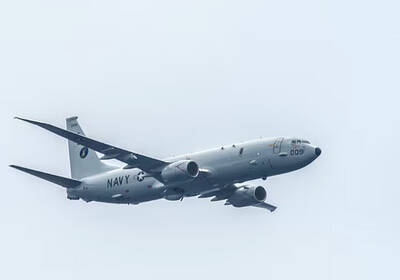
CHINA REACTS: The patrol and reconnaissance plane ‘transited the Taiwan Strait in international airspace,’ the 7th Fleet said, while Taipei said it saw nothing unusual The US 7th Fleet yesterday said that a US Navy P-8A Poseidon flew through the Taiwan Strait, a day after US and Chinese defense heads held their first talks since November 2022 in an effort to reduce regional tensions. The patrol and reconnaissance plane “transited the Taiwan Strait in international airspace,” the 7th Fleet said in a news release. “By operating within the Taiwan Strait in accordance with international law, the United States upholds the navigational rights and freedoms of all nations.” In a separate statement, the Ministry of National Defense said that it monitored nearby waters and airspace as the aircraft

Taiwan’s first drag queen to compete on the internationally acclaimed RuPaul’s Drag Race, Nymphia Wind (妮妃雅), was on Friday crowned the “Next Drag Superstar.” Dressed in a sparkling banana dress, Nymphia Wind swept onto the stage for the final, and stole the show. “Taiwan this is for you,” she said right after show host RuPaul announced her as the winner. “To those who feel like they don’t belong, just remember to live fearlessly and to live their truth,” she said on stage. One of the frontrunners for the past 15 episodes, the 28-year-old breezed through to the final after weeks of showcasing her unique


 RSS
RSS