


Although they did not submit any new evidence yesterday, the pan-blue alliance's attorneys said that the Central Election Commission (CEC) had failed to carry out its duties to maintain a fair and clean election, and demanded that the presidential election be rendered invalid.
The argument by the Chinese Nationalist Party (KMT) and People First Party (PFP) alliance's attorneys was not strong enough to persuade the judges, and Taiwan High Court presiding judge Cheng Ya-ping (
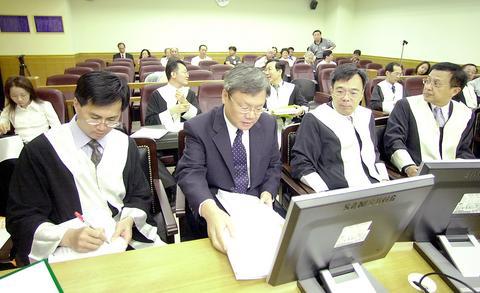
PHOTO: LO PEI-TEH, TAIPEI TIMES
Lee Tsung-teh (
The lawyer was apparently referring to the March 19 attempt to assassinate President Chen Shui-bian (
"The evidence we collected showed that many voters decided not to vote or voted for Chen and Lu after the shooting," said Lee. "Under these kinds of circumstances, the CEC should have suspended the election until investigators closed the case."
The evidence mentioned by Lee includes a questionnaire conducted by the National Policy Foundation (
Lee's argument was immediately rebutted by Democratic Progressive Party (DPP) defense counsel Johnson Chuang (
"KMT Chairman Lien Chan (連戰) said we shall carry on with the election when he was interviewed on TV after the shooting took place," said Chuang. "Your Honor, what I said is verifiable if you ask for the video footage from any of local TV stations. Why is it that they are complaining the election should have been suspended now? It is ironic, isn't it?"
Huang Chao-yuan (黃昭元), a National Taiwan University law professor and a CEC member said that the alliance's complaint is illogical.
"The CEC is only authorized to suspend an election when the candidate is dead. While they [the plaintiffs] are complaining that we did not `do something,' does that mean the CEC's authorization should be expanded?" said Huang. "The CEC is a government office which is supposed to stay neutral under all kinds circumstances, no?"
Article 17, Section 1 of the Referendum Law (
According to the article, the referendum shall be carried out if the president proposes it and the Cabinet approves, if the issue concerns national defense.
Other than issues of national defense, a referendum can be carried out with an endorsement of 5 percent of registered voters and an approval by the Legislature's referendum evaluation committee.
"This is extremely unfair to the alliance's candidates," said Lee.
Before Lee finished his argument over the article, Cheng immediately rebutted by asking, "Excuse me, but, isn't the current Referendum Law the version which was passed by KMT and PFP lawmakers? If so, why are you complaining about something that was passed by your own lawmakers?" the judge asked.
Yesterday's four-hour debate did not result in any conclusion, and Cheng did not announce the next hearing date.
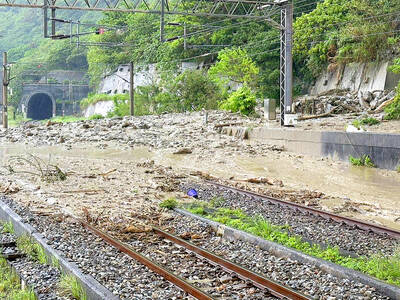
ROLLER-COASTER RIDE: More than five earthquakes ranging from magnitude 4.4 to 5.5 on the Richter scale shook eastern Taiwan in rapid succession yesterday afternoon Back-to-back weather fronts are forecast to hit Taiwan this week, resulting in rain across the nation in the coming days, the Central Weather Administration said yesterday, as it also warned residents in mountainous regions to be wary of landslides and rockfalls. As the first front approached, sporadic rainfall began in central and northern parts of Taiwan yesterday, the agency said, adding that rain is forecast to intensify in those regions today, while brief showers would also affect other parts of the nation. A second weather system is forecast to arrive on Thursday, bringing additional rain to the whole nation until Sunday, it

CONDITIONAL: The PRC imposes secret requirements that the funding it provides cannot be spent in states with diplomatic relations with Taiwan, Emma Reilly said China has been bribing UN officials to obtain “special benefits” and to block funding from countries that have diplomatic ties with Taiwan, a former UN employee told the British House of Commons on Tuesday. At a House of Commons Foreign Affairs Committee hearing into “international relations within the multilateral system,” former Office of the UN High Commissioner for Human Rights (OHCHR) employee Emma Reilly said in a written statement that “Beijing paid bribes to the two successive Presidents of the [UN] General Assembly” during the two-year negotiation of the Sustainable Development Goals. Another way China exercises influence within the UN Secretariat is

LANDSLIDES POSSIBLE: The agency advised the public to avoid visiting mountainous regions due to more expected aftershocks and rainfall from a series of weather fronts A series of earthquakes over the past few days were likely aftershocks of the April 3 earthquake in Hualien County, with further aftershocks to be expected for up to a year, the Central Weather Administration (CWA) said yesterday. Based on the nation’s experience after the quake on Sept. 21, 1999, more aftershocks are possible over the next six months to a year, the agency said. A total of 103 earthquakes of magnitude 4 on the local magnitude scale or higher hit Hualien County from 5:08pm on Monday to 10:27am yesterday, with 27 of them exceeding magnitude 5. They included two, of magnitude

Taiwan’s first drag queen to compete on the internationally acclaimed RuPaul’s Drag Race, Nymphia Wind (妮妃雅), was on Friday crowned the “Next Drag Superstar.” Dressed in a sparkling banana dress, Nymphia Wind swept onto the stage for the final, and stole the show. “Taiwan this is for you,” she said right after show host RuPaul announced her as the winner. “To those who feel like they don’t belong, just remember to live fearlessly and to live their truth,” she said on stage. One of the frontrunners for the past 15 episodes, the 28-year-old breezed through to the final after weeks of showcasing her unique


 RSS
RSS