


US Attorney General John Ashcroft, pressed by senators in testy exchange, refused to make public Justice Department memos that contended a wartime president was not bound by anti-torture laws or treaties.
However, Ashcroft denied on Tuesday that US President George W. Bush had issued orders that would have allowed violations of such laws.
During a three-hour appearance before the Senate Judiciary Committee, Ashcroft repeatedly insisted that the Bush administration does not condone torture, even of al-Qaeda terrorist suspects. He said his department would investigate vigorously anyone accused of it who is outside military jurisdiction.
"This administration rejects torture," Ashcroft said. Later, he added: "I don't think it's productive, let alone justified."
Still, the attorney general refused to give the committee copies of department memos written in 2002 that Democratic senators said could have laid legal groundwork for abuses that occurred at Iraq's Abu Ghraib prison and elsewhere in the war on terror.
"I do believe the president has the right to have legal advice from his attorney general and not have that revealed to the whole world," said Ashcroft. Yet the administration was not invoking executive privilege claims to protect the documents, he said.
Presidential spokeswoman Claire Buchan said that the White House counsel's office was aware of the task force's work but "didn't review drafts or edit them.
"The president has made it clear that US policy is that the Geneva Convention applied in Iraq and that detainees elsewhere are treated consistent with the Geneva accords."
One of the memos, cited in a Pentagon policy paper in March last year, stated that the president's broad wartime national security authority may override anti-torture laws and treaties, including the Geneva Conventions, in certain circumstances.
Waving photos of abused prisoners in Iraq, Democratic Senator Edward Kennedy said such memos could lead to interpretations by military personnel or interrogators that laws and agreements that forbid torture were no longer in effect.
"We know when we have these kinds of orders what happens: We get the stress test, we get the use of dogs, we get the forced nakedness that we've all seen, and we get the hooding," Kennedy said.
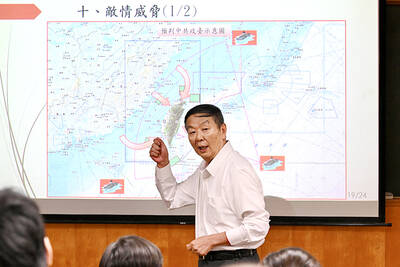
RETHINK? The defense ministry and Navy Command Headquarters could take over the indigenous submarine project and change its production timeline, a source said Admiral Huang Shu-kuang’s (黃曙光) resignation as head of the Indigenous Submarine Program and as a member of the National Security Council could affect the production of submarines, a source said yesterday. Huang in a statement last night said he had decided to resign due to national security concerns while expressing the hope that it would put a stop to political wrangling that only undermines the advancement of the nation’s defense capabilities. Taiwan People’s Party Legislator Vivian Huang (黃珊珊) yesterday said that the admiral, her older brother, felt it was time for him to step down and that he had completed what he

Taiwan has experienced its most significant improvement in the QS World University Rankings by Subject, data provided on Sunday by international higher education analyst Quacquarelli Symonds (QS) showed. Compared with last year’s edition of the rankings, which measure academic excellence and influence, Taiwanese universities made great improvements in the H Index metric, which evaluates research productivity and its impact, with a notable 30 percent increase overall, QS said. Taiwanese universities also made notable progress in the Citations per Paper metric, which measures the impact of research, achieving a 13 percent increase. Taiwanese universities gained 10 percent in Academic Reputation, but declined 18 percent
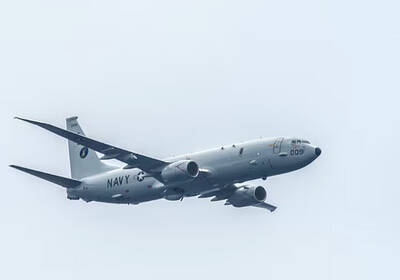
CHINA REACTS: The patrol and reconnaissance plane ‘transited the Taiwan Strait in international airspace,’ the 7th Fleet said, while Taipei said it saw nothing unusual The US 7th Fleet yesterday said that a US Navy P-8A Poseidon flew through the Taiwan Strait, a day after US and Chinese defense heads held their first talks since November 2022 in an effort to reduce regional tensions. The patrol and reconnaissance plane “transited the Taiwan Strait in international airspace,” the 7th Fleet said in a news release. “By operating within the Taiwan Strait in accordance with international law, the United States upholds the navigational rights and freedoms of all nations.” In a separate statement, the Ministry of National Defense said that it monitored nearby waters and airspace as the aircraft
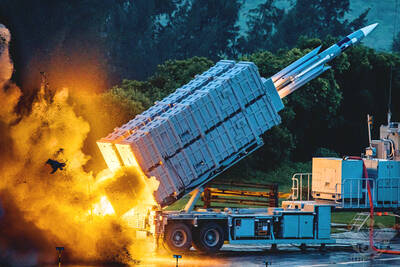
UNDER DISCUSSION: The combatant command would integrate fast attack boat and anti-ship missile groups to defend waters closest to the coastline, a source said The military could establish a new combatant command as early as 2026, which would be tasked with defending Taiwan’s territorial waters 24 nautical miles (44.4km) from the nation’s coastline, a source familiar with the matter said yesterday. The new command, which would fall under the Naval Command Headquarters, would be led by a vice admiral and integrate existing fast attack boat and anti-ship missile groups, along with the Naval Maritime Surveillance and Reconnaissance Command, said the source, who asked to remain anonymous. It could be launched by 2026, but details are being discussed and no final timetable has been announced, the source


 RSS
RSS