


Police swamped Tiananmen Square yesterday, keeping dissent at bay on the 15th anniversary of the bloody pro-democracy crackdown as survivors and their families privately mourned the hundreds who died.
With the event remaining highly sensitive to the ruling Chinese Communist Party, few, if any, commemorations were taking place to mark the day when hundreds, if not thousands, of protesters were killed by Chinese troops.
On the vast square yesterday, police vans criss-crossed constantly to maintain order, while on majestic Changan Avenue -- the main route used by tanks and soldiers in 1989 -- uniformed People's Armed Police and undercover teams were out in force.
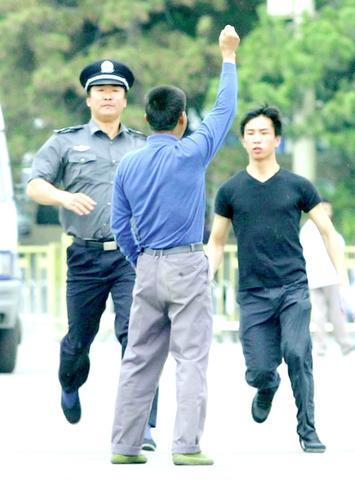
PHOTO: AP
All traces of the bullet holes and tanks tracks that scarred the area have long since been erased.
One wheelchair-bound man dared to protest, wearing a headband with a slogan on it.
He managed to unveil and hold up a slip of paper before security forces pounced and took him away, a news photographer witnessed.
A group of middle-aged men and women, meanwhile, were seen being processed in the courtyard of the Tiananmen Square police station where detainees are first taken, although why they were there was not clear.
Police refused to comment.
While few in the capital dare to publicly commemorate the massacre, an estimated 60,000 people were expected to gather in Hong Kong to light candles in memory of those who died.
In Washington, many of the student leaders of the 1989 protests who now live in exile in the US held their own memorial in front of the Chinese embassy.
The only candles being lit in Beijing are behind closed doors, and even then it is far from safe.
"They threatened to take me away if I lit a candle," Hu Jia, a leading Tiananmen and AIDS activist, told reporters from his Beijing home where he is under house arrest.
In the lead-up to the anniversary, China's secretive state security police have placed known dissidents under house arrest and even forced some from their homes to hotels outside the Chinese capital.
Universities, meanwhile, were being monitored by a state security police task force to prevent commemorations taking place, academics said.
"The Chinese government is trying to wipe out the memory of Tiananmen Square, but the horror of what happened still resonates inside and outside China," said Kenneth Roth, executive director of Human Rights Watch.
"We don't even know exactly who died in the massacre. The Chinese authorities need to punish those responsible, compensate the victims, and allow those who fled the country to return home."
Qi Zhiyong, who lost his leg when he was run over by an armored personnel carrier on the night of June 4, said he was marking the event in his own way.
"My heart feels very grieved. Democracy has eluded us for such a long time," he told reporters.
"Democracy is the goal of freedom and Chinese people all strive for freedom. Today I will mourn for those that lost their lives 15 years ago and I will mourn with those mothers, fathers and relatives that have lost family."
Many people in Beijing are too scared to talk about those fateful events, while others have moved on and are more concerned with jobs and money in a country where economic reforms have rapidly transformed lives.
Some, though, refuse to forget.
"The police came to warn to me and told me not to leave my home and not to invite friends to the house," Zhou Duo, a former economics professor at Peking University who took part in the 1989 demonstrations, told reporters.
"But this year, like every year on June 4, I will make a hunger strike during the day."
The Chinese leadership has shown no sign of changing its position on the crackdown, defending its actions this week as necessary for economic growth and China's emergence on the world stage.
State media, which are banned from using the phrase "liusi," or June 4, predictably made no mention of the anniversary.
Analysts said Beijing was unlikely to change tack any time soon.
"This is still a taboo subject," China specialist Joseph Cheng from City University in Hong Kong said.
"This can be very controversial and this can create a lot of divisions within the leadership. That's why the subject must be suppressed, must be hidden from the public," Cheng said.
Also see story:
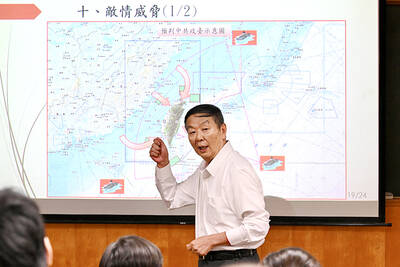
RETHINK? The defense ministry and Navy Command Headquarters could take over the indigenous submarine project and change its production timeline, a source said Admiral Huang Shu-kuang’s (黃曙光) resignation as head of the Indigenous Submarine Program and as a member of the National Security Council could affect the production of submarines, a source said yesterday. Huang in a statement last night said he had decided to resign due to national security concerns while expressing the hope that it would put a stop to political wrangling that only undermines the advancement of the nation’s defense capabilities. Taiwan People’s Party Legislator Vivian Huang (黃珊珊) yesterday said that the admiral, her older brother, felt it was time for him to step down and that he had completed what he
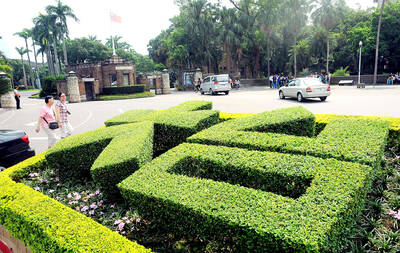
Taiwan has experienced its most significant improvement in the QS World University Rankings by Subject, data provided on Sunday by international higher education analyst Quacquarelli Symonds (QS) showed. Compared with last year’s edition of the rankings, which measure academic excellence and influence, Taiwanese universities made great improvements in the H Index metric, which evaluates research productivity and its impact, with a notable 30 percent increase overall, QS said. Taiwanese universities also made notable progress in the Citations per Paper metric, which measures the impact of research, achieving a 13 percent increase. Taiwanese universities gained 10 percent in Academic Reputation, but declined 18 percent
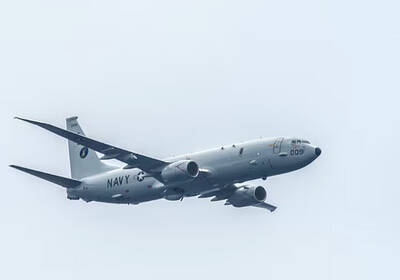
CHINA REACTS: The patrol and reconnaissance plane ‘transited the Taiwan Strait in international airspace,’ the 7th Fleet said, while Taipei said it saw nothing unusual The US 7th Fleet yesterday said that a US Navy P-8A Poseidon flew through the Taiwan Strait, a day after US and Chinese defense heads held their first talks since November 2022 in an effort to reduce regional tensions. The patrol and reconnaissance plane “transited the Taiwan Strait in international airspace,” the 7th Fleet said in a news release. “By operating within the Taiwan Strait in accordance with international law, the United States upholds the navigational rights and freedoms of all nations.” In a separate statement, the Ministry of National Defense said that it monitored nearby waters and airspace as the aircraft

UNDER DISCUSSION: The combatant command would integrate fast attack boat and anti-ship missile groups to defend waters closest to the coastline, a source said The military could establish a new combatant command as early as 2026, which would be tasked with defending Taiwan’s territorial waters 24 nautical miles (44.4km) from the nation’s coastline, a source familiar with the matter said yesterday. The new command, which would fall under the Naval Command Headquarters, would be led by a vice admiral and integrate existing fast attack boat and anti-ship missile groups, along with the Naval Maritime Surveillance and Reconnaissance Command, said the source, who asked to remain anonymous. It could be launched by 2026, but details are being discussed and no final timetable has been announced, the source


 RSS
RSS