


The US has retained Taiwan on a list of countries with the world's worst piracy records, sparking calls from the Ministry of Foreign Affairs that Washington has ignored the nation's progress on intellectual property rights (IPR).
The Office of the US Trade Representative (USTR) announced on Monday that Taiwan will remain on the so-called "Special 301" priority watch list for the fourth year in a row, a designation that could subject Taiwan to trade sanctions if the situation does not improve.
Fourteen other economies, including the entire EU, join Taiwan on the list.
In announcing the designation, the USTR commended Taiwan for its increased enforcement, but noted that pirates have apparently adjusted to the crackdown "in ways that maintain business losses due to IPR infringement at unacceptably high levels."
The office also hinted that it might be willing to resume bilateral high-level meetings to discuss the dispute. Such meetings have been suspended since early last year. It said it would conduct a special review of Taiwan's progress in the fall, to see if the country can be removed from the list.
"The United States commends the Taiwan authorities and, in particular, its enforcement authorities, for increasing the frequency and effectiveness of raids against night markets and inspections of optical media factories, which have significantly reduced the number of pirate optical media products for retail sales," the USTR said.
But it noted that pirates have adjusted by using non-traditional retail channels, including catalogue sales to anonymous customers for home delivery, and marketing pirated products over the Internet, including counterfeit pharmaceuticals.
The US agency said Taiwan must strengthen its laws to prevent unfair commercial use of pharmaceutical and agricultural chemical test data and strengthen its copyright laws.
"Although Taiwan amended its copyright law in June 2003, several provisions remain deficient," the trade representative's report said, without giving examples.
The report noted that a promise by the government in February to seek improvements in the copyright law has not yet been fulfilled.
Taiwan has been on and off the piracy list since the early 1990s. In 2001, after a three year gap, the country was placed back on the list, where it has been ever since.
The dispute between Washington and Taipei over piracy is the biggest irritant in bilateral economic relations, and has quashed hopes that Washington would sign a free trade agreement with Taiwan.
The two countries also have disputes over telecommunications, pharmaceuticals and rice imports, but heavy pressure on the US government from the entertainment industry, which claims it loses several billions of dollars a year due to piracy in Taiwan, has kept the issue in the forefront.
The Ministry of Economic Affairs yesterday expressed regret and discontent over the US government's decision.
"The US government ignored our efforts in passing the new Copyright Law (
Jack Lu (
Lu, who visited US trade officials early last month, worried, however, that it would be hard to make progress in the short term because of post-election political turmoil.
But Lu said it was unfair to blame Taiwan for counterfeiting and weak border enforcement, noting that the value of counterfeit goods from Taiwan seized by the US Customs Service dropped to US$610,000 last year from US$26.5 million in 2002.
John Eastwood, co-chairman of the European Chamber of Commerce Taipei's (ECCT) IPR committee, agreed that Taiwan had improved its record on piracy.
But he said Taiwan should work on laws to protect unfair commercial use of pharmaceutical and agricultural chemical test data, as the report noted, he said.
Eastwood said he does not think Taiwan will be able to pass technology protection laws by the fall and get off the priority watch list because the legislature will be preoccupied with the year-end elections.
Taiwan's staying on the priority watch list didn't surprise a Taipei-based foreign legal expert.
"They [the US industry] will never be satisfied," said Robin Winkler of the law firm Winkler Partners.
"Taiwan has done more than any country in the world in line with expectations of US industry, and I think they all know it," Winkler said. "If they are not satisfied today, they only have themselves to blame."
Also See Story:
Ukraine named top violator of copyrights

Chinese President Xi Jinping (習近平) yesterday met with former president Ma Ying-jeou (馬英九) at the Great Hall of the People in Beijing, with Xi’s opening statement once more emphasizing that people on both sides of the Taiwan Strait are Chinese and that foreign intervention cannot change their inevitable unification. Xi said that 5,000 years of history of zhonghua minzu (中華民族, ethnic Chinese group) have seen their ancestors move to Taiwan to establish new lives, while also documenting them fighting side-by-side against foreign forces and finally freeing Taiwan. “Both sides are Chinese,” and there are no issues that cannot be worked through, he
Taiwan has experienced its most significant improvement in the QS World University Rankings by Subject, data provided on Sunday by international higher education analyst Quacquarelli Symonds (QS) showed. Compared with last year’s edition of the rankings, which measure academic excellence and influence, Taiwanese universities made great improvements in the H Index metric, which evaluates research productivity and its impact, with a notable 30 percent increase overall, QS said. Taiwanese universities also made notable progress in the Citations per Paper metric, which measures the impact of research, achieving a 13 percent increase. Taiwanese universities gained 10 percent in Academic Reputation, but declined 18 percent
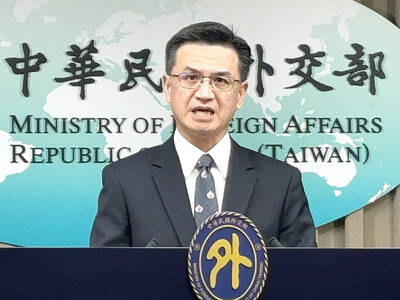
BULLY TACTICS: Beijing has continued its incursions into Taiwan’s airspace even as Xi Jinping talked about Taiwan being part of the Chinese family and nation China should stop its coercion of Taiwan and respect mainstream public opinion in Taiwan about sovereignty if its expression of goodwill is genuine, the Ministry of Foreign Affairs (MOFA) said yesterday. Ministry spokesman Jeff Liu (劉永健) made the comment in response to media queries about a meeting between former president Ma Ying-jeou (馬英九) and Chinese President Xi Jinping (習近平) the previous day. Ma voiced support for the so-called “1992 consensus,” while Xi said that although the two sides of the Taiwan Strait have “different systems,” this does not change the fact that they are “part of the same country,” and that “external

UNDER DISCUSSION: The combatant command would integrate fast attack boat and anti-ship missile groups to defend waters closest to the coastline, a source said The military could establish a new combatant command as early as 2026, which would be tasked with defending Taiwan’s territorial waters 24 nautical miles (44.4km) from the nation’s coastline, a source familiar with the matter said yesterday. The new command, which would fall under the Naval Command Headquarters, would be led by a vice admiral and integrate existing fast attack boat and anti-ship missile groups, along with the Naval Maritime Surveillance and Reconnaissance Command, said the source, who asked to remain anonymous. It could be launched by 2026, but details are being discussed and no final timetable has been announced, the source


 RSS
RSS