


Clinton and Bush administration officials engaged in lengthy, ultimately fruitless diplomatic efforts instead of military action to try to get Osama bin Laden before the Sept. 11 attacks, a federal panel said Tuesday.
Top officials for US President George W. Bush countered that the terror attacks would have occurred even if the US had killed the al-Qaeda leader.
Secretary of Defense Donald Rumsfeld and Secretary of State Colin Powell, in a strong defense of pre-Sept. 11 actions that have become a major presidential campaign issue, told the federal commission reviewing the attacks that the Sept. 11 plot was well under way when the Bush administration took office in January 2001.
"Killing bin Laden would not have removed al-Qaeda's sanctuary in Afghanistan," Rumsfeld said. "Moreover, the sleeper cells that flew the aircraft into the World Trade Towers and the Pentagon were already in the United States months before the attack."
Powell said that even if US forces had invaded Afghanistan, killed bin Laden and neutralized al-Qaeda, "I have no reason to believe that would have caused them to abort their plans."
Separately, Bush said on Tuesday that he would have acted before Sept. 11 "had my administration had any information that terrorists were going to attack New York City on Sept. 11."
The testimony by Rumsfeld and Powell came against the backdrop of counterterrorism adviser Richard Clarke's claim that top Bush administration officials ignored bin Laden and the threat of al-Qaeda while focusing on Iraq and its then-president, Saddam Hussein.
Clarke, a holdover from the Clinton administration, said in a newly published book that he warned Bush officials of an urgent need to address the al-Qaeda threat but was ignored. Clarke was scheduled to testify before the commission yesterday.
Powell did not mention Clarke, but said, "President Bush and his entire national security team understood that terrorism had to be among our highest priorities and it was."
Still, according to preliminary findings in one of two reports issued by the commission, it wasn't until the day before the attacks that the Bush administration had a military strategy to overthrow the Taliban government and get at bin Laden in case a final diplomatic push failed. However, that strategy was expected to take three years, the commission said.
The commission report said US officials, in both the Clinton and Bush administrations, feared a failed attempt on bin Laden could kill innocents and would only boost bin Laden's prestige. And the American public and Congress would have opposed any large-scale military operations before the September 2001 attacks, the report said.
In the end, it said, pursuing diplomacy over military action allowed bin Laden and other al-Qaeda leaders to elude capture.
The panel, formally the National Commission on Terrorist Attacks Upon the United States, is holding two days of hearings with top-level Bush and Clinton administration officials. The aim is to question them on their efforts to stop bin Laden in the years leading up to Sept. 11. In addition to Clarke, the panel was to hear yesterday from CIA Director George Tenet and Clinton administration national security adviser Sandy Berger.
The commission's staff has spent months interviewing Clinton and Bush administration officials and poring over documents. Its preliminary findings will be considered by the 10-member panel, which plans to issue a final report this summer.
The staff reports found both administrations lacked the detailed "actionable" intelligence needed to strike directly at bin Laden and al-Qaeda, so they unsuccessfully sought a diplomatic solution to get the al-Qaeda leader out of Afghanistan so he could be captured.
That prompted some angry questioning from commissioner Bob Kerrey, a former Democratic senator from Nebraska. He asked former secretary of state Madeleine Albright why nearly a dozen attacks by radical Islamists against Americans from 1993 through 2001 weren't enough for Clinton officials to justify force.
"I keep hearing the excuse we didn't have actionable intelligence. Well, what the hell does that say to al-Qaeda?" Kerry said. "Basically, they knew -- beginning in 1993 it seems to me -- that there was going to be limited, if any, use of military and that they were relatively free to do whatever they wanted."
Albright responded: "We used every single tool we had in terms of trying to figure out what the right targets would be. I am satisfied that we did what we could given the intelligence that we had."
Former defense secretary William Cohen said the Clinton administration recognized the dangers posed by al-Qaeda and considered the US to be "at war" against the terrorist organization. Three times after the August 1998 al-Qaeda bombings on US embassies in Africa, Clinton officials considered using missile strikes to kill bin Laden. Each time it was decided the intelligence wasn't good enough to ensure success, he said.
Shortly before the attacks, the Bush administration was debating how to force bin Laden out. At a Sept. 10, 2001, meeting of second-tier Cabinet officials, officials settled on a three-phase strategy. The first step called for dispatching an envoy to talk to the Taliban. If this failed, diplomatic pressure would be applied and covert funding and support for anti-Taliban fighters would be increased.
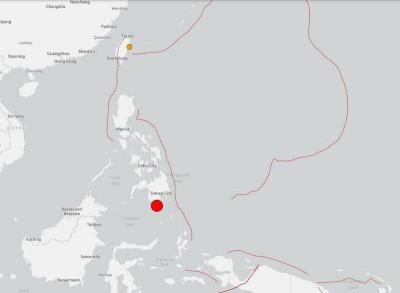
A magnitude 7.8 earthquake struck off the southern coast of Mindanao in the Philippines at 7:38am today, prompting the US Tsunami Warning System to issue an alert for neighboring countries, including Taiwan. The system issued a purple alert indicating a "tsunami threat." The potential threat zone includes Taiwan, the Philippines, Papua New Guinea, Yap and Palau. Philippine authorities were assessing the damage from the quake, with the office of civil defense seeking to verifying initial reports that 15 people had been killed and 129 injured in the region, mostly from falling debris. Arlene Hollero, disaster chief of Maasim town in the Philippines' Sarangani Province,

‘GRAY ZONE’ PRESSURE: Beijing’s activities are intended to create the deceitful impression that China has jurisdiction over the area around Taiwan, the CGA said Taiwan’s rights over its territorial waters and exclusive economic zone must not be violated by any country, the Mainland Affairs Council said yesterday, adding that it will not accept any unprovoked actions. The council issued the remarks in response to the China Coast Guard conducting maritime enforcement drills near eastern Taiwan and claiming to fully exercise China’s maritime administrative law enforcement authority. The Coast Guard Administration (CGA) has been closely monitoring the situation and is taking concrete steps to defend the nation’s sovereignty and secure its waters, the council said. China has no sovereign rights over the waters off eastern
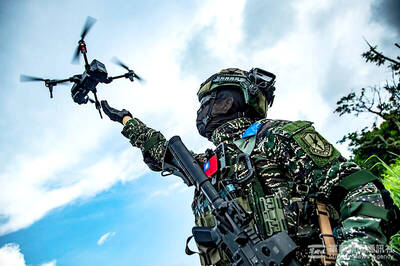
RESILIENCE: Taiwan plays a key role in semiconductors, energy, information infrastructure and advanced manufacturing, AIT Director Raymond Greene said Taiwan’s continued investment in deterrence and resilience remains vital, especially in uncrewed systems and other emerging technologies, American Institute in Taiwan (AIT) Director Raymond Greene said yesterday. Greene made the remarks at the annual National Strategic Summit on Supply Chain Resilience held by the Research Institute for Democracy, Society and Emerging Technology (DSET), a government-backed think tank. As Taiwan last year became the US’ fourth-largest trading partner and supply chain security is becoming more important, cooperation in emerging technologies continues to deepen between the two countries, he said. The US is committed to accelerating innovation, building key infrastructure, strengthening cooperation

RIGHT DIRECTION: Taiwan’s efforts to prevent forced labor include a proposal to ‘fully prohibit’ employers from withholding workers’ documents, an official said Taiwan is to establish a mechanism to restrict imports of goods linked to forced labor, the Executive Yuan said yesterday, after the US proposed imposing additional tariffs on Taiwanese goods over labor concerns. “The Ministry of Labor and the Ministry of Economic Affairs are to establish an interministerial review procedure,” Executive Yuan spokesperson Michelle Lee (李慧芝) said at a news briefing in Taipei. “The government is to use the Foreign Trade Act [貿易法] as the legal basis to restrict imports of goods produced with forced labor” and bring its supply chain governance more in line with international standards on human rights, resilience


 RSS
RSS