


Israel assassinated Hamas leader Sheikh Ahmed Yassin outside a Gaza mosque yesterday, striking its heaviest blow against the militant group behind dozens of suicide bombings and drawing enraged vows of revenge.
Israeli security sources said Prime Minister Ariel Sharon personally ordered and monitored the helicopter attack against the paralysed cleric, whose wheelchair lay smashed in a pool of blood after three missiles exploded.
It was the highest-profile assassination of a Palestinian since the April 1988 killing in Tunis of Palestinian commando chief Khalil al-Wazir. At least seven other people died in the Gaza strike and two of Yassin's sons were among 15 wounded.
The attack on Yassin as he and his entourage left dawn prayers seemed to be aimed at weakening Hamas, a group seeking Israel's destruction, to prevent it from claiming victory should Sharon go ahead with a planned unilateral pullout from Gaza.
After the first missile hit, a witness told reporters: "I looked to see where Sheikh Ahmed Yassin was."
"He was lying on the ground and his wheelchair was destroyed. People there darted left and right. Then another two missiles landed," he said.
Another one of Yassin's sons, Mohammed, said he had remarked to his father about three hours before the attack about an Israeli reconnaissance plane spotted in the sky.
"He said, `We seek martyrdom ... to him [God] we belong and to him we return.'"
Israeli Defense Minister Shaul Mofaz, speaking to reporters, called Yassin "the Palestinian [Osama] bin Laden" and said his hands were covered in Israeli blood. Mofaz pledged more Israeli attacks on Hamas's top echelon.
But a dissenting voice in the Israeli cabinet, Interior Minister Avraham Poraz, said Yassin -- Hamas's spiritual leader -- was not "a ticking bomb" and voiced concern his death could lead to the loss of many more Israeli lives in suicide attacks.
Previous assassinations of militants have triggered waves of suicide bombings that have turned Israeli buses, restaurants and cafes into charred wrecks and deepened violence that has stalled a US-backed peace "road map."
Hundreds of thousands of Palestinians poured out their grief in a funeral procession for Yassin and the other dead.
While espousing "armed struggle," Yassin's movement also ran a broad welfare network for Palestinians and he was seen by many in the West Bank and Gaza as a heroic symbol of resistance to Israeli occupation.
ROLLER-COASTER RIDE: More than five earthquakes ranging from magnitude 4.4 to 5.5 on the Richter scale shook eastern Taiwan in rapid succession yesterday afternoon Back-to-back weather fronts are forecast to hit Taiwan this week, resulting in rain across the nation in the coming days, the Central Weather Administration said yesterday, as it also warned residents in mountainous regions to be wary of landslides and rockfalls. As the first front approached, sporadic rainfall began in central and northern parts of Taiwan yesterday, the agency said, adding that rain is forecast to intensify in those regions today, while brief showers would also affect other parts of the nation. A second weather system is forecast to arrive on Thursday, bringing additional rain to the whole nation until Sunday, it

CONDITIONAL: The PRC imposes secret requirements that the funding it provides cannot be spent in states with diplomatic relations with Taiwan, Emma Reilly said China has been bribing UN officials to obtain “special benefits” and to block funding from countries that have diplomatic ties with Taiwan, a former UN employee told the British House of Commons on Tuesday. At a House of Commons Foreign Affairs Committee hearing into “international relations within the multilateral system,” former Office of the UN High Commissioner for Human Rights (OHCHR) employee Emma Reilly said in a written statement that “Beijing paid bribes to the two successive Presidents of the [UN] General Assembly” during the two-year negotiation of the Sustainable Development Goals. Another way China exercises influence within the UN Secretariat is

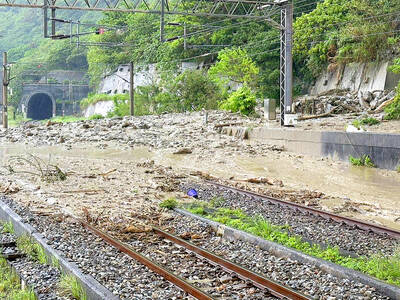
LANDSLIDES POSSIBLE: The agency advised the public to avoid visiting mountainous regions due to more expected aftershocks and rainfall from a series of weather fronts A series of earthquakes over the past few days were likely aftershocks of the April 3 earthquake in Hualien County, with further aftershocks to be expected for up to a year, the Central Weather Administration (CWA) said yesterday. Based on the nation’s experience after the quake on Sept. 21, 1999, more aftershocks are possible over the next six months to a year, the agency said. A total of 103 earthquakes of magnitude 4 on the local magnitude scale or higher hit Hualien County from 5:08pm on Monday to 10:27am yesterday, with 27 of them exceeding magnitude 5. They included two, of magnitude

Taiwan’s first drag queen to compete on the internationally acclaimed RuPaul’s Drag Race, Nymphia Wind (妮妃雅), was on Friday crowned the “Next Drag Superstar.” Dressed in a sparkling banana dress, Nymphia Wind swept onto the stage for the final, and stole the show. “Taiwan this is for you,” she said right after show host RuPaul announced her as the winner. “To those who feel like they don’t belong, just remember to live fearlessly and to live their truth,” she said on stage. One of the frontrunners for the past 15 episodes, the 28-year-old breezed through to the final after weeks of showcasing her unique


 RSS
RSS