


Participants in a televised debate yesterday on the cross-strait stability framework spent little time dealing with the referendum question itself and focussed on whether the referendum should be held at all.
Democratic Progressive Party (DPP) Legislator Chiu Tai-san (
The referendum asks: "Do you agree our government should engage in negotiations with China about the establishment of a peaceful and stable framework for cross-strait interactions in order to build consensus and for the welfare of the peoples on both sides?"
Broadcast on China Television Co (
The three panelists were: Chao Chien-min (
Although the panelists tried to guide the two debaters back to the referendum question, Chiu and Ting traded blows over whether to support the referendum during most of the debate.
On behalf of the "yes" side, Chiu said the March 20 vote is "absolutely legal and constitutional."
"Many people claimed that the referendum is illegal, yet they didn't seek an interpretation from the Council of Grand Justices (大法官會議)," Chiu said. "They simply consider themselves grand justices."
Chiu also said many opponents confused the referendum with the emergency decree.
Chiu read the contents of Article 17 of the Referendum Law (
"If China steadily increasing its military budgets and weaponry and deploying 496 guided missiles targeted at Taiwan cannot be counted as a threat, then what is a threat to Taiwan?" Chiu said.
Chiu stressed that the result of the referendum will send the message to China that the people of Taiwan are against missile threats and desire peace.
"It will also help Taiwan's representatives when negotiating with China," Chiu said.
Chiu urged people not to give up their rights and to be the nation's masters.
Ting, a former president of Gallup Taiwan, representing the "no" side, said he opposed the referendum being held on the same day as the presidential election because it is "obviously a political tool manipulated by Chen to boost his re-election campaign."
Ting said he supports referendums but is opposed to the upcoming one. Ting wondered why the DPP did not hold a referendum on the Fourth Nuclear Power Plant or on reducing the number of legislators, saying this showed the DPP's intention to cheat people out of their votes.
As for the question itself, Ting said he objected resuming negotiations with Beijing because "the Chinese Communist Party [CCP] is too fearful and artful."
Ting said, as a Mainlander in Taiwan, he has witnessed how terrifying the Communist Party was because his grandfathers were killed by the party.
"Taiwan had better not provoke the CCP giant," he said.
Ting argued that Taiwan should interact with China more in terms of economics and culture, and should avoid discussing political issues.
"It is favorable for Taiwan to postpone the negotiation with the CCP," Ting said. "The later we negotiate with the CCP, the better."
"As long as Taiwan does not declare its independence and keeps its name as the Republic of China, the CCP cannot find any excuse to assault Taiwan," Ting said.
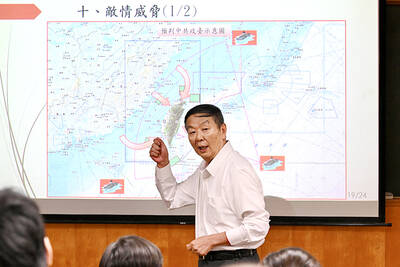
RETHINK? The defense ministry and Navy Command Headquarters could take over the indigenous submarine project and change its production timeline, a source said Admiral Huang Shu-kuang’s (黃曙光) resignation as head of the Indigenous Submarine Program and as a member of the National Security Council could affect the production of submarines, a source said yesterday. Huang in a statement last night said he had decided to resign due to national security concerns while expressing the hope that it would put a stop to political wrangling that only undermines the advancement of the nation’s defense capabilities. Taiwan People’s Party Legislator Vivian Huang (黃珊珊) yesterday said that the admiral, her older brother, felt it was time for him to step down and that he had completed what he

Taiwan has experienced its most significant improvement in the QS World University Rankings by Subject, data provided on Sunday by international higher education analyst Quacquarelli Symonds (QS) showed. Compared with last year’s edition of the rankings, which measure academic excellence and influence, Taiwanese universities made great improvements in the H Index metric, which evaluates research productivity and its impact, with a notable 30 percent increase overall, QS said. Taiwanese universities also made notable progress in the Citations per Paper metric, which measures the impact of research, achieving a 13 percent increase. Taiwanese universities gained 10 percent in Academic Reputation, but declined 18 percent
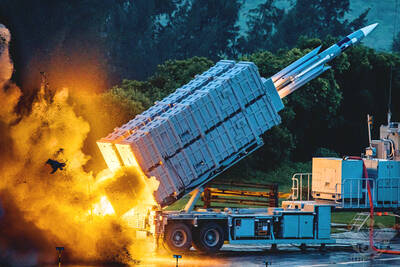
UNDER DISCUSSION: The combatant command would integrate fast attack boat and anti-ship missile groups to defend waters closest to the coastline, a source said The military could establish a new combatant command as early as 2026, which would be tasked with defending Taiwan’s territorial waters 24 nautical miles (44.4km) from the nation’s coastline, a source familiar with the matter said yesterday. The new command, which would fall under the Naval Command Headquarters, would be led by a vice admiral and integrate existing fast attack boat and anti-ship missile groups, along with the Naval Maritime Surveillance and Reconnaissance Command, said the source, who asked to remain anonymous. It could be launched by 2026, but details are being discussed and no final timetable has been announced, the source
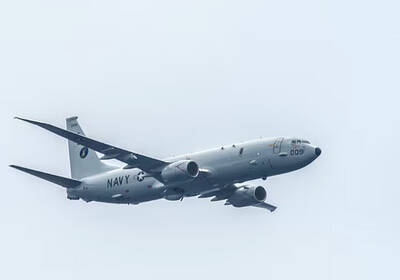
CHINA REACTS: The patrol and reconnaissance plane ‘transited the Taiwan Strait in international airspace,’ the 7th Fleet said, while Taipei said it saw nothing unusual The US 7th Fleet yesterday said that a US Navy P-8A Poseidon flew through the Taiwan Strait, a day after US and Chinese defense heads held their first talks since November 2022 in an effort to reduce regional tensions. The patrol and reconnaissance plane “transited the Taiwan Strait in international airspace,” the 7th Fleet said in a news release. “By operating within the Taiwan Strait in accordance with international law, the United States upholds the navigational rights and freedoms of all nations.” In a separate statement, the Ministry of National Defense said that it monitored nearby waters and airspace as the aircraft


 RSS
RSS