


Kaohsiung Mayor Frank Hsieh (謝長廷), as the Cabinet's representative, yesterday debated against writer and political commentator Li Ao (李敖), with both of them failing to answer questions put to them by academics arranged to take part by the Central Election Committee.
The second question of the referendum proposed by President Chen Shui-bian (
In the opening statement, Hsieh argued that it is the first time -- as well as a sacred opportunity -- for the people of Taiwan to voice their opinions about Taiwan's future to the international community through a referendum. Hsieh said the importance of the referendum is clear if people think about the whole issue, taking into account Taiwan's interests as a whole.
"We have to let the international community and China know about our people's firm opposition to China's missile threats and our goodwill in pursuing peace and the resolution to guard our land," he said.
"A referendum or the human chain rallies held on Feb. 28 are some of the best ways to express our feelings," he said.
Hsieh said that it would deliver a message to the international community that the people of Taiwan are split on their future if the referendum fails, and this would be a disadvantage for Taiwan when negotiating with China.
Hsieh urged the people of Taiwan to show their love for Taiwan by taking practical action.
"What we need is not metaphysical love. This is a critical historic moment for the people of Taiwan to show their love and resolution by casting their precious ballots," Hsieh said.
Li argued that the referendum launched by the Democratic Progressive Party (DPP) is a fake, as the DPP has been promoting the idea of Taiwan's independence and even put it into the party program.
Li asked why the DPP does not hold a real referendum on changing Taiwan's official name or the establishment of the Republic of Taiwan.
"I urged the courageous Taiwanese people to launch a referendum on Taiwan's independence.
"We will face the `one China' framework as soon as we start to negotiate with China. Taiwan has to deal with the name `Republic of China' since the `People's Republic of China' stands for the so-called `one China,'" Li said.
Although the CEC arranged three academics to put questions to both debaters -- Chao Chien-min (趙建民), a political science professor at National Chengchi University; Lin Te-chang (林德昌), head of National Sun Yat-sen University's NGO research center; and Yang Kai-huang (楊開煌) a political science professor at National Donghwa University -- they did not reply directly to the questions in the following debate.
Chao asked what other issues, apart from the political issues, should the negotiators deal with to improve the cross-strait relationship and establish negotiations on a reciprocal basis?
Li did not answer the question but continued to describe his opposition and criticism of the referendum. He said that Taiwan would not necessarily lose out in negotiations, as long as negotiators possess eloquence like Hsieh.
Hsieh said that the interaction of business, the development of cities or a solution to international crime might be issues that could help cross-strait interaction.
He said that Taiwan's referendum could teach the Chinese people to think about their own situation and help China to become democratized.
In his closing statement, Hsieh said that Taiwan should find a way that would give it dignity when negotiating with China, and the referendum is the answer.
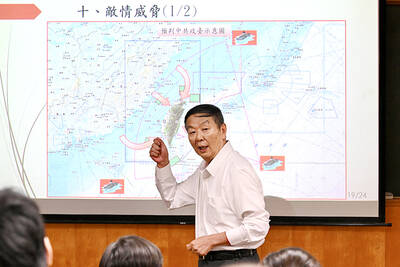
RETHINK? The defense ministry and Navy Command Headquarters could take over the indigenous submarine project and change its production timeline, a source said Admiral Huang Shu-kuang’s (黃曙光) resignation as head of the Indigenous Submarine Program and as a member of the National Security Council could affect the production of submarines, a source said yesterday. Huang in a statement last night said he had decided to resign due to national security concerns while expressing the hope that it would put a stop to political wrangling that only undermines the advancement of the nation’s defense capabilities. Taiwan People’s Party Legislator Vivian Huang (黃珊珊) yesterday said that the admiral, her older brother, felt it was time for him to step down and that he had completed what he

Taiwan has experienced its most significant improvement in the QS World University Rankings by Subject, data provided on Sunday by international higher education analyst Quacquarelli Symonds (QS) showed. Compared with last year’s edition of the rankings, which measure academic excellence and influence, Taiwanese universities made great improvements in the H Index metric, which evaluates research productivity and its impact, with a notable 30 percent increase overall, QS said. Taiwanese universities also made notable progress in the Citations per Paper metric, which measures the impact of research, achieving a 13 percent increase. Taiwanese universities gained 10 percent in Academic Reputation, but declined 18 percent
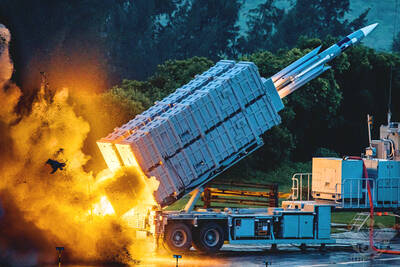
UNDER DISCUSSION: The combatant command would integrate fast attack boat and anti-ship missile groups to defend waters closest to the coastline, a source said The military could establish a new combatant command as early as 2026, which would be tasked with defending Taiwan’s territorial waters 24 nautical miles (44.4km) from the nation’s coastline, a source familiar with the matter said yesterday. The new command, which would fall under the Naval Command Headquarters, would be led by a vice admiral and integrate existing fast attack boat and anti-ship missile groups, along with the Naval Maritime Surveillance and Reconnaissance Command, said the source, who asked to remain anonymous. It could be launched by 2026, but details are being discussed and no final timetable has been announced, the source
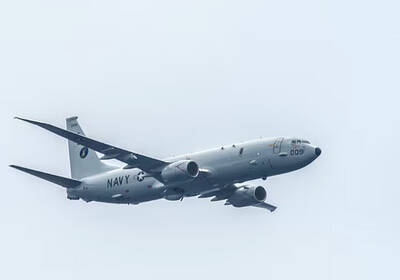
CHINA REACTS: The patrol and reconnaissance plane ‘transited the Taiwan Strait in international airspace,’ the 7th Fleet said, while Taipei said it saw nothing unusual The US 7th Fleet yesterday said that a US Navy P-8A Poseidon flew through the Taiwan Strait, a day after US and Chinese defense heads held their first talks since November 2022 in an effort to reduce regional tensions. The patrol and reconnaissance plane “transited the Taiwan Strait in international airspace,” the 7th Fleet said in a news release. “By operating within the Taiwan Strait in accordance with international law, the United States upholds the navigational rights and freedoms of all nations.” In a separate statement, the Ministry of National Defense said that it monitored nearby waters and airspace as the aircraft


 RSS
RSS