


Partial results from Iran's disputed parliamentary election showed Islamic conservatives hostile to President Mohammad Khatami's liberal reforms cruising to an expected victory yesterday on a sharply lower turnout.
Interior Ministry figures showed conservatives had won 43 of the first 83 constituencies declared, out of 289 seats contested on Friday.
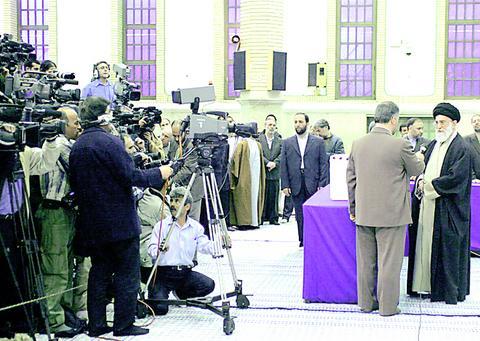
PHOTO: EPA
Reformists had won 21, and the rest went to independents of unknown sympathies. In 17 constituencies where no candidate polled more than 25 percent, there will be a run-off later.
Reformists branded the election rigged and many boycotted it after the unelected hardline Guardian Council banned 2,500 mainly reformist candidates, including 80 sitting lawmakers, prompting Washington to say the vote was neither free nor fair.
A conservative majority could spell an end to Khatami's seven-year experiment in allowing greater freedom of speech and loosening Islamic cultural and social restrictions, a drive that hardliners have tried to obstruct at every turn.
But conservative commentator Amir Mohebian, a policy adviser to Iran's senior clerical leaders, suggested the victors would use a velvet glove rather than an iron fist.
The new majority would usher in a second phase of reforms, implemented more effectively, he said, as attempts to impose a political and social crackdown would only generate a backlash.
But political analyst Hossein Rassam forecast an escalation of factional conflict.
"The reformists are aware that the conservatives will try to make deals with the European Union and will try to prevent this by being outspoken about the state of democracy in Iran," he told reporters. "This will antagonize the hardliners and will lead to arrests, the closure of more newspapers and so on."
A senior government official said between 20 and 22 million of the 46 million eligible voters had cast ballots.
If confirmed, that would put the turnout at between 43 and 48 percent, sharply down on the 67 percent who voted in 2000, when Khatami's reformist allies won two thirds of the seats, but more than the 40 percent or less that reformists had predicted.
The lowest previous turnout for a parliamentary election since the 1979 Islamic Revolution was 53 percent in 1980.
The clerical Guardian Council, which vets candidates and validates the results, gave a lower figure of 43 million for the electorate, which could enable it to claim a turnout of over 50 percent, a psychologically important threshold.
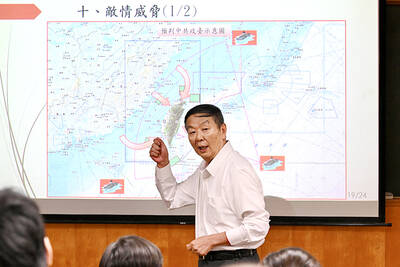
RETHINK? The defense ministry and Navy Command Headquarters could take over the indigenous submarine project and change its production timeline, a source said Admiral Huang Shu-kuang’s (黃曙光) resignation as head of the Indigenous Submarine Program and as a member of the National Security Council could affect the production of submarines, a source said yesterday. Huang in a statement last night said he had decided to resign due to national security concerns while expressing the hope that it would put a stop to political wrangling that only undermines the advancement of the nation’s defense capabilities. Taiwan People’s Party Legislator Vivian Huang (黃珊珊) yesterday said that the admiral, her older brother, felt it was time for him to step down and that he had completed what he
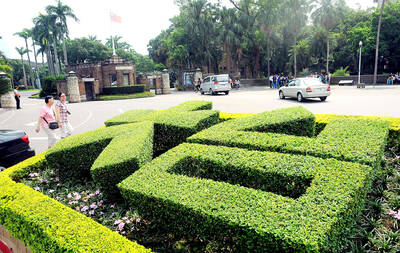
Taiwan has experienced its most significant improvement in the QS World University Rankings by Subject, data provided on Sunday by international higher education analyst Quacquarelli Symonds (QS) showed. Compared with last year’s edition of the rankings, which measure academic excellence and influence, Taiwanese universities made great improvements in the H Index metric, which evaluates research productivity and its impact, with a notable 30 percent increase overall, QS said. Taiwanese universities also made notable progress in the Citations per Paper metric, which measures the impact of research, achieving a 13 percent increase. Taiwanese universities gained 10 percent in Academic Reputation, but declined 18 percent
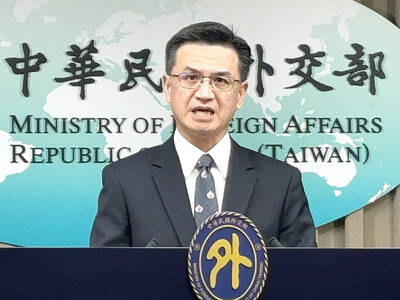
BULLY TACTICS: Beijing has continued its incursions into Taiwan’s airspace even as Xi Jinping talked about Taiwan being part of the Chinese family and nation China should stop its coercion of Taiwan and respect mainstream public opinion in Taiwan about sovereignty if its expression of goodwill is genuine, the Ministry of Foreign Affairs (MOFA) said yesterday. Ministry spokesman Jeff Liu (劉永健) made the comment in response to media queries about a meeting between former president Ma Ying-jeou (馬英九) and Chinese President Xi Jinping (習近平) the previous day. Ma voiced support for the so-called “1992 consensus,” while Xi said that although the two sides of the Taiwan Strait have “different systems,” this does not change the fact that they are “part of the same country,” and that “external
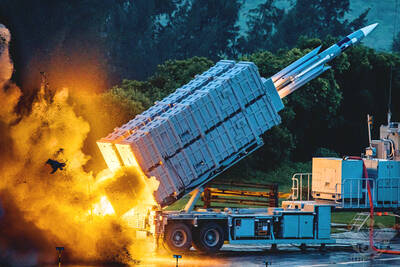
UNDER DISCUSSION: The combatant command would integrate fast attack boat and anti-ship missile groups to defend waters closest to the coastline, a source said The military could establish a new combatant command as early as 2026, which would be tasked with defending Taiwan’s territorial waters 24 nautical miles (44.4km) from the nation’s coastline, a source familiar with the matter said yesterday. The new command, which would fall under the Naval Command Headquarters, would be led by a vice admiral and integrate existing fast attack boat and anti-ship missile groups, along with the Naval Maritime Surveillance and Reconnaissance Command, said the source, who asked to remain anonymous. It could be launched by 2026, but details are being discussed and no final timetable has been announced, the source


 RSS
RSS