


After months of avoiding confrontations with Beijing, democracy activists in Hong Kong are planning on today to hold their first big march since a series of rallies last July forced the government to withdraw a stringent internal security bill.
The Civil Human Rights Front, a coalition of religious, labor, social welfare, gay and feminist groups that brought 500,000 people into the streets on July 1, has organized today's demonstration.
Marchers will call for the government of the autonomous territory to allow the public to elect the next chief executive and the entire legislature, said Richard Tsoi (蔡耀昌), the front's spokesman and the organizer of the rally.
On Tuesday, all of the pro-democracy political parties here issued a joint appeal for people to attend the New Year's Day march, which will cover the same route as the July 1 march, from Victoria Park to the central government offices downtown. Heavily criticized last summer for not having done more to prepare for the earlier march, the police announced plans to close many downtown streets to vehicles today.
Today's rally, coming a month after the main pro-Beijing party suffered a sharp setback in local council elections, could make Beijing even more leery of allowing greater democracy in Hong Kong, which Britain handed over to China in 1997.
How many people will attend today's rally is anybody's guess, but nobody is predicting that organizers can draw a crowd as large as last summer's, when nearly a tenth of the territory's population turned out to protest the security legislation as well as a weak economy, mismanagement of SARS and government scandals. Since then, the economy has recovered, the government withdrew the security legislation and the two most controversial government ministers, Antony Leung (梁錦松) and Regina Ip (葉劉淑儀), have resigned.
But polls continue to show that large segments of society are upset with Tung Chee-hwa (
Michael DeGolyer, the director of the Hong Kong Transition Project said that the group's most recent poll, in November, had found only 20 percent of the public satisfied with Tung, the lowest level yet.
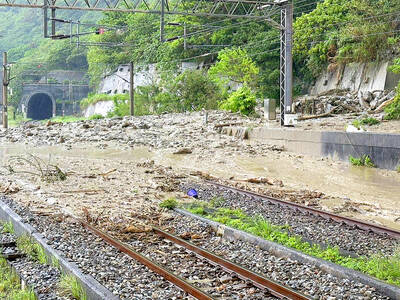
ROLLER-COASTER RIDE: More than five earthquakes ranging from magnitude 4.4 to 5.5 on the Richter scale shook eastern Taiwan in rapid succession yesterday afternoon Back-to-back weather fronts are forecast to hit Taiwan this week, resulting in rain across the nation in the coming days, the Central Weather Administration said yesterday, as it also warned residents in mountainous regions to be wary of landslides and rockfalls. As the first front approached, sporadic rainfall began in central and northern parts of Taiwan yesterday, the agency said, adding that rain is forecast to intensify in those regions today, while brief showers would also affect other parts of the nation. A second weather system is forecast to arrive on Thursday, bringing additional rain to the whole nation until Sunday, it

CONDITIONAL: The PRC imposes secret requirements that the funding it provides cannot be spent in states with diplomatic relations with Taiwan, Emma Reilly said China has been bribing UN officials to obtain “special benefits” and to block funding from countries that have diplomatic ties with Taiwan, a former UN employee told the British House of Commons on Tuesday. At a House of Commons Foreign Affairs Committee hearing into “international relations within the multilateral system,” former Office of the UN High Commissioner for Human Rights (OHCHR) employee Emma Reilly said in a written statement that “Beijing paid bribes to the two successive Presidents of the [UN] General Assembly” during the two-year negotiation of the Sustainable Development Goals. Another way China exercises influence within the UN Secretariat is
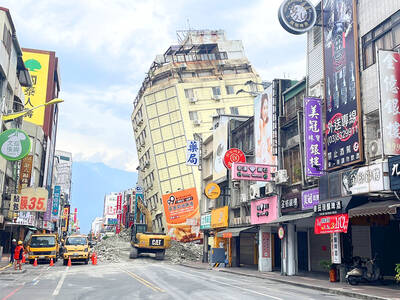
LANDSLIDES POSSIBLE: The agency advised the public to avoid visiting mountainous regions due to more expected aftershocks and rainfall from a series of weather fronts A series of earthquakes over the past few days were likely aftershocks of the April 3 earthquake in Hualien County, with further aftershocks to be expected for up to a year, the Central Weather Administration (CWA) said yesterday. Based on the nation’s experience after the quake on Sept. 21, 1999, more aftershocks are possible over the next six months to a year, the agency said. A total of 103 earthquakes of magnitude 4 on the local magnitude scale or higher hit Hualien County from 5:08pm on Monday to 10:27am yesterday, with 27 of them exceeding magnitude 5. They included two, of magnitude

Taiwan’s first drag queen to compete on the internationally acclaimed RuPaul’s Drag Race, Nymphia Wind (妮妃雅), was on Friday crowned the “Next Drag Superstar.” Dressed in a sparkling banana dress, Nymphia Wind swept onto the stage for the final, and stole the show. “Taiwan this is for you,” she said right after show host RuPaul announced her as the winner. “To those who feel like they don’t belong, just remember to live fearlessly and to live their truth,” she said on stage. One of the frontrunners for the past 15 episodes, the 28-year-old breezed through to the final after weeks of showcasing her unique


 RSS
RSS